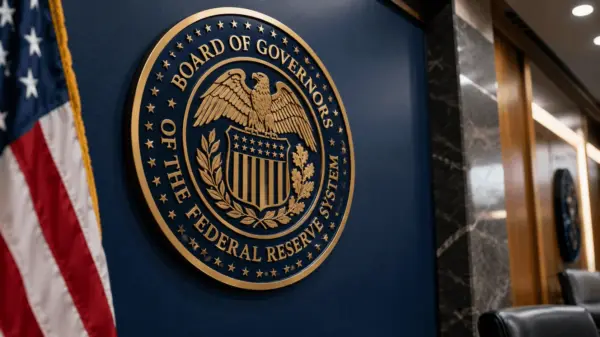
The Federal Reserve’s Inspector General has found significant management and cost-control problems in the renovation of the central bank’s historic headquarters, while finding no grounds for a criminal referral or administrative misconduct.
The report, released on September 29, examined the renovation of the Fed’s Eccles and 1951 buildings in Washington, D.C. It found that the project’s construction budget more than doubled from $921 million in February 2020 to $2.018 billion by 2024.
The findings have renewed scrutiny of the Federal Reserve’s management practices and the political dispute surrounding former Fed Chair Jerome Powell, who faced criticism from President Donald Trump over the project and the central bank’s monetary policy.
Want to stay informed about market performance, key developments, and the latest financial trends? Explore our Market Report for detailed market insights.
Fed Renovation Costs More Than Double
The Inspector General found that the Federal Reserve Board had not effectively managed the project’s construction-management contract and repeatedly deviated from cost-management provisions.
The report said the Board failed to take several actions available to it that could have helped control costs and limit some of the increases.
The original renovation budget was $921 million. By December 2024, the Board’s most recently revised construction budget had reached $2.018 billion.
The OIG also found weaknesses in the project’s internal governance, saying the Board’s management structure was insufficient for a project of the size and complexity involved.
What Did the Fed Inspector General Find?
The report identified several areas of concern involving project oversight and cost management.
Among the findings were repeated deviations from contractual cost-management provisions and a failure to use available mechanisms that could have limited cost increases.
The Inspector General also noted that the Board did not effectively manage its construction manager at risk (CMAR) contract.
The project had already experienced similar problems to those identified in an earlier renovation of the Fed’s Martin Building, yet the Board did not sufficiently apply lessons from that experience.
The OIG issued seven recommendations aimed at addressing the problems identified in the review. The Federal Reserve Board concurred with the recommendations.
No Criminal Referral or Administrative Misconduct Finding
Despite the scale of the cost overruns, the Inspector General did not find grounds to refer anyone for criminal prosecution.
The report also did not identify administrative misconduct warranting such action.
That distinction is important because the renovation had previously become part of a broader dispute involving Trump, Powell and the Federal Reserve.
The OIG’s findings therefore point to significant project-management deficiencies without establishing criminal wrongdoing connected to the renovation. Reuters reported that the watchdog found no grounds for a criminal referral or administrative misconduct while highlighting extensive oversight problems.
Want to gain deeper insights into market trends, price movements, and key market drivers? Explore our latest Market Analysis for in-depth analysis.
Trump, Powell and the Federal Reserve Renovation Dispute
The renovation became a major political issue during the Trump administration’s criticism of then-Fed Chair Jerome Powell.
Trump had criticized the cost of the project while also repeatedly calling for lower interest rates from the Federal Reserve. The renovation therefore became intertwined with the broader debate over the Fed’s independence and its monetary-policy decisions.
The relationship between the renovation controversy and monetary policy has been the subject of political and media debate. However, the Inspector General’s report itself focuses on project management, construction costs and oversight, rather than determining whether monetary-policy decisions were politically influenced.
Trump renewed his criticism of Powell after the report was released and called for the former Fed chair to resign from the Board.
Jerome Powell Remains on the Federal Reserve Board
Powell is no longer the Fed’s chair. Kevin Warsh became chairman in May 2026, while Powell remains a member of the Board of Governors.
The renovation investigation had become relevant to Powell’s decision to remain on the Board while questions surrounding the project and related investigations were being addressed.
A separate Justice Department investigation into Powell was not reopened after the Inspector General’s findings. The Justice Department said on October 2 that it would not reopen the criminal investigation, according to Reuters.
Kevin Warsh Moves to Strengthen Oversight
Current Fed Chair Kevin Warsh has responded to the Inspector General’s report by moving to change how the renovation project is managed.
The Federal Reserve announced that the General Services Administration (GSA) would serve as Project Executive for the ongoing renovation.
Warsh also said the Fed would work with an independent auditor to review the project and its costs, while the Board moves to implement the recommendations contained in the Inspector General’s report.
The move is intended to strengthen accountability and cost discipline as the renovation continues.
Should Congress Have More Oversight of the Fed’s Non-Monetary Spending?
The report has also renewed a broader policy question over how the Federal Reserve’s non-monetary activities should be overseen.
One argument is that Congress could exercise greater control over the Fed’s administrative and construction spending through appropriations, while leaving monetary-policy operations financially independent.
Supporters of greater oversight could argue that congressional control would provide an additional mechanism for accountability over major federal expenditures.
Opponents could argue that expanding congressional control over the Federal Reserve’s finances could create additional political pressure on an institution whose independence is considered important to monetary policy.
The distinction between administrative oversight and monetary-policy independence is therefore central to the debate.
Does the Renovation Report Affect Fed Independence?
The report itself does not change the Federal Reserve’s authority over interest rates or monetary policy.
The Fed continues to make monetary-policy decisions through the Federal Open Market Committee, while the renovation concerns the Board’s management of physical infrastructure and related contracts.
However, the political controversy surrounding the project has contributed to a wider discussion about the balance between accountability and central-bank independence.
For financial markets, the key distinction is whether oversight measures remain focused on administrative spending or extend into monetary-policy decisions.
Key Findings From the Fed Renovation Report
| Item | Finding |
|---|---|
| Original renovation budget | $921 million |
| Revised 2024 budget | $2.018 billion |
| Report date | September 29, 2026 |
| Recommendations | 7 |
| Criminal referral | None |
| Administrative misconduct | None identified |
| Main concern | Project management and cost controls |
| New oversight | GSA involvement and independent audit |
The figures and findings above come from the Federal Reserve Inspector General’s official report.
Looking to expand your trading knowledge and better understand financial markets? Explore our Blog for practical guides, trading insights, and educational content.
What the Fed Report Means for Financial Markets
The renovation itself is unlikely to be a major direct driver of interest rates or currency markets.
The more important market issue is the broader debate surrounding Federal Reserve independence and monetary policy.
Investors typically monitor any development that could affect expectations for Fed decision-making, especially when political pressure and central-bank leadership are involved.
However, the Inspector General’s findings concern administrative management rather than a change in the Fed’s monetary-policy framework.
For traders, developments involving the Fed’s leadership, independence and interest-rate decisions remain more directly relevant to the U.S. dollar, Treasury yields and other financial assets.
Market Impact
The Fed renovation report has limited direct implications for financial markets because it concerns administrative spending rather than monetary policy. The more relevant market channel is the broader debate over Fed independence and leadership, particularly if future political or institutional developments affect expectations for interest-rate decisions. The report itself does not establish a change in the Fed’s monetary-policy framework.
Conclusion
The Federal Reserve Inspector General found substantial management and cost-control deficiencies in the renovation of the Eccles and 1951 buildings, with the construction budget rising from $921 million to $2.018 billion.
At the same time, the watchdog found no grounds for criminal referral or administrative misconduct.
The findings have renewed scrutiny of the Fed’s project-management practices and the broader debate over oversight of the central bank.
Under Chairman Kevin Warsh, the Fed has brought in the General Services Administration to help oversee the remaining renovation work and plans to use an independent auditor to review the project’s costs.
For financial markets, however, the most important issue remains separate from the building project itself: whether developments surrounding the Federal Reserve affect expectations for central-bank independence and future monetary policy.
 Check Our
  Whether you’re a day trader or a long-term investor, FastPip gives you the tools to trade smarter, not harder.