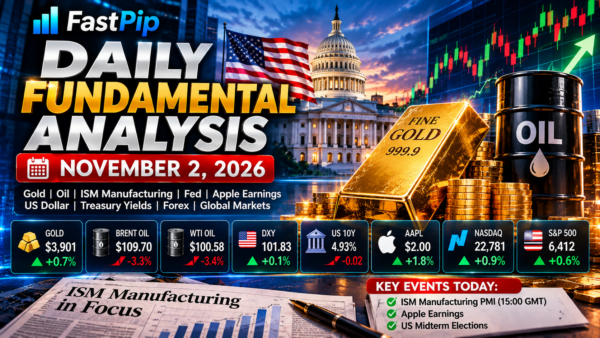
Daily Fundamental Analysis November 3 2026 | FastPip
Daily Fundamental Analysis November 3 2026: 7 Critical Market Risks
The Daily Fundamental Analysis November 3 2026 begins with gold consolidating after Monday’s powerful rebound, crude oil recovering modestly from a 7% collapse, the US dollar stabilizing after hitting a one-month low, and global equity markets turning cautious ahead of the US midterm election results.
Spot gold traded around $3,926 per ounce during Tuesday’s session after gaining more than 2% on Monday.
Gold remains well below the $4,000 psychological threshold but has recovered significantly from Friday’s one-year low.
Brent crude traded close to $105 per barrel after suffering its largest daily decline in months on Monday as hopes for US-Iran diplomacy reduced the geopolitical risk premium.
The US 10-year Treasury yield remained around 4.91%, while the US dollar stabilized after recent weakness.
At the same time, today’s macro calendar brings two important US releases:
JOLTS Job Openings
and:
Factory Orders
Both arrive at 15:00 GMT.
Today’s seven major market drivers are:
- US midterm election results
- Gold consolidating near $3,925
- JOLTS Job Openings
- US Factory Orders
- Oil recovering after a 7% collapse
- RBA raising rates to 4.85%
- Apple’s weaker forward margin outlook
For live updates as the data are released, follow the FastPip Economic Calendar.
Daily Fundamental Analysis November 3 2026: Global Market Snapshot
| Asset / Market | Latest Reported Level / Move | Fundamental Signal |
|---|---|---|
| Gold / XAUUSD | ~$3,926 | Neutral |
| Silver / XAGUSD | ~$49.7 | Neutral → Bearish |
| Brent Oil | ~$105 | Recovering |
| WTI Oil | Near $100 | Volatile |
| DXY | Slightly Firmer | Neutral |
| US 10Y Yield | ~4.91% | Stable |
| AUD/USD | Lower Post-RBA | Mildly Bearish |
| EUR/USD | Stable | Neutral |
| USD/JPY | Stable / Elevated | Neutral |
| Asia ex-Japan | ~-0.9% | Risk-Off |
| Korean Equities | Sharply Lower | Bearish |
| US Futures | Slightly Higher | Neutral → Bullish |
Reuters reported that Asian equities declined as investors waited for US midterm election results, while technology shares remained under pressure following Apple’s cautious outlook. Read the Reuters global-markets report.
Gold Fundamental Analysis Today
Gold moved slightly lower on Tuesday after Monday’s strong rebound.
Spot gold traded around $3,926.52 per ounce, while US December futures were near $3,936.30.
The metal gained more than 2% on Monday after oil prices collapsed and inflation expectations eased.
However, gold remains in a consolidation phase after last week’s extremely sharp decline.
Reuters noted that some of the recent gold selling reflected forced liquidation and margin calls generated by losses elsewhere in financial markets rather than a complete deterioration in gold’s long-term fundamentals.
Read the Reuters gold-market report.
Why Gold Is Struggling to Extend Monday’s Rally
Gold faces two conflicting forces.
Bullish
- oil prices remain far below last week’s peak;
- Treasury yields are below 5%;
- political uncertainty is elevated;
- AI-market stress remains unresolved.
Bearish
- the Federal Reserve may still raise rates in December;
- US growth remains resilient;
- the dollar is attempting to stabilize;
- gold remains below the $4,000 psychological level.
Markets currently price approximately a 74% probability of another Federal Reserve rate increase in December.
That remains one of the biggest obstacles to a sustained gold recovery.
Gold Bullish Scenario
Gold could extend higher if:
- JOLTS falls substantially below expectations;
- Factory Orders disappoint;
- Treasury yields decline;
- US political uncertainty increases;
- DXY weakens again.
Potential reaction:
Gold ↑
Treasuries ↑
DXY ↓
Gold Bearish Scenario
Gold could decline again if:
- JOLTS beats expectations;
- Factory Orders rise strongly;
- Treasury yields return above 5%;
- DXY strengthens;
- election uncertainty fades quickly.
Potential reaction:
Gold ↓
DXY ↑
USD/JPY ↑
Gold Fundamental Bias
Neutral
The immediate inflation environment has improved because oil is much lower than last week.
However, December Fed tightening expectations continue to limit upside.
Traders can compare this fundamental outlook with current FastPip Trading Signals.
US Midterm Elections: Today’s Biggest Political Risk
US voters are heading to the polls today for the 2026 midterm elections.
The outcome could influence expectations for:
- fiscal spending;
- AI regulation;
- data-center policy;
- banking regulation;
- cryptocurrency;
- healthcare;
- defense;
- energy;
- future debt-ceiling negotiations.
Reuters reports that markets are particularly focused on control of the House and Senate because a divided Congress could significantly affect the government’s fiscal agenda.
Read Reuters’ US midterm election explainer.
Why Elections Matter for Markets
The immediate impact is likely to come through:
Fiscal Expectations
Regulation
and:
Political Uncertainty
A divided government could reduce expectations for large fiscal changes.
A decisive sweep by either side could increase expectations for more substantial policy changes.
Election Risk for Gold
Political uncertainty can normally support safe-haven demand.
However, Friday’s market action showed that during severe liquidity stress, gold can also be sold to raise cash.
Therefore:
Political Risk ≠ Automatically Bullish Gold
The reaction depends on Treasury yields, USD and broader equity-market conditions.
JOLTS Job Openings: Today’s Main Labor-Market Indicator
September JOLTS Job Openings are scheduled for 15:00 GMT.
The consensus estimate is approximately:
7.11 million
compared with:
7.079 million previously.
View the JOLTS release calendar.
The official report is produced by the US Bureau of Labor Statistics.
JOLTS Job Openings
| Indicator | Actual | Forecast | Previous |
|---|---|---|---|
| JOLTS Job Openings | Pending | 7.11M | 7.079M |
The report provides insight into labor demand.
Job openings remain important because the Federal Reserve wants to know whether the labor market is cooling enough to reduce wage and inflation pressure.
JOLTS Scenario Analysis
JOLTS Above 7.2M
A stronger reading would suggest labor demand remains resilient.
Potential reaction:
Fed-Hike Expectations ↑
Treasury Yields ↑
DXY ↑
Gold ↓
JOLTS Near 7.1M
A result near consensus would likely have limited impact.
Markets could quickly return their attention to elections and Wednesday’s ADP employment report.
JOLTS Below 6.9M
A significant decline in openings would indicate greater labor-market cooling.
Potential reaction:
Treasury Yields ↓
DXY ↓
Gold ↑
A very weak number could also create additional concerns about economic growth.
Friday’s Nonfarm Payrolls Remain the Bigger Labor Test
Today’s JOLTS report matters.
But Friday’s October employment report remains the week’s most important labor-market event.
Current expectations center on modest job creation after September’s weak 29K increase.
A stronger payroll report could substantially increase expectations for another Fed hike in December.
A weaker report could challenge the current tightening narrative.
For all major releases this week, follow the FastPip Economic Calendar.
US Factory Orders
Factory Orders are also scheduled for 15:00 GMT.
The September reading is expected to increase approximately:
1.2% month-over-month
compared with:
0.1% previously.
View US Factory Orders data and forecasts.
Factory Orders
| Indicator | Actual | Forecast | Previous |
|---|---|---|---|
| Factory Orders MoM | Pending | 1.2% | 0.1% |
| Factory Orders ex Transportation | Pending | — | 0.3% |
Factory Orders combine both durable and nondurable manufactured goods.
The report is useful for assessing:
- manufacturing demand;
- corporate investment;
- inventory conditions;
- future industrial production.
Factory Orders Scenario Analysis
Above 1.2%
Potential reaction:
US Growth Expectations ↑
Treasury Yields ↑
USD ↑
Gold ↓
Below Expectations
Potential reaction:
Treasury Yields ↓
USD ↓
Gold ↑
However, today’s JOLTS number is likely to have a larger direct impact on Fed expectations.
Yesterday’s ISM Manufacturing Was Strong
Monday’s ISM Manufacturing report exceeded expectations.
The headline index increased to:
55.5
compared with:
54.5 forecast
and:
54.5 previously.
New Orders also came in at 55.5.
Employment remained expansionary at 52.4.
Prices Paid remained extremely high at 75.2, although below the 77.2 consensus estimate.
ISM Manufacturing Results
| Indicator | Actual | Forecast | Previous |
|---|---|---|---|
| ISM Manufacturing PMI | 55.5 | 54.5 | 54.5 |
| New Orders | 55.5 | 54.5 | 55.3 |
| Employment | 52.4 | 52.0 | 52.7 |
| Prices Paid | 75.2 | 77.2 | 77.9 |
The report showed that US manufacturing remains in expansion.
That is fundamentally supportive for the dollar and reinforces the argument that the US economy remains resilient.
Construction Spending Delivered the Opposite Message
US Construction Spending fell sharply in September.
Spending declined:
1.9% month-over-month
compared with expectations for an increase.
The previous month’s gain was revised to approximately 2.0%.
Residential investment was particularly weak.
Reuters reported that private residential construction spending fell 5.5%, reflecting high mortgage rates and elevated construction costs.
Read the Reuters construction-spending report.
Construction Spending Results
| Indicator | Actual | Forecast | Previous |
|---|---|---|---|
| Construction Spending MoM | -1.9% | ~+0.3% | +2.0% revised |
The divergence is important:
Manufacturing Strong
but:
Housing / Construction Weak
This keeps the Fed’s policy decision complicated.
US Dollar Fundamental Analysis
The US dollar is slightly firmer today after falling toward a one-month low.
The currency is caught between:
Bullish Factors
- strong ISM Manufacturing;
- December Fed-hike expectations;
- resilient economic growth;
- political safe-haven demand.
Bearish Factors
- oil remains below last week’s highs;
- Treasury yields remain under 5%;
- housing activity is weakening;
- election uncertainty.
Reuters reported that DXY stabilized as investors balanced US election risk against renewed Middle East tensions.
Read the Reuters currency-market report.
US Dollar Fundamental Bias
Neutral to Mildly Bullish
A strong JOLTS report would improve the bullish USD case.
US Treasury Yields
The US 10-year yield traded around 4.91%.
The level remains below the psychologically important 5% threshold.
That matters across multiple markets.
For gold:
Yield Below 5% = Supportive
For Nasdaq:
Lower Yields = Valuation Support
For USD:
Lower Yields = Reduced Yield Advantage
A strong JOLTS + Factory Orders combination could push the 10-year yield back toward 5%.
Oil Fundamental Analysis Today
Oil prices stabilized after Monday’s enormous selloff.
Brent traded around $104.7–$105.3 per barrel.
WTI also recovered modestly.
Reuters reported that oil edged higher after reports of a US strike on Iran’s Qeshm Island renewed concern that diplomatic progress could stall.
Read the latest Reuters oil-market report.
Why Oil Fell More Than 7% Monday
Monday’s collapse was driven by optimism that talks could reduce the eight-month US-Iran conflict.
Iranian and Qatari officials held discussions aimed at developing a framework for de-escalation.
The possibility of lower geopolitical risk caused traders to remove a large portion of the oil risk premium.
Why Oil Is Recovering Today
The reported US strike on Qeshm Island has challenged the diplomatic narrative.
The market now faces two opposite forces:
Diplomacy → Oil ↓
versus:
Military Escalation → Oil ↑
Oil Fundamental Bias
Neutral / Extremely High Volatility
The direction is currently dominated by geopolitical headlines rather than traditional supply-and-demand data.
Lower Oil Remains Important for Gold
Even after today’s modest rebound, oil remains dramatically below last week’s highs.
That helps gold because it reduces one of the strongest inflationary forces in the market.
If Brent remains close to $105:
Inflation Pressure ↓
which could eventually lead to:
Fed-Hike Expectations ↓
and:
Gold Support ↑
A renewed move above $110 would weaken that argument.
RBA Raises Rates to 4.85%
The Reserve Bank of Australia raised its cash rate by 25 basis points to 4.85% today.
This was widely expected.
The new rate is the highest since 2008.
Reuters reported that the RBA has now increased rates by a total of 125 basis points during 2026 as policymakers continue to respond to persistent core inflation.
Why AUD Fell After the Hike
AUD weakened despite the rate increase.
Why?
Because:
The Hike Was Already Priced In
Markets had already expected the move.
The Australian dollar therefore experienced a classic:
Buy the Rumor, Sell the Fact
reaction.
AUD/USD Fundamental Bias
Neutral
Further direction depends on the RBA’s future tightening guidance and global risk sentiment.
Apple Earnings: Strong Results, Weak Forward Margin Signal
Apple reported fiscal fourth-quarter results above Wall Street expectations.
Revenue reached approximately:
$114.48 billion
while profit was:
$2.10 per share.
Strong demand for the iPhone 18 Pro helped support results.
However, Apple’s forward guidance disappointed investors.
Reuters reported that the company expects December-quarter gross margins of approximately:
45%–46%
compared with:
47.9% previously.
Read the Reuters Apple earnings report.
Why Apple Shares Came Under Pressure
Apple highlighted rising memory-chip costs.
Services revenue growth is also expected to slow.
The company forecast services growth of around:
8%–9%
below market expectations.
The result reinforces one of the biggest themes across the technology sector:
Revenue Growth Is Not Enough
Investors increasingly want:
Margin Protection + Free Cash Flow
AI Stocks Remain Under Pressure
Global technology shares remain vulnerable because investors continue to question AI spending.
The market is becoming more selective about:
- data-center investment;
- chip costs;
- cloud spending;
- borrowing;
- free cash flow;
- future AI profitability.
Apple avoided some of the extreme capital expenditure seen among hyperscalers.
But its margin warning shows that technology companies face another issue:
Rising Hardware and Component Costs
Nasdaq Fundamental Outlook
Nasdaq sentiment remains fragile.
US futures edged slightly higher on Tuesday, but Asian technology stocks declined.
The biggest risks remain:
- AI cash burn;
- high capex;
- margin compression;
- rising component costs;
- Fed tightening.
Nasdaq Bullish Scenario
The strongest positive setup would be:
Weak JOLTS + Falling Yields + Stable Oil
Potential reaction:
Nasdaq ↑
Nasdaq Bearish Scenario
The most negative setup would be:
Strong JOLTS + Yields Above 5% + More Tech Margin Warnings
Potential reaction:
Nasdaq ↓
Nasdaq Fundamental Bias
Neutral to Mildly Bearish / High Volatility
S&P 500 Fundamental Outlook
The S&P 500 remains better diversified than Nasdaq.
However, mega-cap technology continues to influence overall sentiment significantly.
The index could benefit from lower oil and Treasury yields.
Election uncertainty remains the key near-term risk.
S&P 500 Fundamental Bias
Neutral
EUR/USD Fundamental Analysis
EUR/USD remains relatively stable.
Lower Treasury yields support the pair.
However, weak European fundamentals continue to limit upside.
EUR/USD Bullish Scenario
Weak JOLTS + Lower US Yields
Potential reaction:
EUR/USD ↑
EUR/USD Bearish Scenario
Strong JOLTS + USD Strength
Potential reaction:
EUR/USD ↓
EUR/USD Fundamental Bias
Neutral
GBP/USD Fundamental Analysis
Sterling remains stable ahead of this week’s Bank of England decision.
Markets currently expect the BoE to raise rates toward 4.00%.
UK Manufacturing data were stronger recently, reinforcing the case for another increase.
GBP/USD Fundamental Bias
Neutral to Mildly Bullish
The BoE meeting becomes the next major catalyst.
USD/JPY Fundamental Analysis
USD/JPY remains elevated.
The pair continues to reflect the large interest-rate differential between the United States and Japan.
However, lower Treasury yields and the BOJ’s tightening bias prevent a stronger bullish signal.
USD/JPY Fundamental Bias
Neutral
Today’s Key Economic Events — November 3, 2026
The Daily Fundamental Analysis November 3 2026 focuses primarily on US labor demand, factory activity and political risk.
All times are shown in GMT / UTC.
| Time GMT | Currency / Market | Event | Actual | Forecast | Previous |
|---|---|---|---|---|---|
| Released | AUD | RBA Rate Decision | 4.85% | 4.85% | 4.60% |
| 15:00 | USD | JOLTS Job Openings | Pending | 7.11M | 7.079M |
| 15:00 | USD | Factory Orders MoM | Pending | 1.2% | 0.1% |
| 15:00 | USD | Factory Orders ex Transportation | Pending | — | 0.3% |
| 15:00 | USD | JOLTS Job Quits | Pending | — | 3.066M |
| 15:00 | USD | Economic Optimism Index | Pending | 46.2 | 46.8 |
| Later | USD | US Midterm Election Results | Pending | — | — |
| Later | USD | API Crude Oil Stocks | Pending | — | -2.03M |
Actual values should be checked through the FastPip Economic Calendar once releases begin.
Daily Fundamental Analysis November 3 2026: Market Bias
| Asset | Fundamental Bias | Confidence | Main Driver |
|---|---|---|---|
| Gold / XAUUSD | Neutral | Moderate | Elections + yields |
| Silver / XAGUSD | Neutral → Bearish | Moderate | Gold + risk |
| DXY | Neutral → Bullish | Moderate | JOLTS + Fed |
| EUR/USD | Neutral | Low | USD direction |
| GBP/USD | Neutral → Bullish | Low | BoE expectations |
| AUD/USD | Neutral | Moderate | RBA already priced |
| USD/JPY | Neutral | Moderate | US yields |
| S&P 500 | Neutral | High | Elections |
| Nasdaq | Neutral → Bearish | High | Apple + AI risk |
| Brent Oil | Neutral / Volatile | High | Iran headlines |
| WTI Oil | Neutral / Volatile | High | Iran headlines |
| US Treasuries | Neutral → Bullish | Moderate | Political risk |
7 Trader Watchpoints for November 3, 2026
1. Gold Around $3,925
Gold remains well below $4,000 but has stabilized after Friday’s one-year low.
A recovery above $4,000 would materially strengthen the bullish structure.
2. US Midterm Elections
Election results could increase volatility across equities, the dollar and Treasuries.
3. JOLTS at 15:00 GMT
A major surprise could change December Fed-hike expectations.
4. Factory Orders at 15:00 GMT
Strong manufacturing orders would reinforce the resilient-growth narrative.
5. US 10-Year Yield Near 4.91%
The 5% level remains an important threshold for gold and Nasdaq.
6. Brent Around $105
Oil is dramatically lower than last week’s $116+ levels.
This reduces near-term inflation pressure.
7. Apple and AI Stocks
Weak forward margins and high AI investment remain key risks for technology equities.
Combined Market Scenario Analysis
Scenario 1: Weak JOLTS + Election Uncertainty
Potential reaction:
Treasury Yields ↓
DXY ↓
Gold ↑
Equity Volatility ↑
Scenario 2: Strong JOLTS + Strong Factory Orders
This would be the most hawkish macro combination.
Potential reaction:
December Fed-Hike Probability ↑
Treasury Yields ↑
USD ↑
Gold ↓
Scenario 3: Democratic Sweep + Tech Regulation Concerns
Potential reaction:
AI Stocks ↓
Nasdaq ↓
Treasury Safe-Haven Demand ↑
Gold’s reaction could initially be mixed if margin calls increase.
Scenario 4: Election Produces Divided Government
Markets may interpret gridlock as reducing the probability of major fiscal or regulatory changes.
Potential reaction:
Equity Volatility ↓
USD Neutral
Gold Neutral
Scenario 5: Iran Tensions Escalate Again
Potential reaction:
Oil ↑
Inflation Expectations ↑
Fed-Hike Risk ↑
Gold Volatility ↑
Final Daily Fundamental Outlook
The Daily Fundamental Analysis November 3 2026 shows markets entering one of the most politically sensitive sessions of the year.
Gold is consolidating below $4,000.
Oil remains far below last week’s highs.
Treasury yields are below 5%.
The dollar is relatively stable.
These conditions are less hostile for gold than they were last week.
However, the Federal Reserve remains a significant obstacle.
Markets still assign a high probability to another December rate increase.
Today’s JOLTS report will therefore be extremely important.
A strong labor-demand reading would reinforce the case for further tightening.
A weak reading would support the argument that labor conditions are cooling enough to reduce additional rate pressure.
The US midterm elections introduce another source of uncertainty.
For gold, the strongest bullish combination is:
Weak JOLTS + Lower Treasury Yields + Oil Near $105
The strongest bearish combination is:
Strong JOLTS + Strong Factory Orders + Yields Above 5%
For the dollar:
Labor Demand + Fed Expectations
For Nasdaq:
Election Risk + Apple Margins + AI Spending
For oil:
US-Iran Diplomacy vs Military Escalation
The central market question today is:
Will softer energy prices and a cooling labor market be enough to reduce expectations for another Federal Reserve rate increase in December?
The answer could determine whether gold can recover toward $4,000 or resume its broader correction.
For definitions of JOLTS, Factory Orders, Treasury yields and Federal Reserve policy, visit the FastPip Financial Glossary.
Frequently Asked Questions
What Is the Daily Fundamental Analysis November 3 2026 Outlook for Gold?
The Daily Fundamental Analysis November 3 2026 suggests a neutral short-term outlook for gold.
Lower oil and Treasury yields provide support, while December Fed-hike expectations remain the main headwind.
What Is Gold Trading at Today?
Spot gold traded around $3,926 per ounce during Tuesday’s session.
Why Did Gold Rise More Than 2% on Monday?
Gold rebounded after crude oil prices collapsed, reducing inflation concerns, while Friday’s forced liquidation pressure began to ease.
What Time Is JOLTS Released Today?
US JOLTS Job Openings are scheduled for 15:00 GMT.
What Is the JOLTS Forecast?
Job openings are expected at approximately 7.11 million, compared with 7.079 million previously.
What Is the Factory Orders Forecast?
Factory Orders are expected to rise approximately 1.2% month-over-month, compared with 0.1% previously.
What Did the RBA Do Today?
The Reserve Bank of Australia raised its cash rate by 25 basis points to 4.85%, the highest level since 2008.
Why Did AUD Fall After an RBA Rate Hike?
The hike was already widely expected and largely priced into the market before the announcement.
What Did Apple Report?
Apple reported approximately $114.48 billion in quarterly revenue and $2.10 EPS, but its lower margin outlook and slower expected services growth pressured sentiment.
Why Is Oil Near $105 After Trading Above $116 Last Week?
Oil collapsed after renewed diplomatic talks increased expectations for de-escalation in the US-Iran conflict, although renewed military tensions have since provided some support.
What Should Traders Watch After the Daily Fundamental Analysis November 3 2026?
Following the Daily Fundamental Analysis November 3 2026, traders should monitor US midterm election results, gold near $3,925, JOLTS Job Openings, Factory Orders, the US 10-year Treasury yield near 4.91%, Brent near $105, DXY, Apple margins, AI-sector volatility and Friday’s Nonfarm Payrolls report.
 Check Our
 Whether you’re a day trader or a long-term investor, FastPip gives you the tools to trade smarter, not harder.