Do Professional Traders Use Trading Signals?
Do Professional Traders Use Trading Signals?
Do professional traders use signals, or do experienced traders create every trading opportunity entirely on their own?
The answer is more nuanced than a simple yes or no.
Professional traders often use:
- Technical alerts
- Quantitative models
- Economic data
- Research reports
- Algorithmic systems
- Market scanners
- Other traders’ analysis
All of these can function as forms of trading signals.
The difference is that professionals rarely treat a signal as an unquestionable instruction.
Instead, they use signals as:
Inputs in a larger decision-making system.
A professional trader may receive a BUY idea and still reject it because:
- Market structure is weak
- Risk/Reward is poor
- Volatility is too high
- Liquidity is insufficient
- Fundamental conditions do not support the trade
Many experienced traders also develop their own systems that generate signals automatically or semi-automatically.
So the better question is not:
“Do professionals use signals?”
It is:
“How do professionals use signals differently from inexperienced traders?”
1. What Is a Trading Signal?
A Trading Signal is information that suggests:
- When to enter
- Where to enter
- When to exit
- Where risk becomes invalid
A signal may contain:
Entry: 1.1000
Stop Loss: 1.0950
Take Profit: 1.1100
Signals can be generated using:
- Technical Analysis
- Fundamental Analysis
- Quantitative models
- Statistical systems
- Algorithms
- Artificial Intelligence
Some are created manually.
Others are generated automatically.
The important distinction is that a signal is an output.
A Trading Strategy is the set of rules that creates that output.
2. The Common Misconception About Professional Traders and Signals
Many traders assume professionals never use signals.
Others assume professional traders have access to secret, highly accurate signals unavailable to retail traders.
Both views are oversimplified.
Professional traders frequently use alerts, research, indicators, economic information and quantitative outputs.
These are all forms of signals.
The difference is how those signals are interpreted.
A beginner may think:
Signal says BUY → I buy.
A professional may think:
Signal says BUY → Is this opportunity compatible with my system?
That difference is fundamental.
3. Do Professional Traders Use Other People’s Signals?
Yes, sometimes.
But usually not in the way retail traders imagine.
Professional traders constantly consume information.
That information can include:
- Institutional research
- Analyst reports
- Market commentary
- Statistical alerts
- Quantitative models
- Research from other traders
These can all generate trading ideas.
But professionals typically perform independent validation before execution.
Suppose another analyst identifies a BUY opportunity.
A professional trader may then examine:
- Trend
- Volume
- Market structure
- Fundamentals
- Volatility
- Liquidity
- Risk/Reward
Only after this evaluation does the trade become actionable.
This makes external signals more of an idea-generation tool than an automatic trading instruction.
Investor.gov similarly warns investors against making decisions solely from social-media recommendations and encourages independent verification of investment information.
4. Using a Signal vs. Creating a Signal
These are very different activities.
Using a Signal
The trader receives analysis produced by someone else.
They may receive:
- Entry
- Stop Loss
- Take Profit
- Direction
This saves time.
But it also creates dependence on the quality of someone else’s analysis.
Creating a Signal
The trader must:
- Analyze the market
- Identify the setup
- Determine entry
- Define invalidation
- Calculate risk
- Select targets
This requires more knowledge and responsibility.
A signal creator understands the logic behind the trade.
A signal follower may only see the final output.
5. Why Professional Traders Value Independent Analysis
Independent analysis is one of the defining characteristics of professional trading.
Markets change constantly.
A signal that was valid ten minutes ago may no longer be valid now.
A trader must therefore understand:
- Why the signal exists
- What conditions support it
- What conditions invalidate it
For example, a BUY signal may look technically strong.
But if a major central-bank announcement is approaching, the risk profile may change completely.
Professionals therefore filter signals through their own system.
This reduces dependency and improves decision consistency.
6. Experience Plays a Major Role in Signal Generation
Trading experience allows a professional to interpret information beyond simple rules.
Two charts may look almost identical.
But an experienced trader may notice differences in:
- Trend strength
- Liquidity
- Volume
- Volatility
- Market psychology
Experience also helps eliminate weak setups.
Professional traders often spend more effort rejecting poor opportunities than finding new ones.
Another major benefit is timing.
Many beginners correctly predict direction but enter at the wrong moment.
Experience helps improve:
- Entry timing
- Exit timing
- Trade selection
Knowing when not to trade can be as valuable as knowing when to enter.
7. Is Using Trading Signals a Sign of Weakness?
No.
Using a signal is not automatically a sign of poor trading ability.
Professionals use information created by other people constantly.
Large investment organizations themselves depend on teams of:
- Analysts
- Researchers
- Economists
- Quantitative specialists
- Risk managers
The problem begins when a trader follows signals without understanding them.
Blind dependence can prevent the trader from:
- Evaluating quality
- Responding to changing conditions
- Managing unusual situations
Using signals intelligently is different from depending on them completely.
Investor.gov also notes that information from external platforms can be useful, but investors should not rely solely on those sources for decisions.
8. How Professional Traders Evaluate Trading Signals
Professionals usually treat each signal as a hypothesis.
They ask:
Does this trade actually make sense?
Important evaluation factors include:
Market Structure
Does the signal align with the broader trend?
Support and Resistance
Is the trade entering into an obvious obstacle?
Fundamental Conditions
Are economic factors supportive?
Risk/Reward
Is the potential reward worth the risk?
Provider Quality
Does the source have a consistent and transparent history?
Market Regime
Was the signal designed for current market conditions?
A signal that works well in a strong trend may perform poorly in a Range.
9. Combining External Signals With Personal Analysis
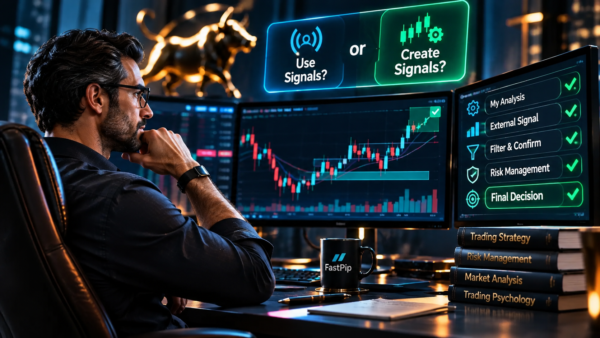
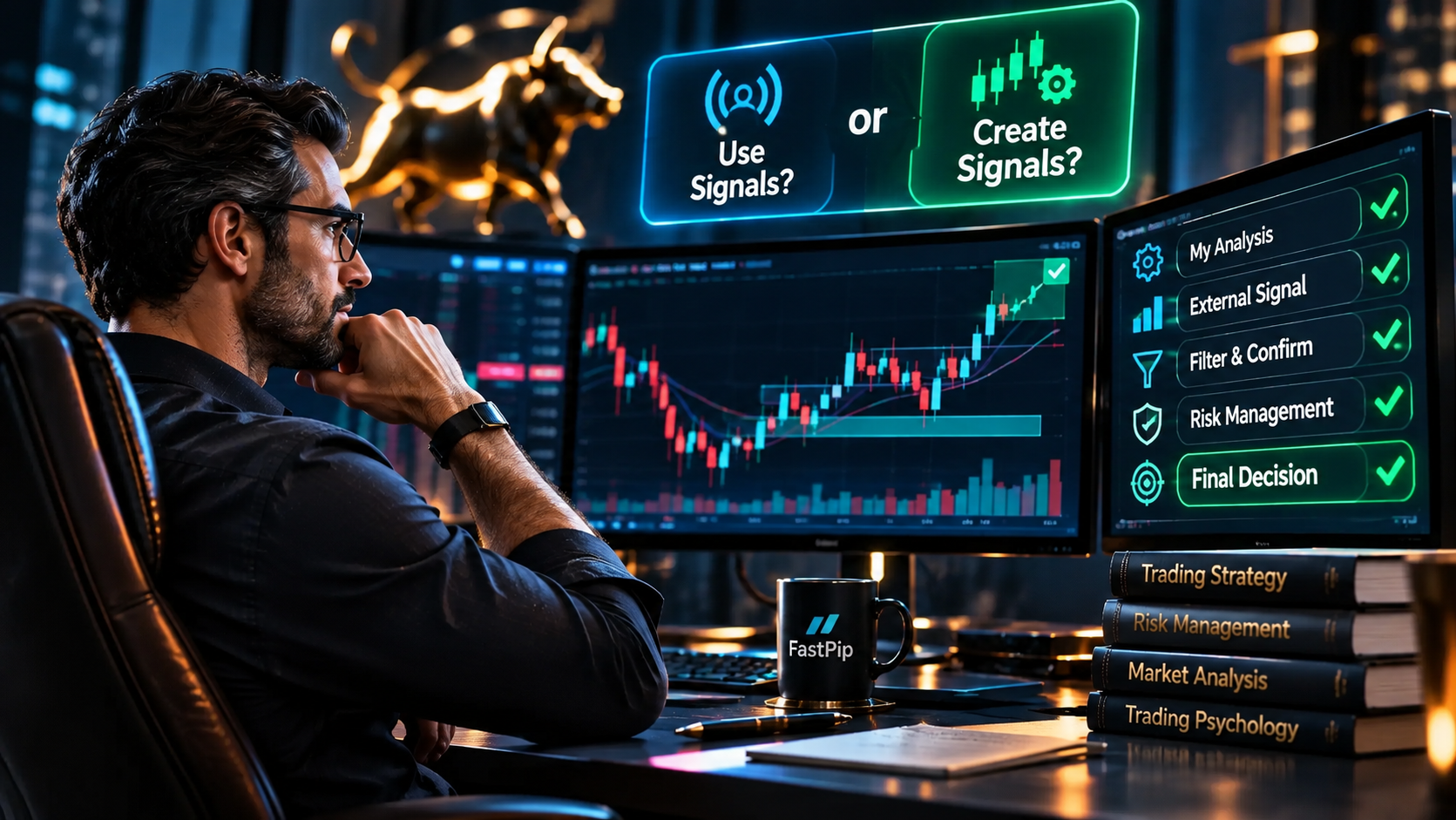
One of the strongest approaches is:
External Signal + Independent Analysis
Suppose a professional receives a BUY signal.
Instead of entering immediately, they evaluate:
- Trend
- Support
- Resistance
- Volume
- Risk
- Economic conditions
If several factors agree, the trade gains credibility.
If they conflict, the trader may reject the signal.
This approach provides two advantages:
- External signals can reveal opportunities the trader did not notice.
- Independent analysis prevents blind execution.
The signal becomes a starting point rather than the final decision.
10. The Role of Data and Analytical Tools
High-quality signals usually come from structured analysis.
Professional traders may use:
- Price data
- Volume
- Volatility
- Economic releases
- Financial reports
- Order-flow information
- Statistical models
They may process this information using:
- Charts
- Indicators
- Market scanners
- Statistical software
- Algorithms
But tools do not automatically create good signals.
The trader must know how to interpret the data.
A simple tool used correctly can be more valuable than a complex system used poorly.
11. Do Financial Institutions Use Trading Signals?
Yes.
Large institutions use signals extensively.
But the signals may look very different from retail Telegram or social-media alerts.
A hedge fund may use a model combining:
- Interest rates
- Capital flows
- Economic data
- Volatility
- Market pricing
The model may produce:
Increase exposure
or:
Reduce exposure
That is still a signal.
Large institutions commonly combine:
Human Analysis + Quantitative Signals + Risk Systems
They rarely execute decisions based on one isolated indicator.
Instead, signals are processed through several layers of research and risk control.
12. Retail Traders vs. Professional Traders: How They View Signals
A retail beginner may ask:
“Should I take this signal?”
A professional asks:
“Does this signal fit my system?”
That distinction changes everything.
Retail traders often focus on:
- Recent wins
- Short-term results
- Signal accuracy
Professionals focus more on:
- Long-term statistics
- Risk
- Drawdown
- Expectancy
- Market conditions
They also understand that even excellent systems experience losing periods.
That is why professional signal evaluation should be based on a large sample of trades.
FastPip covers this process in more detail in its guide to Signal Provider Performance Evaluation.
13. Advantages and Disadvantages of Relying Completely on Signals
Signals can provide real benefits.
Advantages
They can:
- Save time
- Identify opportunities
- Provide structured entries
- Help beginners understand trade structure
But full dependence creates important weaknesses.
Disadvantages
The trader may:
- Stop learning
- Lose analytical independence
- Become dependent on one provider
- Struggle when market conditions change
If the provider disappears or performance deteriorates, the trader may have no independent framework.
Signals should support skill development—not replace it.
14. Why Many Professionals Develop Their Own Systems
Professional traders usually evolve toward personalized systems.
There is no universal strategy that perfectly matches every trader’s:
- Time horizon
- Risk tolerance
- Personality
- Capital
- Trading style
A scalper and a Position Trader require completely different systems.
FastPip’s Trading Types guide explains these differences across Scalping, Day Trading, Swing Trading and Position Trading.
A proprietary system provides:
- Clear entry rules
- Clear exit rules
- Risk control
- Repeatability
- Independence
It also reduces emotional decision-making.
15. Is a Signal a Decision Tool or an Execution Tool?
Beginners frequently treat signals as complete decisions.
Professionals often use them differently.
The broader trade decision may already exist.
The signal simply determines:
When to execute.
Example:
The trader has already determined that EURUSD is bullish.
Their system then generates an alert when:
- Resistance breaks
- Volume increases
- Momentum confirms
The alert is not creating the entire trading idea.
It is triggering execution.
This is a much more advanced use of signals.
16. Can Professional Traders Trade Without External Signals?
Yes.
If we define a signal as a message from someone else, many professionals can trade without external signals.
But if we define a signal as:
Any condition that triggers a trade
then every systematic trader uses signals.
For example:
If price breaks resistance with strong volume while the higher timeframe remains bullish, enter BUY.
That rule generates a signal.
The important difference is that the signal originates from the trader’s own system.
Professionals often move from:
External Signal → Internal System
This increases analytical independence.
17. Risk Management Matters More Than the Signal
Even the best signal can produce a poor result if risk management is weak.
Suppose a very high-quality BUY signal appears.
If the trader:
- Uses excessive leverage
- Risks too much capital
- Ignores Stop Loss
the trade can still damage the account.
Professional traders typically evaluate risk before execution.
They ask:
- How much capital is at risk?
- Where is the invalidation point?
- What is the Risk/Reward?
- Does this trade fit portfolio exposure?
The signal identifies an opportunity.
Risk management determines whether the opportunity is acceptable.
18. How Professionals Measure Signal Quality
Professional traders rarely evaluate signals as simply:
Right or Wrong
Instead, they evaluate statistical quality.
Important metrics include:
- Win Rate
- Risk/Reward
- Expectancy
- Maximum Drawdown
- Consistency
- Execution quality
A BUY signal against a strong bearish trend may receive a lower quality score.
The same signal in a supportive environment may be stronger.
Professionals also consider:
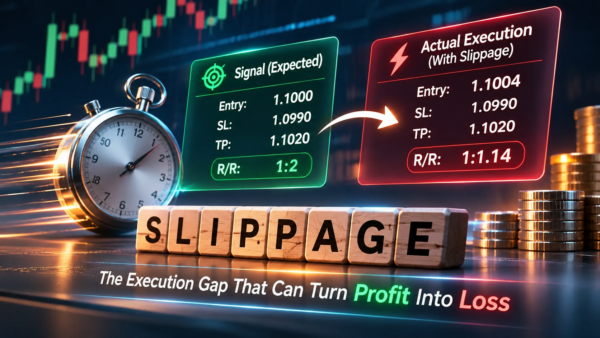
- Slippage
- Spread
- Liquidity
- Execution speed
because theoretical signal quality can differ from actual trading results.
FastPip’s related articles on Slippage in Trading Signals and Same Trading Signal Different Results explain why execution matters just as much as analysis.
19. From Signal Consumer to Signal Creator
Many traders begin as signal users.
That is not necessarily a problem.
Signals can help beginners understand:
- Entry
- Stop Loss
- Take Profit
- Trade structure
But eventually an important question appears:
Why was this signal generated?
That question marks the beginning of analytical independence.
The progression often looks like:
Follow Signals → Study Signals → Filter Signals → Create Signals
The trader gradually learns:
- Technical Analysis
- Fundamental Analysis
- Risk Management
- Statistics
Eventually, their own trading system begins producing opportunities.
This is the shift from dependence to independence.
20. Conclusion: Do Professional Traders Use Signals or Create Them?
So, do professional traders use signals?
Yes.
Many also create their own signals.
Some use external research.
Some rely almost entirely on proprietary systems.
Many do both.
The defining characteristic of a professional is not whether they use signals.
It is how they process them.
Professionals generally:
- Evaluate signals
- Filter signals
- Understand the logic
- Measure risk
- Compare the trade with their strategy
- Take responsibility for the final decision
They do not usually treat signals as unquestionable instructions.
The most important evolution in a trader’s development is therefore:
Signal Dependency → Signal Evaluation → Signal Generation
A professional trader may use information from many sources, but the final decision remains inside a structured trading framework.
Investor.gov makes a similar point for externally sourced investment recommendations: decisions should not be based solely on information received through social media or investment-tip channels. Independent research and verification remain important.
The final principle is:
Professional traders do not necessarily avoid signals—they control how signals influence their decisions.
Frequently Asked Questions
Do professional traders use signals?
Yes. Professional traders may use technical alerts, research, statistical models and other signals, but they usually evaluate them independently before trading.
Do professional traders follow other traders’ signals?
Sometimes. External signals may be used as idea sources rather than automatic trade instructions.
Do professional traders create their own signals?
Many do. Experienced traders often build proprietary systems that generate trading opportunities.
Is using trading signals a sign of weakness?
No. The problem is not using signals; the problem is blindly depending on them.
Do hedge funds use trading signals?
Yes. Quantitative models, research systems and algorithmic tools can generate signals for institutional decision-making.
What is the difference between a signal and a strategy?
A signal is a specific trade opportunity. A strategy is the set of rules that generates those opportunities.
Why do professionals perform independent analysis?
Because market conditions can change and no external signal is guaranteed to remain valid.
Can signals help beginners?
Yes. They can help beginners understand trade structure, but complete dependency can slow skill development.
How do professional traders evaluate signals?
They examine market structure, risk, statistics, execution conditions, market regime and compatibility with their own strategy.
What is more important: the signal or risk management?
Both matter, but poor risk management can destroy even a high-quality signal.
Do professionals use multiple signal sources?
Many do. Different sources may provide research, alerts, quantitative data or market ideas.
Can a trader become independent after using signals?
Yes. Many traders evolve from following signals to analyzing and eventually generating their own opportunities.
Why do professional traders use proprietary systems?
A proprietary system can better match the trader’s risk tolerance, timeframe, capital and decision-making style.
Can professional traders trade without external signals?
Yes. Their own strategies and rules can generate internal trading signals.
Should traders blindly follow signal providers?
No. Independent evaluation, risk management and understanding of the trade remain essential.
What is the best way to use trading signals?
Use them as one input in a broader analytical and risk-management process rather than as a substitute for independent decision-making.