
Exposure in Trading refers to the amount of financial market risk associated with an open position, investment, or portfolio. It describes how strongly a trader’s capital or portfolio value may be affected by changes in asset prices, exchange rates, or other market factors.
In Forex and CFD trading, exposure is often measured using the notional value of open positions. However, exposure can also refer to directional risk, currency holdings, or sensitivity to specific market movements.
For example, a trader holding a $100,000 EUR/USD position has approximately $100,000 in notional market exposure, even if the margin required to open the position is considerably smaller.
Exposure is a fundamental concept in day trading, portfolio management, institutional dealing, and brokerage risk monitoring.
Understanding exposure helps traders and financial institutions evaluate position concentration, leverage, and potential losses under different market conditions.
Market exposure begins when a trader or investor takes a position whose value changes in response to market conditions.
A long position generally benefits from an increase in the underlying asset’s price, while a short position generally benefits from a decrease.
The magnitude of the position determines how sensitive its value may be to market movements.
Consider two traders holding positions in the same financial instrument:
For an equivalent 1% price movement, the approximate profit or loss would be $100 for Trader A and $1,000 for Trader B, assuming linear exposure and excluding trading costs.
The second trader therefore has ten times the notional exposure and approximately ten times the monetary sensitivity to the same percentage price movement.
However, notional exposure should not be confused with maximum possible loss, margin requirements, or the amount of money deposited into an account.
Exposure can be classified in several ways depending on position direction, portfolio composition, and underlying financial risks.
Five particularly important categories are long exposure, short exposure, gross exposure, net exposure, and currency exposure.
Long Exposure represents the market value or notional amount of positions that generally benefit when the underlying asset appreciates.
For example, a trader purchasing 10,000 shares at $20 per share has a long position worth $200,000.
If the share price rises, the position generally gains value.
If the price declines, the position generally loses value.
Long exposure is commonly associated with buying stocks, currency pairs, commodities, or other financial instruments.
Short Exposure represents positions that generally benefit when the underlying asset declines in value.
For example, a trader holding a $50,000 short position in an equity index may profit if the index decreases.
However, the position may generate losses if the index rises.
Short exposure can be created through short selling, CFDs, futures, and other derivatives.
The risks depend on the financial instrument and trading arrangement. Some short positions can generate losses exceeding the initial capital allocated to the position.
Gross Exposure measures the combined absolute value of all long and short positions.
It does not offset opposing positions against each other.
The basic formula is:
Where:
For example, a portfolio containing $300,000 in long positions and $200,000 in short positions has gross exposure of $500,000.
Gross exposure is useful for understanding the overall scale of market positions.
It does not, by itself, measure the portfolio’s potential loss or account for correlations between instruments.
Net Exposure measures the difference between long and short position values.
It provides a simplified indication of a portfolio’s directional market bias.
The formula is:
For example:
The positive net exposure indicates an overall net-long position under this aggregation method.
If short exposure exceeds long exposure, the result becomes negative, indicating a net-short position.
A net exposure close to zero does not necessarily mean that a portfolio has no risk.
Different assets may behave differently, and opposing positions may fail to offset each other during unusual market conditions.
Currency Exposure describes sensitivity to changes in foreign exchange rates.
It can arise from Forex trades, international investments, business transactions, or assets denominated in foreign currencies.
For example, a European investor holding U.S. equities may be exposed to changes in the USD/EUR exchange rate, even if the underlying stock prices remain unchanged.
Currency exposure is especially relevant to Forex brokers, multinational corporations, global investment funds, and international investors.
Currency risk management often involves measuring and, where appropriate, hedging exposures across different currencies.
Gross and net exposure provide different views of the same portfolio.
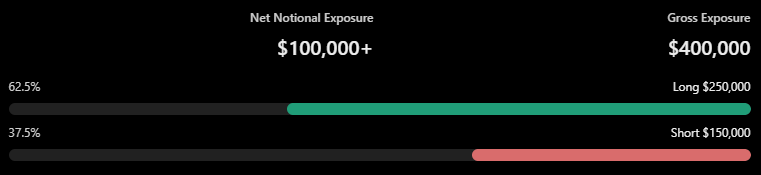
Consider a trading portfolio with the following hypothetical positions:
| Position | Direction | Notional Value |
|---|---|---|
| EUR/USD | Buy | $150,000 |
| GBP/USD | Buy | $100,000 |
| XAU/USD | Sell | $80,000 |
| US100 | Sell | $70,000 |
| Total | $400,000 |
The total long position value is $250,000.
The total short position value is $150,000.
Net Exposure Calculation
In Forex, position exposure is commonly expressed using the notional value of the currency contract.
For a standard spot Forex position:
The notional value in the quote currency is:
The result can then be converted into the account’s reporting currency.
Suppose a trader opens a 1.00-lot Buy position in EUR/USD.
Assume:
The base currency exposure is:
The USD-equivalent notional exposure is:
Therefore, the trader controls a position with a notional value of $110,000 at the assumed exchange rate.
If EUR/USD moves by 100 pips, or 0.0100, the profit or loss for this position is approximately $1,000, excluding trading costs.
This demonstrates how position size and price movement determine the monetary sensitivity of Forex exposure.
Gold exposure is particularly important because XAU/USD can experience significant price movements during economic announcements and changes in market sentiment.
For a linear XAU/USD contract denominated in USD, notional exposure can be estimated using:
Assume:
The total exposure is:
The trader therefore controls $400,000 in notional gold exposure.
If gold rises by $10 per ounce, the long position gains approximately $1,000 before trading costs.
If gold declines by $10, the position loses approximately $1,000.
Actual contract sizes and profit calculations depend on the broker’s instrument specifications.
Exposure, margin, and leverage are related concepts, but they measure different aspects of a trading position.
| Concept | Meaning |
|---|---|
| Exposure | Market position size or sensitivity to a risk factor |
| Margin | Collateral required to open or maintain a leveraged position |
| Leverage | Relationship between controlled market value and capital |
| Equity | Account balance adjusted for unrealized profit or loss |
Suppose a trader opens a $100,000 notional position with 1:100 leverage and a corresponding 1% initial margin requirement.
The approximate required margin is:
Exposure, margin, and leverage are related concepts, but they measure different aspects of a trading position.
| Concept | Meaning |
|---|---|
| Exposure | Market position size or sensitivity to a risk factor |
| Margin | Collateral required to open or maintain a leveraged position |
| Leverage | Relationship between controlled market value and capital |
| Equity | Account balance adjusted for unrealized profit or loss |
Suppose a trader opens a $100,000 notional position with 1:100 leverage and a corresponding 1% initial margin requirement.
margin requirement.
The approximate required margin is:
Margin = 100,000 / 100 = $1,0000
In this example:
The trader controls a $100,000 position using $1,000 in required margin.
However, this does not mean the trader can lose only $1,000.
Losses depend on price movements, position size, execution conditions, and the account’s applicable protection and liquidation rules.
Margin rules and definitions also vary by product and jurisdiction. The CFTC Futures Glossary provides authoritative terminology for futures and related derivatives markets.
Exposure management is also a core responsibility of Forex brokers and dealing desks.
Brokerage exposure can be analyzed from several perspectives, including client positions, market risk, liquidity provider hedging, and the broker’s residual risk.
A broker may have thousands of open client positions across currency pairs, metals, energy products, indices, and cryptocurrencies.
Monitoring these positions helps risk teams understand where significant market sensitivities are concentrated.
Client exposure represents the market positions held by traders.
Broker exposure depends on how those client positions are executed, offset, or hedged.
For example, a broker may have clients holding a net-long position in gold.
If the broker acts as the counterparty to those positions and does not hedge them externally, it may carry an offsetting net-short market exposure.
If the broker transfers or hedges the risk through liquidity providers, its residual exposure may be reduced.
The actual result depends on execution arrangements, hedging ratios, and outstanding positions.
In an A-Book arrangement, a broker generally passes or hedges relevant market risk through external counterparties.
In a B-Book arrangement, the broker typically internalizes client positions and may retain their market risk.
Many brokers use hybrid execution models that combine internalization and external hedging.
The broker’s residual exposure therefore depends on the positions retained internally, the hedge positions executed externally, and the effectiveness of the hedging arrangements.
Professional risk monitoring systems may evaluate exposure across several dimensions:
Risk teams may also monitor concentrated positions, changes in net directional exposure, and the effects of unusual market movements.
Accurate exposure reporting requires consistent position valuations, currency conversions, contract specifications, and real-time trade updates.
Exposure measurement is an important component of financial risk management.
However, exposure measurement alone is not sufficient to quantify total market risk.
Two portfolios with identical notional exposure may have substantially different risk profiles.
The difference can result from market volatility, instrument correlation, liquidity conditions, and position diversification.
For example, $100,000 of exposure to a relatively stable currency pair may behave differently from $100,000 of exposure to a highly volatile cryptocurrency.
Restrict the maximum allowable position size or notional exposure for an account or portfolio.
Reduce excessive dependence on individual symbols, currencies, sectors, or correlated assets.
Use offsetting positions or instruments to reduce selected market sensitivities.
Estimate the impact of hypothetical market shocks on open positions and portfolio equity.
Track changes in notional values, directional exposures, and potential risk concentrations as market prices and positions change.
Exposure controls are most effective when combined with liquidity analysis, realistic execution assumptions, and clearly defined risk limits.
Exposure analysis helps traders and institutions understand where market sensitivities originate.
It provides a structured overview of long and short market positions.
Exposure measurements help determine whether position sizes align with available capital and investment objectives.
Net positions and currency sensitivities can help identify risks that may benefit from hedging.
Gross and net exposure measures support portfolio analysis, internal controls, and management reporting.
The notional value of a position does not necessarily equal the maximum amount that could be lost.
Offsetting long and short notionals do not eliminate basis risk, correlation risk, or instrument-specific risk.
Equal notional exposures can generate different levels of profit-and-loss volatility.
Exposure may become more difficult to reduce during market stress, widening spreads, or declining liquidity.
Positions denominated in different currencies require conversion into a common reporting currency.
Differences in instruments, contract specifications, execution timing, and market movements can create residual exposure.
Understanding Exposure in Trading allows market participants to evaluate financial positions beyond their required margin or initial investment.
For retail traders, exposure analysis helps connect position size with potential gains and losses.
For portfolio managers, gross and net exposure provide complementary views of market participation and directional positioning.
For Forex brokers, exposure monitoring helps identify concentrations, evaluate hedging needs, and manage risks retained through internal execution.
Most importantly, exposure analysis encourages traders and institutions to evaluate the market value and sensitivity of their positions rather than relying solely on account balances or margin figures.
Exposure in Trading refers to the market value or risk sensitivity associated with open positions or investments. It helps traders understand how financial market movements may affect their positions.
Gross exposure adds the absolute values of long and short positions. Net exposure subtracts short exposure from long exposure to provide a simplified measure of directional positioning.
Forex notional exposure is calculated using position size, contract specifications, and the relevant exchange rate. The result may need to be converted into the account’s reporting currency.
No. Exposure represents the market value or sensitivity of a position, while margin is the collateral required to open or maintain a leveraged trade.
Yes. A portfolio can have equal long and short notionals and still face substantial market risk because different instruments may not move together.
Negative net exposure occurs when the absolute value of short positions exceeds the value of long positions. It indicates an overall net-short position under the measurement method being used.
Forex brokers monitor exposure to evaluate client positions, identify market risk concentrations, calculate residual risk, and support hedging decisions.
Traders can reduce exposure by decreasing position sizes, closing selected positions, diversifying holdings, or using appropriate hedging strategies. The effectiveness of each method depends on the instruments and market conditions.
Category
Risk Management / Forex / Trading Concepts
Related Terms
Risk Management, Gross Exposure, Net Exposure, Market Risk, Currency Exposure, Position Sizing, Hedging, Leverage, Margin, Drawdown, Liquidity Risk, Counterparty Risk, A-Book, B-Book