
Asia-Pacific Markets Face Diverging Monetary Paths as BOJ Tightening, China Risks, and FX Volatility Shape Outlook
Asia-Pacific monetary policy outlook has become a critical focus for global investors as central banks across the region move in sharply different directions. Shifting interest rate expectations in Japan, persistent structural stress in China, and renewed FX volatility are reshaping capital flows and risk sentiment across Asia-Pacific markets. Understanding these dynamics requires a macro-driven approach that connects policy signals with real market behavior.
Accurate interpretation of macroeconomic signals has become increasingly critical in today’s Asia-Pacific markets, where even subtle shifts in central bank language can trigger sharp movements across currencies, equities, and rates. This is precisely why professional traders increasingly rely on signal-based, macro-aware frameworks such as FastPip Signals, which integrate fundamental developments with real-time market behavior rather than reacting solely to headlines.
As of today, Asia-Pacific financial markets are navigating a complex intersection of monetary policy divergence, structural economic challenges, and heightened FX sensitivity. Developments in Japan, New Zealand, China, and broader regional currency markets collectively underline how uneven the post-pandemic adjustment process has become.
This report provides a comprehensive, in-depth analysis of today’s macro news flow, market reactions, and policy implications shaping the Asia-Pacific outlook.
Japan: Tankan Survey Signals Stability, Not Stagnation
Corporate Sentiment Holds Firm
Japan’s latest Bank of Japan (BOJ) December Tankan survey showed that corporate sentiment remains broadly stable, particularly among large manufacturers. The headline index for major manufacturers was unchanged from the previous quarter, while conditions in the services sector remained elevated.
This stability is notable given ongoing global uncertainties, including slowing global trade growth and geopolitical tensions. Rather than signaling economic fatigue, the data suggests that Japanese corporates are adapting to higher costs and a changing global demand environment.
Services Sector Resilience
The services sector continued to outperform, supported by domestic consumption, tourism recovery, and demand linked to digital transformation. This divergence between services and manufacturing underscores Japan’s gradual shift toward a more balanced growth model.
Profit Expectations and Labor Constraints Remain Key Headwinds
Despite stable sentiment, firms reported slightly softer profit expectations, reflecting rising input costs and wage pressures. Labor shortages remain acute, particularly in construction, logistics, and healthcare.
Japan’s aging demographics continue to constrain labor supply, pushing companies toward automation, productivity investments, and selective price increases.
BOJ Commentary: Easing Uncertainty and Improved Cost Pass-Through
Follow-up remarks from a BOJ official provided crucial context to the Tankan results. According to the BOJ:
-
Trade-related uncertainty has eased compared to earlier in the year
-
Firms are increasingly able to pass higher costs onto consumers
-
Demand linked to AI infrastructure and semiconductor investment remains robust
These factors directly support the BOJ’s assessment that inflation dynamics are becoming more sustainable.
For reference, official BOJ policy communications can be found via the Bank of Japan’s website:
External link: https://www.boj.or.jp/en/
Rising Costs: A Double-Edged Sword for Policy Makers
While rising wages support consumption and inflation normalization, they also compress corporate margins. This creates a delicate balancing act for the BOJ, which must ensure inflation sustainability without choking off growth.
The Tankan survey reinforces that inflationary pressures are no longer purely imported but increasingly domestically generated—a critical condition for policy normalization.
BOJ Policy Outlook: December Rate Hike Firmly in Focus
Taken together, the data and official commentary reinforce market expectations that the BOJ will deliver a rate hike at its December 18–19 meeting. Such a move would represent another milestone in Japan’s exit from ultra-loose monetary policy.
Importantly, markets now perceive BOJ action as conditional but credible, increasing the sensitivity of JPY crosses to incoming data.
FX Market Reaction: USD/JPY Reverses on Policy Expectations
Initial Weakening of the Yen
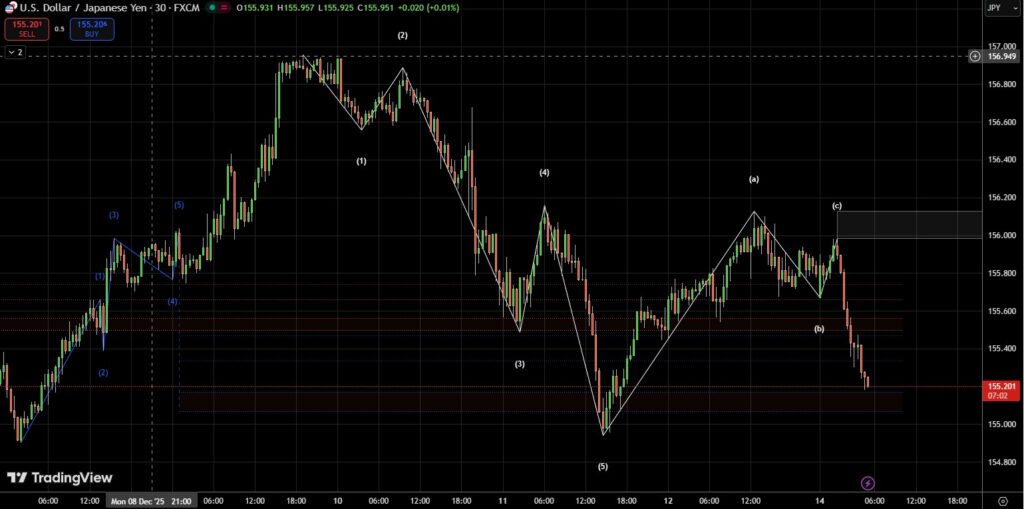
Immediately following the Tankan release, the yen weakened, with USD/JPY rising toward the 156.00 level in early Asia trading. This reflected initial headline-focused interpretations suggesting limited urgency for tightening.
Rapid Reversal as Details Were Digested
However, the move quickly reversed. As traders analyzed the full report and BOJ commentary, USD/JPY slid back toward 155.30.
This reversal highlights a key theme in current FX markets: policy expectations now outweigh headline data. Traders are increasingly positioning ahead of BOJ decisions rather than reacting mechanically to survey releases.
New Zealand: NZD Weakens on Dovish RBNZ Signals
In contrast to Japan, New Zealand’s monetary outlook tilted more dovish. RBNZ Governor Breman stated that further rate cuts remain possible if economic conditions deteriorate.
This guidance pressured the New Zealand dollar, with NZD/USD losing ground as markets priced a higher probability of additional easing.
The divergence between BOJ and RBNZ trajectories has widened rate differentials, reinforcing relative FX moves.
China: Fiscal Support Signals, Structural Stress Persists
Ultra-Long-Term Bonds Announced
Over the weekend, China’s Ministry of Finance announced plans to issue ultra-long-term special government bonds next year. Proceeds will fund national strategies, security initiatives, and industrial upgrading.
While the announcement signals ongoing fiscal support, markets reacted cautiously due to the lack of detail on scale, timing, and specific projects.
Property Sector Crisis Deepens
Stress in China’s property sector remains severe:
- Bonds issued by China Vanke sold off sharply
- Negotiations with bondholders continue just ahead of a key maturity
- No agreement has yet been finalized
These developments underscore persistent systemic risk within the sector.
Housing Data Confirms Prolonged Downturn
Recent data paints a stark picture:
-
New home prices declined month-on-month for the 30th consecutive month
-
Existing home prices fell for the 31st straight month
This prolonged contraction continues to erode household wealth and consumer confidence.
November Activity Data: Mixed Signals from China
Retail Sales Slow Sharply
Retail sales growth weakened significantly in November, highlighting fragile consumer demand amid declining property values and cautious household behavior.
Official Narrative: “Stabilized While Improving”
China’s National Bureau of Statistics stated that the economy has “stabilized while improving,” citing firmer momentum in select industrial and services segments.
However, officials acknowledged persistent challenges and pledged to step up counter-cyclical and cross-cyclical policy adjustments, leaving the door open for further support.
For official data releases, see:
External link: https://www.stats.gov.cn/english/
Regional FX: Yuan Strength, Rupee Under Pressure
Across Asia:
- The onshore Chinese yuan climbed to a 14-month high, supported by policy guidance and improved sentiment
- The Indian rupee continued to weaken, prompting renewed intervention from the Reserve Bank of India
These moves highlight divergent capital flow dynamics across emerging Asia.
Geopolitics: Tentative Progress on Ukraine Raises Risk Sentiment
Geopolitical developments also influenced sentiment. Ukrainian President Volodymyr Zelenskiy signaled potential flexibility on NATO membership ambitions as peace discussions with U.S. envoys in Berlin showed signs of progress.
While early, such developments could reduce geopolitical risk premiums if sustained.
Market Structure Note: U.S. Equity Futures Rollover
Market participants should note that U.S. equity index futures rollover occurs on Monday, December 15, with liquidity shifting to the next contract as volume and open interest migrate.
This transition can temporarily affect volatility and execution quality.
Asia-Pacific Equity Market Performance
Equity markets across the region traded mostly lower:
- Japan (Nikkei 225): -1.47%
- Hong Kong (Hang Seng): -0.92%
- Shanghai Composite: -0.11%
- Australia (ASX 200): -0.77%
The declines reflect a cautious investor stance amid policy uncertainty and structural concerns.
Conclusion: Diverging Paths Demand Precision, Not Guesswork
Today’s developments reinforce a critical reality for traders and investors: Asia-Pacific markets are no longer moving in unison. Japan edges toward normalization, New Zealand leans dovish, China grapples with structural stress, and FX markets react instantly to shifting expectations.
In this environment, success increasingly depends on macro-aware signal frameworks, disciplined risk management, and the ability to filter noise from actionable insight—principles embedded at the core of FastPip Signals.
As central banks move further out of sync, volatility is not a risk to avoid—but an opportunity to manage intelligently.
 Check Our
  Whether you’re a day trader or a long-term investor, FastPip gives you the tools to trade smarter, not harder.