
Trading Strategies in Range-Bound Markets: How to Profit in Neutral Market Conditions
Many traders rely on range market trading techniques to capture consistent profits during periods of low volatility.
Range market trading becomes essential for traders during periods when financial markets are not strongly trending. On many days, price simply moves within a limited range—neither rising sharply nor falling significantly. This phase, known as a range-bound or sideways market, can be confusing for many traders. However, when approached correctly, it offers some of the best opportunities for generating steady and low-risk profits.
Financial markets are not always fast-moving or strongly trending. On many days, price oscillates within a limited range—neither rallying nor falling sharply. This phase, known as a Range Market or Sideways Market, often confuses many traders. Yet in reality, these conditions can offer some of the best opportunities for generating steady, low-risk profits.
But here’s the key point:
⭐ In neutral markets, timing and precision become far more important than in trending markets.
This is exactly where FastPip’s professional tools help traders navigate the market with confidence.
FastPip Tools for Trading in Range Markets
FastPip provides traders with advanced analytical tools, smart automation, and free trading insights. Two of its most powerful free services play a crucial role in range-bound trading:
1. FastPip Signals — Professional Forex Signals (100% Free)
FastPip Signals are generated using a combination of:
- Technical analysis
- Price action
- Algorithmic models
- Global market data
These signals are especially effective in range-bound markets because they:
- Provide precise entry and exit points
- Highlight key support and resistance zones
- Identify reversal points earlier than most traditional tools
- Keep the risk of each trade controlled and manageable
FastPip signals are published daily and completely free.
Why FastPip Signals Work Well in Range Markets
In sideways conditions, a trader must identify the upper and lower boundaries accurately.
FastPip signals do this automatically, giving traders a clear roadmap for decision-making.
2. FastPip Smart Trading Assistant — Free AI Trading Tool
This advanced AI-powered assistant is available through Telegram and offers fully automated market insights — completely free.
What the Smart Assistant Can Do
- Technical analysis for any symbol
- Short-term, medium-term, and long-term fundamental insights
- Detects range zones and reversal points
- Highlights key support and resistance levels
- Provides analysis in different styles (SMC, ICT, Classic, and more)
- Delivers fast and simple analysis in seconds
- Supports multiple languages
Why It’s Ideal for Range Markets
In sideways markets, quick validation and clear analysis are essential.
FastPip Smart Trading Assistant:
- Clearly identifies valid range boundaries
- Suggests optimal entry and exit levels
- Warns you before price reverses
- Helps avoid fake breakouts
It is the perfect solution for traders who want fast, precise analysis without complexity.
Conclusion of the Introduction
Before diving into the technical concepts of range markets, remember this:
Successful trading in neutral markets requires accurate data, reliable signals, and fast analysis.
FastPip’s two free tools — Professional Signals and the Smart Trading Assistant — give traders everything they need to succeed in range-bound conditions.
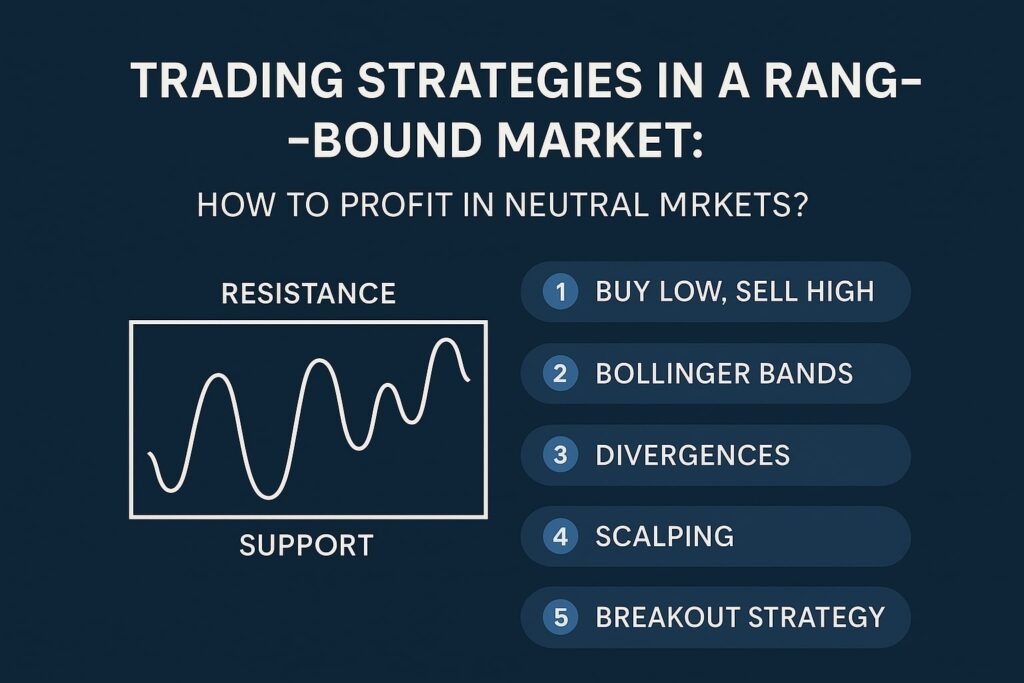
What Is a Range Market?
A range market occurs when price moves between two defined boundaries: a resistance level above and a support level below.
Neither buyers nor sellers have enough strength to push the market into a strong trend.
This creates a horizontal channel in which price fluctuates.
How Traders Behave in These Conditions
- Buyers become active near support
- Sellers become active near resistance
- Market volume declines
- Price movement becomes slow and repetitive
Trend-following tools usually fail here, which is why specialized range strategies are needed.
Characteristics of a Range Market
One of the biggest advantages of range market trading is the ability to identify precise entry and exit zones.
To confirm that the market is truly range-bound, observe the following:
1. No Higher Highs or Lower Lows
Trending markets produce continuous new highs or lows.
But in a range:
- Highs remain nearly equal
- Lows occur at similar levels
This shows the market is storing energy for a future move.
2. Decreasing Market Volume
Lower volume reflects reduced participation and uncertainty—classic signs of consolidation.
3. Indicator Compression
Moving Averages, Bollinger Bands, and ATR all tighten when the market enters a sideways phase.
A low ATR = low volatility → a strong indicator of consolidation.
4. Small Candles with Long Wicks
These reflect indecision and equal pressure from buyers and sellers.
How to Identify a Range Market (Step-by-Step)
Accurate identification is essential. Here’s how to do it:
1. Identify Strong Horizontal Support and Resistance
This is the foundation of range trading.
- Support: A price zone where buyers repeatedly defend the level
- Resistance: A zone where sellers consistently push price down
If these levels are drawn incorrectly, every strategy will fail.
Note: Indicators like Moving Averages or Bollinger Bands can also help identify consolidation zones, and combining them increases accuracy.
2. Use the ADX Indicator
ADX measures trend strength:
| ADX Value | Interpretation |
|---|---|
| Below 20 | Strongly range-bound market |
| 20–25 | Market preparing for a new move |
| Above 25 | Strong trend forming |
ADX under 20 = Very likely a sideways market.
3. Visual Market Structure Analysis
Ask yourself:
- Is price moving horizontally?
- Are highs and lows repeating?
- Are candles lacking directional momentum?
If yes, you’re looking at a range.
Top Trading Strategies for Range Markets
Below are the most effective strategies for range-bound conditions, with complete rules and insights.
1. Buy at Support, Sell at Resistance
Step-by-Step Execution
1. Identify the range zone
Draw the horizontal channel clearly.
2. Enter Buy near Support
Use confirmations such as:
- Pin Bar
- Engulfing
- Morning Star
- RSI below 30 or Stochastic below 20
3. Enter Sell near Resistance
Confirmations:
- Bearish reversal candlestick
- RSI in overbought territory
4. SL Placement
- Buy: Below support
- Sell: Above resistance
5. Take Profit
- Target the opposite boundary of the range
2. Bollinger Bands Strategy
Bollinger Bands act as dynamic support and resistance in range markets.
How It Works
- Touch at lower band → high chance of bounce → Buy
- Touch at upper band → high chance of drop → Sell
Strong Signals
| Market Condition | Strategy |
|---|---|
| Price at lower band + reversal candle | Buy |
| Price at upper band + reversal candle | Sell |
| Reaching middle band | Take profit |
Strength of this Method
Highly effective in quiet markets and reduces false entries.
Learn more:
https://www.investopedia.com/terms/b/bollingerbands.asp
3. Divergence Trading (RSI – MACD – CCI)
Divergence is one of the most powerful tools in sideways markets.
What Is Divergence and Why Does It Occur?
Divergence happens when price action disagrees with an indicator.
- Price says one thing
- Indicator says another
This difference signals weakening momentum.
Why It Happens
Price reflects the visible outcome, but indicators measure underlying strength.
When the market continues making new highs or lows without internal power, a reversal becomes likely.
Why Divergence Matters More in Range Markets
Sideways conditions include:
- Low momentum
- Frequent reversals
- Lack of clear trend
Divergence becomes extremely useful because it:
- Detects early reversal signals
- Filters fake breakouts
- Reveals hidden strength/weakness
- Confirms support & resistance behavior
Types of Divergence
1. Bullish Divergence
Indicates potential upward reversal.
Conditions:
- Price makes a lower low
- Indicator makes a higher low
→ Sellers losing strength → Market likely to reverse upward
2. Bearish Divergence
Indicates potential downward reversal.
Conditions:
- Price makes a higher high
- Indicator makes a lower high
→ Buyers losing strength → Possible downward reversal
Advantages of Divergence Trading
| Advantage | Details |
|---|---|
| Early reversal detection | Very useful in ranges |
| Avoiding fake breakouts | Indicator reveals weakening trends |
| Works in all timeframes | Especially strong in H1, H4, Daily |
| Enhances accuracy | When combined with RSI or Bollinger Bands |
Example in a Range
-
Price near 1.0800 (support)
-
RSI shows higher low → Bullish divergence → Strong buy setup
-
Price near 1.0850 (resistance)
-
MACD shows lower high → Bearish divergence → High-quality sell setup
4. Scalping Inside the Range
Designed for experienced traders.
Rules
- Timeframes: M1, M5, M15
- Tools: EMA20, EMA50
- Entry: Price reacts to EMA
- Exit: Quick 5–10 pips or first reversal sign
High frequency → small but consistent profits
5. Breakout Strategy
A range eventually ends.
This strategy identifies valid breakouts.
Signs of a Valid Breakout
- Large momentum candles
- Increased volume
- At least two candle closes outside the range
- A clean pullback to the broken level
Entry Rules
- Buy Breakout: Resistance → Retest → Buy
- Sell Breakout: Support → Retest → Sell
Risk Management in Range Markets
Golden rules:
- Always use tight stop-loss
- Never trade in the middle of the range
- Reduce lot size
- Avoid revenge trading
- Use multiple confirmations
Common Mistakes in Range Markets
- Entering fake breakouts
- Using trend indicators in non-trending conditions
- Trading without stop-loss
- Expecting large profits in a low-volatility environment
Market Cycle: Range → Trend → Range
A key truth in market behavior:
1. Every major trend begins with a range
Before explosive movement:
- Market consolidates
- Liquidity accumulates
- Volume drops
- Energy builds
Once one side takes control → strong trend forms.
2. After large trends, market returns to a range
Because:
- Traders take profits
- Market needs rebalancing
- Momentum fades
This continuous cycle helps traders plan long-term strategies.
Importance of Take Profit and Stop Loss
Because ranges connect two major phases (before and after trends), SL and TP become essential:
Why SL is critical
- Fake breakouts are common
- Market reverses frequently
- One sharp move can wipe out trades
Why TP is important
- Profit potential is limited
- Small, consistent wins are ideal
- Prevents holding trades unnecessarily
Final Summary
Range markets are not downtime—they are high-potential opportunities.
Successful range trading requires:
- Clear boundaries (support & resistance)
- Confirmations using RSI, MACD, Bollinger Bands
- Smart stop-loss / take-profit planning
- Avoiding the center of the range
When combined with FastPip Signals and the AI Smart Trading Assistant, traders gain a significant advantage in navigating and profiting from range-bound markets.