
Recent UK housing surveys and consumer-confidence data point to an economy that remains fragile, despite some signs of improvement.
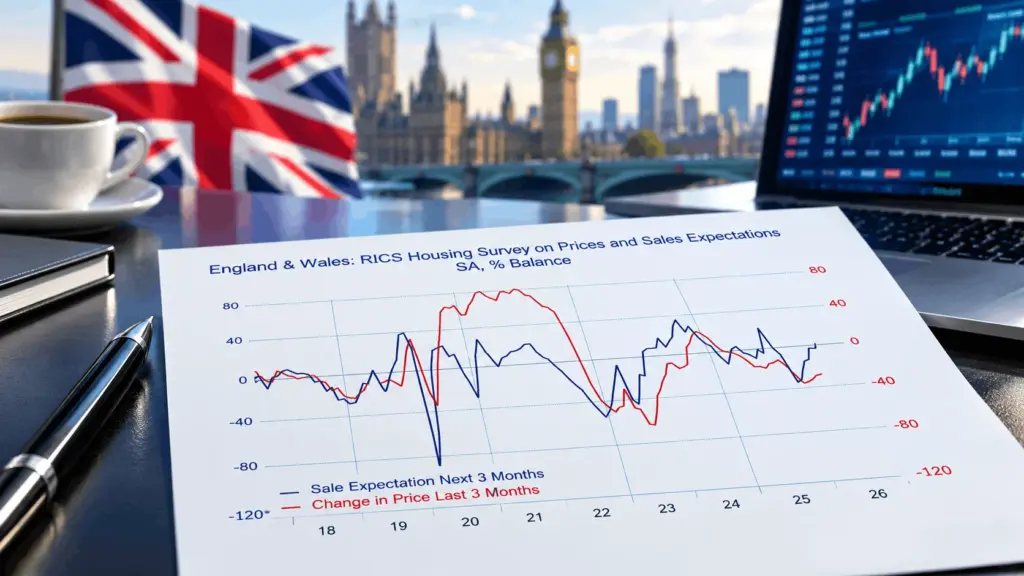
Data from the RICS housing survey, Nationwide house prices and the GfK consumer confidence index present a mixed picture. Housing activity remains weak, while consumer confidence has improved in recent months but is still at a relatively low level.
Together, the indicators suggest that the UK economy is not showing strong momentum.
UK Housing Market Remains Weak
The RICS survey of sales expectations shows some improvement in housing activity, although the data do not yet indicate a strong recovery.
Nationwide house prices are also continuing to rise, but at a slower pace than in previous years. The moderation in annual house-price growth points to continued weakness in the housing market.
The relative ranking of year-over-year house-price changes remains around the 30th to 40th percentile of the historical data set extending back to 1992.
This suggests that housing conditions remain subdued, even though the latest data do not point clearly toward another deterioration.
Consumer Confidence Is Improving but Remains Low
The GfK consumer confidence index provides a similar signal.
Consumer confidence remains weak, but it has improved in recent months. The latest two readings also showed year-over-year improvement in the monthly data.
Like the housing data, the confidence measure sits around the 30th to 40th percentile of its historical range.
The combination of low confidence and modest improvement suggests that consumers are becoming somewhat less pessimistic, but the broader economic environment remains fragile.
Is the UK Housing Market Recovering?
The latest indicators leave several possibilities open.
Housing prices are still recording small gains, while sales expectations have shown some improvement. However, the pace of activity remains weak and does not yet provide clear evidence of a strong recovery.
The data therefore appear to point more toward stabilization than a full recovery.
At the same time, there is no clear evidence in the latest figures of significant backsliding in housing conditions.
Why the Bank of England Is Cautious
The housing and confidence data are particularly important because the Bank of England is facing a difficult policy environment.
Inflation data released before the latest BoE meeting were worse than expected, yet the central bank decided not to raise interest rates.
One factor behind that decision is the nature of the current inflation pressure.
Higher international energy prices are contributing to inflation, but raising interest rates cannot directly increase the global supply of oil or energy. The BoE therefore has to consider whether these higher costs are likely to generate broader inflationary effects throughout the economy.
So far, policymakers have not seen clear evidence that higher oil prices are spreading widely through the economic system.
Inflation Versus Economic Fragility
This creates a difficult balance for the Bank of England.
If energy-price increases begin to generate broader inflation through wages, services and other prices, the central bank may need to respond to prevent inflation expectations from becoming entrenched.
However, aggressive tightening could also put additional pressure on an economy that is already showing signs of weakness.
The latest housing and consumer-confidence data reinforce the importance of this trade-off.
The BoE must therefore assess not only headline inflation, but also the underlying strength of demand, consumer behavior and the risk that temporary price shocks become more persistent.
What Traders Should Watch Next
Financial-market participants should monitor several indicators for clues about the next direction of UK monetary policy:
- UK inflation
- Energy and oil prices
- RICS housing activity
- Nationwide house prices
- GfK consumer confidence
- Wage growth
- Bank of England guidance
- MPC member comments
These indicators should be followed alongside the latest Macroeconomic News, Central Banks and Economic Calendar Events.
Impact on GBP and Financial Markets
Weak housing activity and subdued consumer confidence could weigh on GBP by reducing expectations for aggressive BoE tightening, while persistent inflation or rising energy prices could have the opposite effect by keeping rate expectations elevated. For GBP/USD, traders will therefore focus on whether inflation remains persistent enough to force the BoE toward tighter policy despite weak growth. UK gilt yields and expectations for future BoE rates are also likely to remain important market signals.
Market Impact
The key market tension is between weak UK growth and persistent inflation pressure. Weak housing and consumer sentiment could limit expectations for further BoE tightening and pressure GBP/USD, while renewed inflation or higher energy prices could support UK rate expectations and the pound. Traders should watch UK inflation, energy prices and BoE guidance as the main catalysts for GBP and UK bond markets.
 Check Our
  Whether you’re a day trader or a long-term investor, FastPip gives you the tools to trade smarter, not harder.