
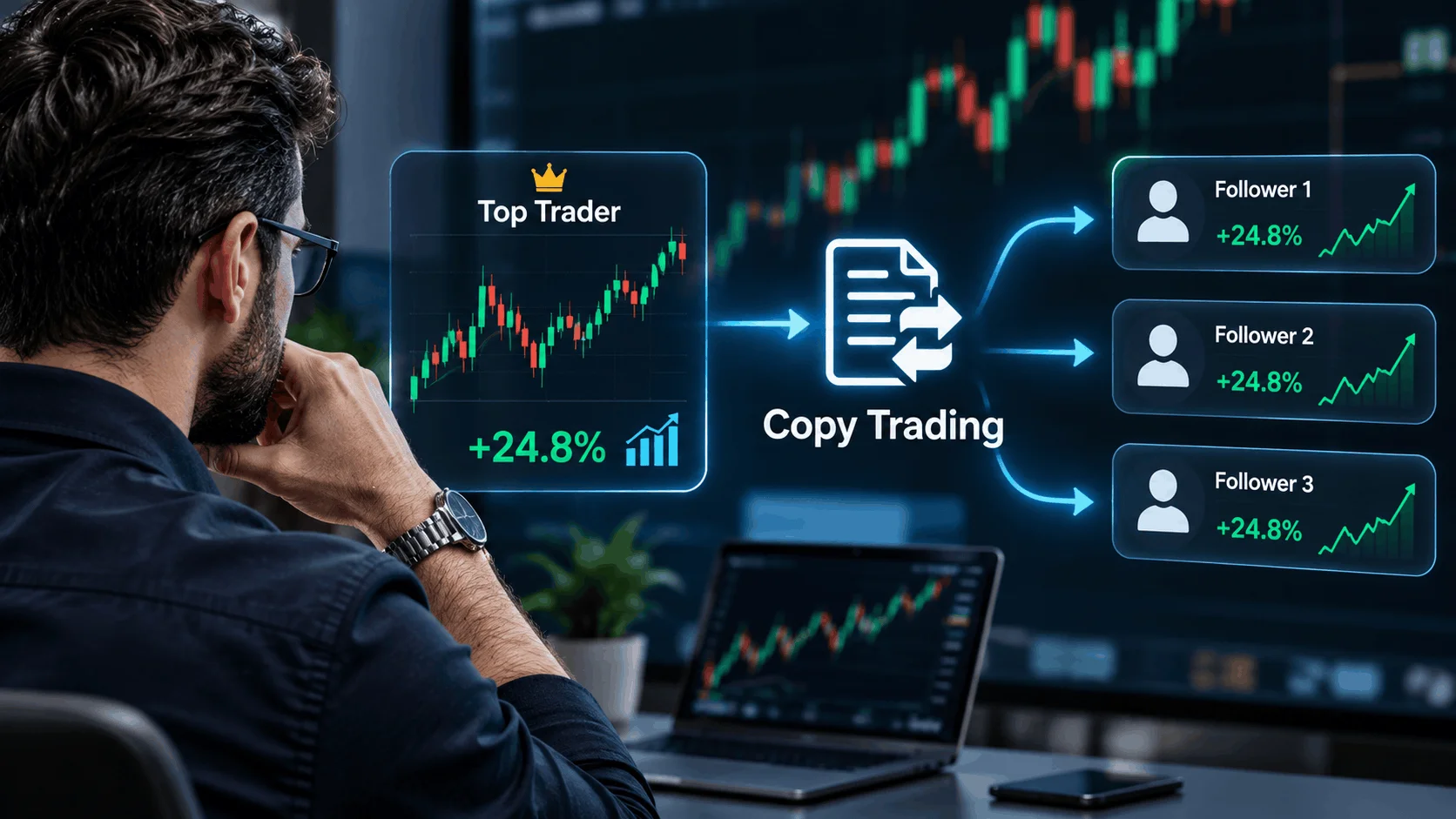
Copy trading is a trading method that allows you to automatically replicate the trades of another trader in your own trading account. When the trader you follow opens, adjusts, or closes a position, the platform can execute a similar trade in your account based on your allocation and risk settings.
Copy trading can save time and give beginners exposure to the decisions of more experienced traders, but it does not remove market risk. Past performance does not guarantee future results, and copied trades can still result in losses.
📋 Key Takeaways
- Copy trading lets you automatically replicate another trader’s positions.
- You can usually set the amount allocated, risk limits, and stop-copy conditions.
- Copy trading is not passive income and does not guarantee profit.
- Past performance is useful context, but it cannot predict future results.
- Maximum drawdown, trading history, leverage, and fees matter as much as returns.
- Execution differences, spreads, slippage, and platform fees can change your results.
- Copy trading is different from social trading and mirror trading.
- Use only money you can afford to lose and monitor your account regularly.
📈 What Is Copy Trading?
Copy Trading Definition
Copy trading is a form of automated trading in which the trades of one trader, often called a strategy provider or master trader, are replicated in the account of another user, often called a follower or copier.
The UK Financial Conduct Authority describes copy trading as a method that lets investors automatically copy another investor’s trades, typically by allocating a proportion of funds to execute those trades.
Want to learn how day trading works and explore its key strategies? Read our guide to Day Trading.
How Copy Trading Differs from Traditional Trading
In traditional trading, you choose the asset, direction, entry point, exit point, and position size yourself. In copy trading, another trader makes many of those decisions, while your platform replicates the trades according to your settings.
However, you still remain responsible for choosing the trader, allocating capital, setting risk limits, and monitoring the account. Copy trading does not transfer responsibility for financial outcomes to the trader you follow.
Who Can Use Copy Trading?
Copy trading may be considered by beginners who want to learn from other traders, busy people who cannot monitor markets all day, or experienced traders looking to diversify their approach. It may also be used by experienced traders who want to become strategy providers.
It is not suitable for everyone. If you cannot accept the possibility of losing your allocated capital, copy trading is not an appropriate solution.
📊 Want to explore different ways to trade the financial markets?
Discover the main trading types, understand how they work, and find the approach that best fits your trading goals.
⚙️ How Does Copy Trading Work?
Choosing a Trader to Copy
First, you select a trader whose strategy, risk profile, trading history, and market focus match your goals. Do not choose a trader based only on high recent returns; examine drawdown, consistency, leverage, and trading style.
Connecting Your Trading Account
After selecting a trader, you connect your trading account to the copy trading service and allocate a specific amount of capital. The platform then uses that allocation to replicate the trader’s positions.
Automatically Copying Trades
When the copied trader opens a position, the platform attempts to open a proportional position in your account. When they close it, the platform usually attempts to close your copied position as well.
Adjusting Trade Sizes and Risk Settings
Most platforms let you set the amount allocated, maximum risk, stop-loss settings, and sometimes a maximum drawdown level. These settings help control exposure, but they cannot eliminate losses.
Monitoring and Stopping Copied Trades
You can usually monitor open positions, performance, and risk metrics. You may also stop copying a trader at any time; the FCA notes that a copying trader may disconnect their funds and manage their investments by closing the copy relationship.
🧩 Types of Copy Trading
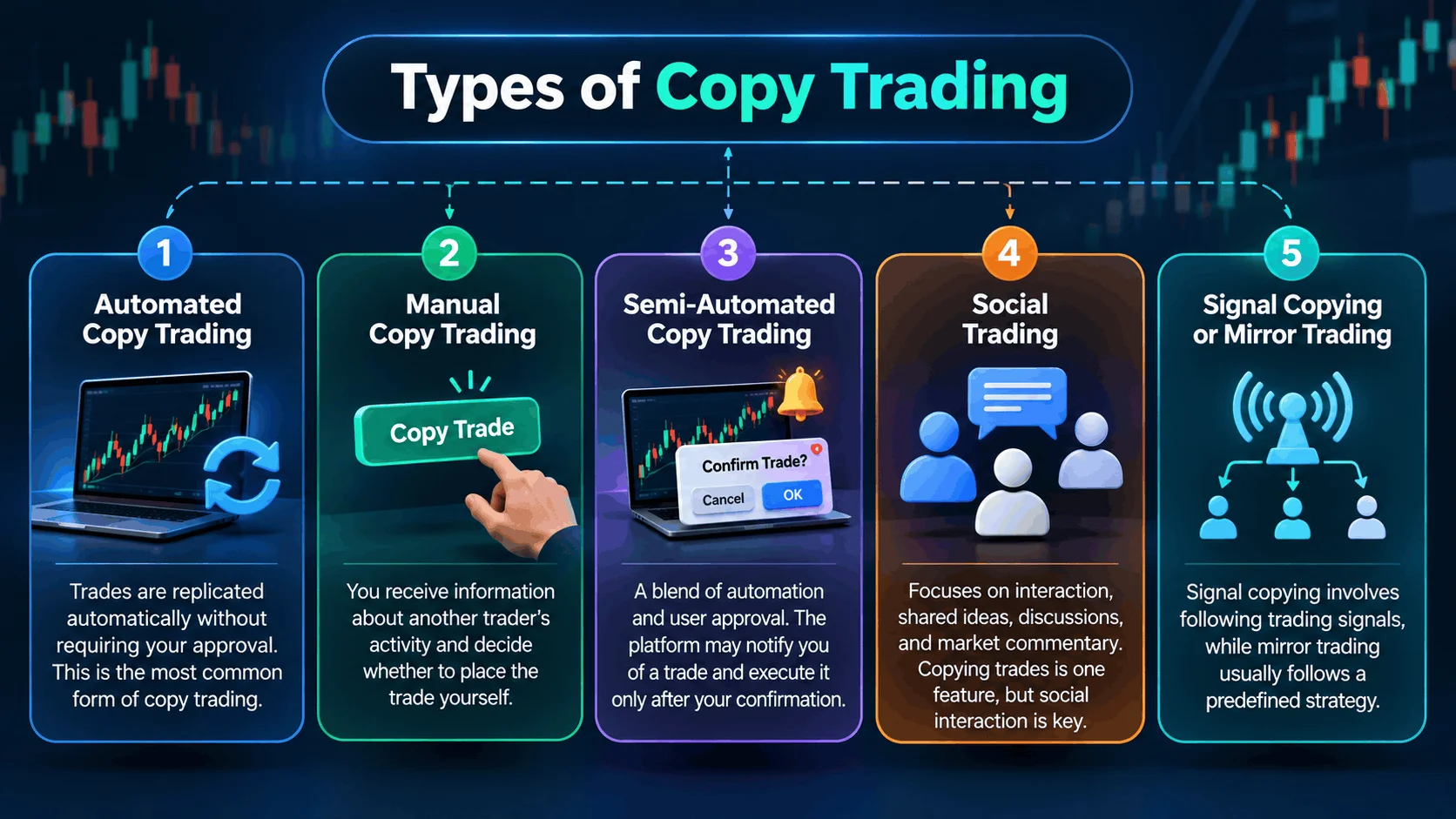
Automated Copy Trading
In automated copy trading, trades are replicated without requiring you to approve each position. This is the most common form of copy trading.
Manual Copy Trading
In manual copy trading, you receive information about another trader’s activity and decide whether to place the trade yourself. This gives you more control but requires more time and attention.
Semi-Automated Copy Trading
Semi-automated copy trading combines automation with user approval. For example, the platform may notify you of a trade and execute it only after you confirm it.
Social Trading
Social trading focuses on interaction, shared ideas, discussions, and market commentary. Copying trades may be one feature, but social interaction is central to the model.
Signal Copying or Mirror Trading
Signal copying involves following trading signals, while mirror trading usually involves following a predefined strategy. The exact meaning can vary by platform, so review the service’s terms carefully.
🔍 Copy Trading vs. Social Trading vs. Mirror Trading
| Feature | Copy Trading | Social Trading | Mirror Trading |
|---|---|---|---|
| Core concept | Replicating another trader’s trades | Sharing ideas and interacting with other traders | Following a predefined trading strategy |
| Execution | Usually automatic | Not necessarily automatic | Usually strategy-based |
| Social interaction | May be available | A central part of the method | Usually limited |
| User control | Depends on platform settings | Depends on execution method | Depends on the service |
What Is Social Trading?
Social trading is a broader concept in which traders share analysis, ideas, performance, and market commentary. You may learn from others, discuss strategies, or copy trades, but copying is not always the main feature.
What Is Mirror Trading?
Mirror trading generally means following a predefined trading strategy rather than copying the individual decisions of a specific person. The exact definition can differ between platforms.
Key Differences Between Copy Trading and Other Trading Methods
Copy trading focuses on replicating a specific trader’s positions. Social trading focuses on community interaction. Mirror trading focuses on replicating a strategy. Always read the platform’s explanation of how trades are selected and executed.
✅ Benefits of Copy Trading
Access to Experienced Traders’ Strategies
Copy trading can give you visibility into how experienced traders approach the market. You may observe their asset choices, trade frequency, risk settings, and reaction to market conditions.
Time-Saving Trading Approach
If you do not have time to analyze markets constantly, copy trading can reduce the need for manual trade execution. However, you should still review performance and risk regularly.
Learning from Other Traders
Following a transparent trader can help you understand how a strategy is applied in real market conditions. Use it as a learning tool, not as a substitute for understanding risk.
Portfolio Diversification Opportunities
Copying traders with different styles or markets may help diversify exposure. Diversification does not guarantee profit or prevent losses, but it can reduce dependence on one approach.
Reduced Need for Manual Trade Execution
Automated copying can reduce the need to place every trade manually. Still, execution quality, platform reliability, and risk settings remain important.
⚠️ Risks and Disadvantages of Copy Trading
Risk of Financial Loss
Copy trading involves real financial risk. The trader you copy can make losing trades, and your account can lose money as a result.
Dependence on Another Trader’s Decisions
Your results depend partly on another person’s judgment, strategy, and risk management. If their approach stops working or changes, your account may be affected.
Past Performance Does Not Guarantee Future Results
A trader’s historical returns do not guarantee future performance. The SEC states that past performance cannot predict how an investment strategy will perform in the future.
Market Volatility and Slippage
Fast-moving markets, low liquidity, and news events can cause slippage. Your copied trade may be executed at a different price from the original trader’s trade.
Leverage and Margin Risks
Leverage can magnify both gains and losses. Investor.gov warns that margin trading can lead to losses greater than the amount invested and may trigger margin calls.
Platform Fees and Hidden Costs
Copy trading services may charge spreads, commissions, subscription fees, or performance fees. These costs can reduce returns, especially if the strategy involves frequent trading.
Limited Control Over Trading Decisions
In fully automated copy trading, you may not control every entry, exit, or position size. Review the platform’s settings and understand what happens when copying is paused or stopped.
Important: The FCA warns that some promotions promising unrealistic returns from copy trading or managed accounts can be misleading, and that unauthorised firms may not provide standard investor protections.
🚀 How to Start Copy Trading
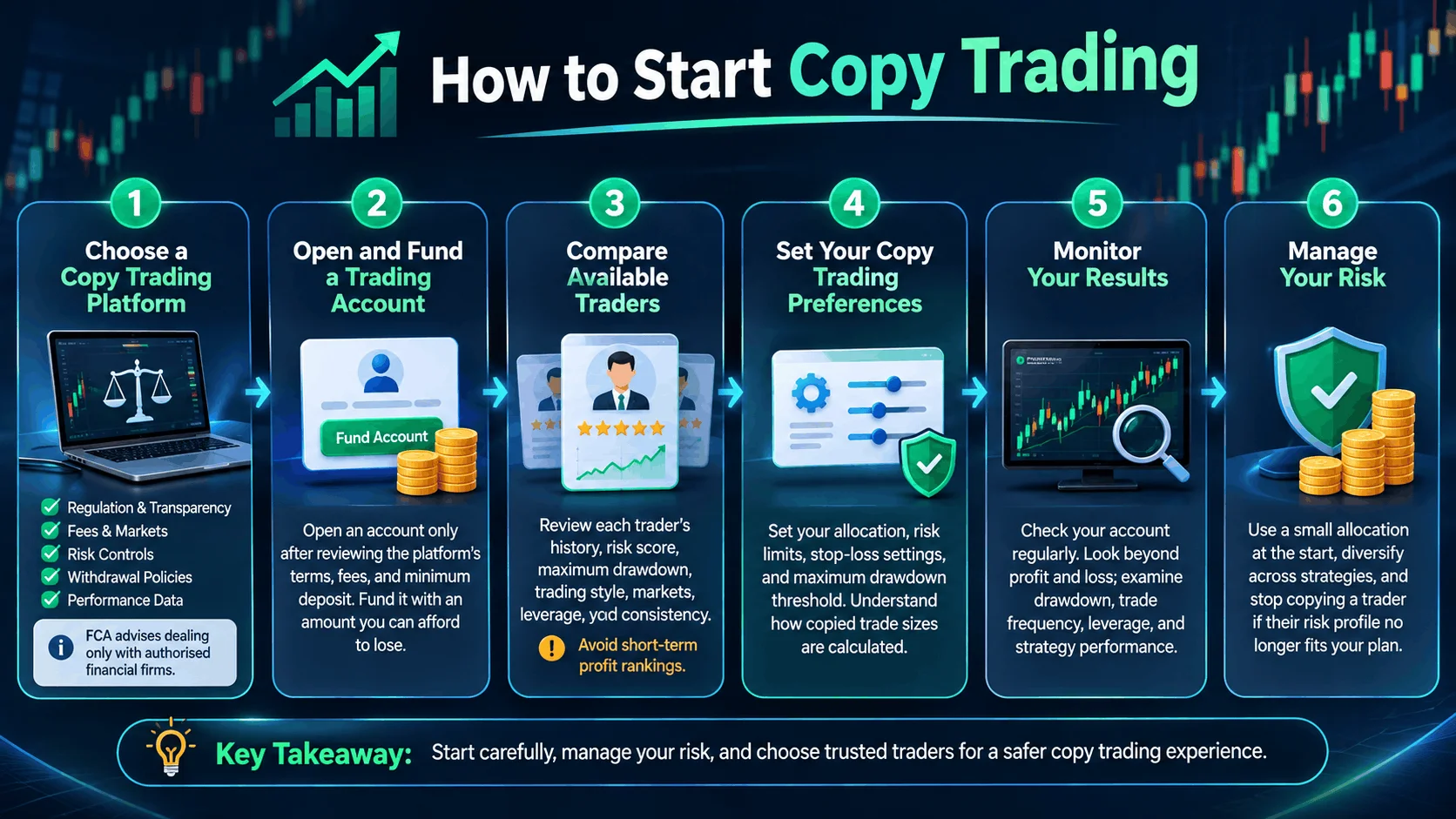
Choose a Copy Trading Platform
Compare platforms based on regulation, transparency, fees, available markets, risk controls, withdrawal policies, and quality of trader performance data. The FCA advises dealing only with authorised financial firms.
Open and Fund a Trading Account
Open an account only after reviewing the platform’s terms, fees, minimum deposit, and withdrawal conditions. Fund it with an amount you can afford to lose.
Compare Available Traders
Review each trader’s history, risk score, maximum drawdown, trading style, markets, leverage, and consistency. Avoid choosing solely based on short-term profit rankings.
Set Your Copy Trading Preferences
Set your allocation, risk limits, stop-loss settings, and maximum drawdown threshold where available. Understand how the platform calculates copied trade sizes.
Monitor Your Results
Check your account regularly. Look beyond profit and loss; examine drawdown, trade frequency, leverage, and whether the trader is following the strategy you expected.
Manage Your Risk
Use a small allocation when starting, diversify across strategies where appropriate, and stop copying a trader if their risk profile or performance no longer fits your plan.
🧭 How to Choose the Right Trader to Copy
Review Historical Performance
Look at performance over a meaningful period, not just the last few weeks. Consider both profitable and losing periods, and check whether the results are verified by the platform.
Check Maximum Drawdown
Maximum drawdown shows the largest decline in account value from a previous peak to a later low. It helps you understand how much an account has historically lost during difficult periods.
Evaluate Trading History and Consistency
A longer, transparent trading history is generally more informative than a short period of exceptional returns. Look for consistent risk management rather than occasional large wins.
Understand the Trader’s Strategy
Understand whether the trader follows trends, scalps, trades news, uses high leverage, or focuses on a particular market. A strategy that does not match your risk tolerance may not be suitable even if its past returns look attractive.
Check Risk Levels and Leverage
High leverage can produce impressive short-term returns but also large losses. Investor.gov notes that leverage magnifies market fluctuations and can lead to the loss of all initial capital in forex trading.
Avoid Choosing Traders Based Only on High Returns
High returns alone do not show risk. A trader with lower returns but controlled drawdown may be more suitable than one with high returns and extreme volatility.
🛡️ How to Manage Risk in Copy Trading
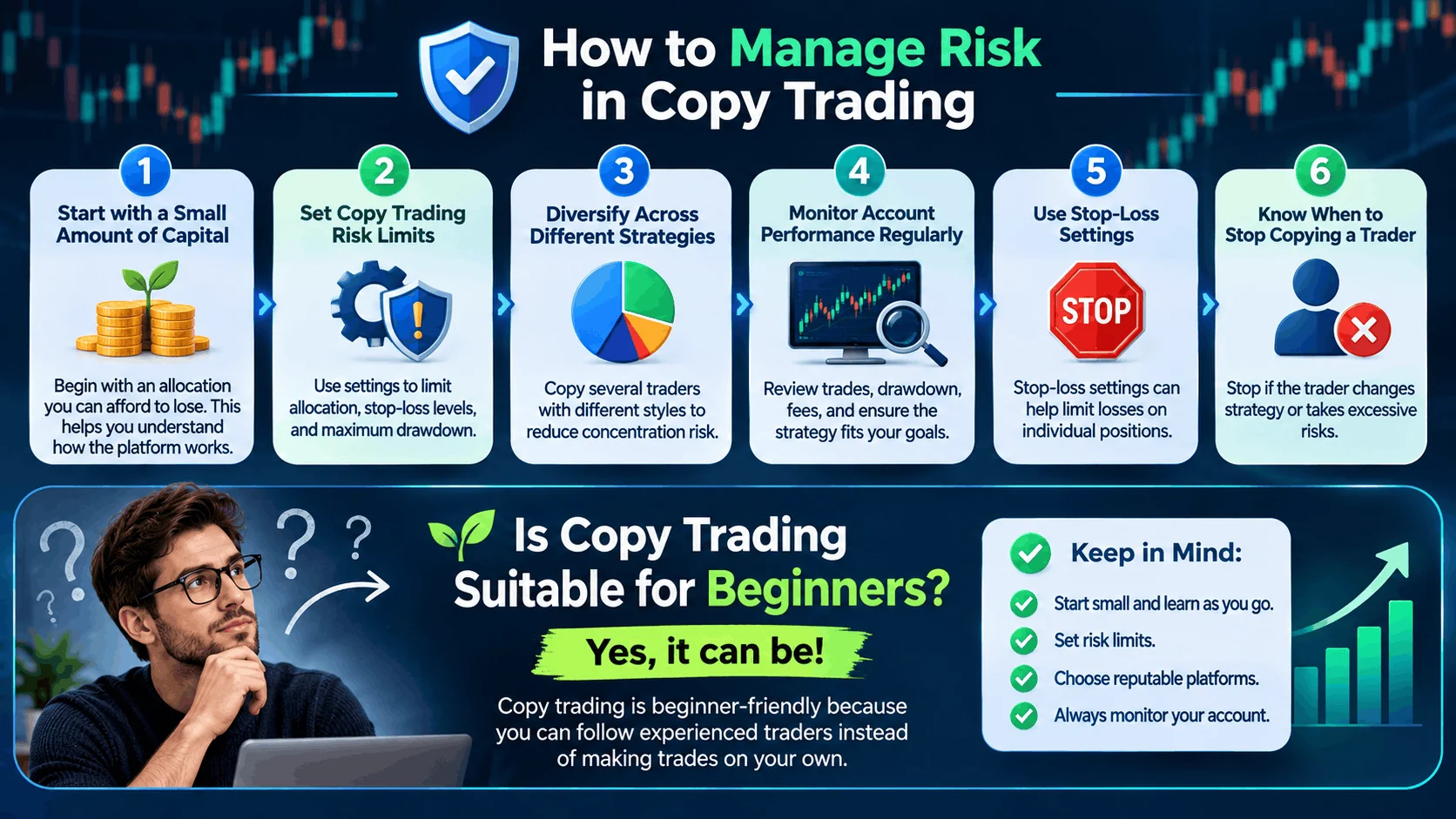
Start with a Small Amount of Capital
Begin with an allocation you can afford to lose. This allows you to understand how the platform executes trades and how the trader behaves in different market conditions.
Set Copy Trading Risk Limits
Use available settings to limit allocation, stop-loss levels, and maximum drawdown. These tools help manage exposure but cannot guarantee protection from losses.
Diversify Across Different Trading Strategies
Copying several traders with different styles may reduce dependence on one person or strategy. Diversification reduces concentration risk but does not remove market risk.
Monitor Account Performance Regularly
Review open trades, equity changes, drawdown, fees, and whether the trader’s behavior matches their stated strategy. Do not rely only on headline profit figures.
Use Stop-Loss Settings Where Available
Stop-loss settings can help limit losses on individual positions. The FCA notes that some copy trading platforms allow users to control risk through stop-loss orders.
Know When to Stop Copying a Trader
Consider stopping if the trader changes strategy, uses excessive leverage, experiences repeated large drawdowns, or no longer matches your risk tolerance.
🌱 Is Copy Trading Suitable for Beginners?
Copy trading can be useful for beginners as a way to observe real trading activity and learn how strategies are executed. However, it is not a shortcut to guaranteed profit or a replacement for basic trading knowledge.
Beginners should understand market risk, leverage, fees, drawdown, and position sizing before allocating capital. They should also verify the platform’s regulatory status and avoid services that promise guaranteed returns.
🧮 Example of Copy Trading
A Practical Copy Trading Example
Suppose you have $1,000 and allocate $500 to copy a trader. The platform uses proportional sizing, so if the trader uses 2% of their account equity in a trade, your copied position may be based on 2% of your $500 allocation, subject to platform rules and minimum trade sizes.
| Scenario | Trader’s Result | Possible Effect on Your $500 Allocation |
|---|---|---|
| Winning trade | +4% account gain | Approximately +$20 before fees and execution differences |
| Losing trade | -4% account loss | Approximately -$20 before fees and execution differences |
| Large drawdown | -30% account decline | Potentially about -$150, depending on allocation and settings |
This is a simplified educational example. Actual results can differ because of allocation method, leverage, minimum trade size, spread, slippage, fees, and the timing of execution.
How Profits and Losses Are Calculated in Copy Trading
Your profit or loss depends on the size of your copied position, the price movement, leverage, fees, and the proportion of capital allocated. A copied trade may not produce exactly the same percentage result as the original trader’s account.
Copy trading does not guarantee profit. Market risk, execution differences, and the possibility of substantial loss remain.
✅ Copy Trading Checklist
☐ I understand the fees, spreads, and performance charges.
☐ I reviewed the trader’s full performance history.
☐ I checked maximum drawdown, not only returns.
☐ I understand the trader’s strategy and leverage use.
☐ I set an allocation I can afford to lose.
☐ I configured risk limits and stop-loss settings where available.
☐ I know how to stop copying and withdraw funds.
☐ I will monitor the account regularly.
Want to explore trading signals and potential market opportunities? Visit our SIGNAL page for the latest trading setups.
🏁 Conclusion
Copy trading allows you to replicate the trades of another trader automatically, which can save time and provide exposure to different strategies. It can also be a useful way to observe how experienced traders manage positions.
However, copy trading is not risk-free, passive income, or a guaranteed way to make money. Choose a transparent platform, evaluate traders beyond their returns, control your allocation, understand leverage, and monitor your account regularly.