
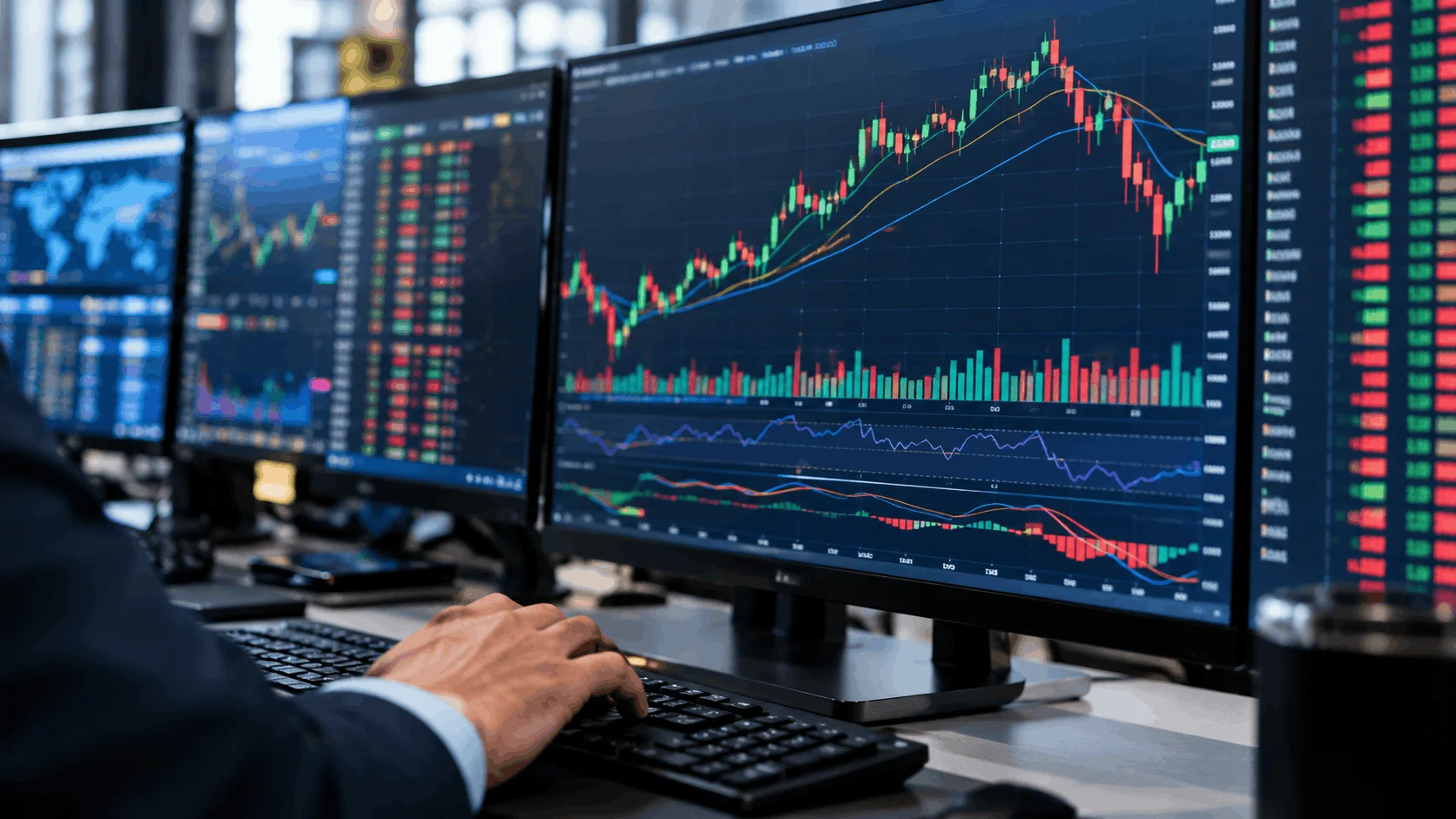
📋 Day Trading at a Glance
- Day trading means opening and closing a position within the same trading day.
- It is also commonly called intraday trading or short-term trading.
- Day traders may trade Forex, stocks, cryptocurrencies, futures, CFDs, or other financial instruments.
- Common tools include charts, technical indicators, market news, economic calendars, and trading platforms.
- Risk management is essential because leverage, volatility, costs, and emotional decisions can increase losses.
- Day trading is not a guaranteed or effortless way to make money.
Day trading is a trading style in which traders open and close positions within the same trading day, aiming to benefit from short-term price movements. Unlike investing, day trading usually does not involve holding positions for months or years. Unlike swing trading, the position is typically closed before the trading day ends.
Day traders may operate in markets such as Forex, stocks, cryptocurrency, futures, or CFDs. They often use technical analysis, price action, volume, market news, and strict risk-management rules to plan entries and exits. This guide explains what day trading means, how it works, what markets and strategies traders use, and what beginners should understand before trying it.
Quick answer: Day trading is a trading style where positions are usually opened and closed within the same trading day to capture short-term price movements. It requires a trading plan, market knowledge, risk management, discipline, and an understanding of the costs and risks involved.
❓ What Is Day Trading?
Day trading is the practice of buying and selling a financial instrument during the same trading day. A trader may open a position after identifying a potential setup and close it later that day, either because the target has been reached, the risk limit has been hit, or the trading plan requires an exit before the session ends.
What Does Day Trading Mean?
The basic meaning of day trading is simple: open today, close today. The trader attempts to benefit from price movements that occur during a single trading session rather than holding the position overnight or for several weeks.
Day trading is often used interchangeably with intraday trading. Both terms describe trading activity that takes place within the same day, although the exact rules may vary depending on the market, broker, instrument, and local regulations.
Why Are Positions Usually Closed Before the End of the Day?
Closing positions before the end of the trading day can help traders avoid overnight exposure. Markets can react to economic announcements, company news, geopolitical events, gaps, or changes in liquidity while the trader is not actively monitoring the position.
However, closing trades within the same day does not eliminate risk. Prices can move quickly during the trading session, and a trader may still experience slippage, unexpected volatility, or losses.
What Is a Day Trader?
A day trader is someone who analyzes short-term market conditions and opens and closes trades within the same trading day. A day trader is not simply someone who makes many transactions. The defining feature is the holding period and the intraday nature of the trading activity.
A day trader may be responsible for:
- Selecting a market and trading session.
- Analyzing price charts, volume, news, or market structure.
- Identifying a possible entry point.
- Defining an exit, stop-loss, and potential target before entering.
- Calculating position size according to acceptable risk.
- Monitoring the trade while it is open.
- Recording the result in a trading journal.
Important: Day trading is an educational topic, not a promise of profit or a trading signal. A strategy that worked in one market condition may not work in another.
Want to stay updated on the latest market developments and events affecting financial markets? Explore our News section for the latest updates.
⚙️ How Does Day Trading Work?
A typical day-trading process starts with choosing a market and ends when the position is closed. The specific method varies by trader, but the decision-making process usually follows several steps.
1. Choosing a Market
The trader first chooses a market that matches their schedule, knowledge, risk tolerance, available capital, and preferred trading hours. Common choices include:
- Forex
- Stocks
- Cryptocurrency
- Futures
- CFDs, where legally available and properly understood
2. Analyzing the Market
Before entering a trade, a day trader may study several types of information:
- Technical analysis: studying price charts, trends, support, resistance, and indicators.
- Price action: examining how price behaves around important levels.
- Volume: evaluating the amount of buying and selling activity.
- Market news: monitoring economic releases, company announcements, and other events.
- Volatility: assessing how quickly and widely the market is moving.
3. Identifying a Trading Opportunity
The trader looks for a setup that matches a predefined trading strategy. A setup may involve a trend continuation, a breakout, a reversal, a range, or a specific price-action pattern.
The key is not simply finding a price movement. The trader should know why the setup may be valid, where the trade becomes invalid, and how much capital can be placed at risk.
4. Opening a Position
If the setup meets the trading plan, the trader opens a position. The entry may be a buy or sell order, depending on the market, instrument, and strategy. Before entering, the trader should understand the order type, spread, commission, slippage, and position size.
5. Managing Risk
Risk management may include setting a stop-loss, limiting position size, avoiding excessive leverage, and defining a maximum daily loss. A day trader should know the potential loss before opening the position.
6. Closing the Position
The position may close when the target is reached, the stop-loss is triggered, the setup is no longer valid, or the trader’s plan requires an end-of-day exit. The result should then be recorded and reviewed.
🌍 What Markets Can You Day Trade?
Day Trading Forex
Forex day trading involves buying and selling currency pairs, such as EUR/USD or GBP/USD. Forex is often associated with high liquidity and extended trading hours during the business week. However, liquidity, spreads, volatility, and available trading sessions can vary by currency pair and market conditions.
A Forex trader should understand the effect of economic releases, interest-rate decisions, market sessions, leverage, and currency correlation before trading.
Day Trading Stocks
Stock day trading involves buying and selling shares during the relevant exchange’s market hours. Traders may focus on stocks with high volume, significant price movement, news catalysts, or unusual market activity.
Important considerations include exchange hours, liquidity, bid-ask spread, company news, volatility, and the rules that apply to the specific market and account type.
Day Trading Cryptocurrency
Cryptocurrency markets are commonly available around the clock, including weekends. This continuous availability can create more opportunities, but it can also increase the temptation to overtrade and make it harder to maintain a consistent schedule.
Crypto assets can differ significantly in liquidity, spread, market depth, volatility, and execution quality. A trader should not assume that all cryptocurrencies behave like highly liquid assets.
Day Trading Futures
Futures are standardized contracts linked to assets such as indices, commodities, currencies, or interest rates. Futures trading commonly involves margin and leverage, which can magnify both gains and losses.
Before trading futures, beginners should understand contract specifications, tick value, expiry, margin requirements, trading hours, and the possibility of rapid losses.
📈 Common Day Trading Strategies
A day-trading strategy is a structured approach for identifying entries, exits, invalidation points, and risk limits. No strategy works in every market condition. The following are educational examples, not recommendations or signals.
Trend Trading
Trend trading attempts to follow an existing upward or downward price movement. A trader may look for a pullback or continuation setup in the direction of the trend.
Potential advantage: The trade follows an established market direction.
Potential risk: Trends can weaken, reverse, or become difficult to identify in sideways markets.
Breakout Trading
Breakout trading focuses on price moving beyond a defined support, resistance, range, or chart pattern. Traders may look for confirmation through volume, momentum, or a successful retest.
Potential advantage: A strong breakout may produce a clear directional move.
Potential risk: False breakouts can quickly move back inside the previous range.
Reversal Trading
Reversal trading attempts to identify a potential change in direction after an extended move. Traders may use price action, momentum, support, resistance, or divergence as part of the analysis.
Potential advantage: A reversal can offer an entry near a turning point.
Potential risk: The market may continue moving in the original direction, causing an early loss.
Momentum Trading
Momentum trading focuses on assets showing strong and rapid price movement. News, volume, market sentiment, and technical structure may contribute to the momentum.
Potential advantage: Strong momentum can create quick price movement.
Potential risk: Momentum may fade suddenly, resulting in slippage or a sharp reversal.
Range Trading
Range trading focuses on markets moving between relatively clear support and resistance levels. A trader may look for potential entries near one boundary and exits near another.
Potential advantage: The trading boundaries may be easier to define.
Potential risk: A sudden breakout can invalidate the range.
Price Action Trading
Price-action trading relies primarily on price behavior rather than a large collection of indicators. Traders may study candle structure, market highs and lows, support and resistance, and changes in momentum.
Potential advantage: The chart may remain relatively simple.
Potential risk: Interpretation can be subjective, especially for inexperienced traders.
📚 Keep Building Your Trading Knowledge
Want to explore different trading strategies and understand how each approach works? Read our guide to Trading Types.
⚖️ Day Trading vs. Other Trading Styles
| Trading Style | Typical Holding Period | Main Focus |
|---|---|---|
| Scalping | Seconds to minutes | Very short-term price movements |
| Day Trading | Within the same trading day | Intraday price movements |
| Swing Trading | Days to weeks | Medium-term movements |
| Position Trading | Weeks to months or years | Long-term trends |
Day Trading vs. Scalping
Scalping usually involves much shorter holding periods, sometimes seconds or minutes, and may involve many trades in one session. Day trading can include longer intraday positions and does not necessarily require a large number of trades.
Day Trading vs. Swing Trading
Day traders generally close positions before the trading day ends. Swing traders hold positions for several days or weeks to capture a broader price movement. Swing trading involves overnight and weekend exposure, while day trading generally aims to avoid it.
For a broader comparison of trading approaches, explore our guide to Trading Types.
Day Trading vs. Position Trading
Position trading focuses on longer-term trends and may involve holding an asset for weeks, months, or longer. It generally requires less intraday monitoring but may involve greater exposure to long-term market changes.
Day Trading vs. Investing
Investing generally focuses on long-term ownership and the underlying value or growth potential of an asset. Day trading focuses on short-term price movement and frequent decision-making. The two approaches require different time commitments, skills, risk controls, and expectations.
🛠️ What Tools Do Day Traders Use?
Trading Platform
A trading platform allows users to view prices, place orders, manage positions, and monitor account information. Platform speed, reliability, available instruments, order types, and security should be evaluated carefully.
Charting Tools
Charts help traders study price movement across different timeframes. A day trader may use candlestick charts, trendlines, support and resistance, market structure, and volume displays.
Economic Calendar
An economic calendar shows scheduled events such as inflation reports, employment data, central-bank decisions, and other market-moving releases. Traders may use it to identify periods when volatility could increase.
Market News
Market news can affect currencies, stocks, commodities, and cryptocurrencies. News should be evaluated carefully because price reactions can be rapid, uncertain, and sometimes opposite to the initial expectation.
Technical Indicators
Indicators such as moving averages, relative strength measures, volatility tools, and volume indicators may help organize market information. Indicators should support a trading plan rather than replace judgment and risk control.
Risk Management Tools
Stop-loss orders, position-size calculators, risk-to-reward tools, margin information, and trading journals can help traders follow predefined risk rules.
Want to learn more about financial markets and different trading approaches? Read our comprehensive guide to Trading.
🛡️ Risk Management in Day Trading
Risk management is one of the most important parts of day trading. A trading strategy may identify an opportunity, but risk management determines how much capital is exposed if the trade fails.
Why Does Risk Management Matter?
Short-term markets can move quickly. A single uncontrolled loss, excessive position, or leveraged trade can have a significant impact on an account. Risk management cannot guarantee a profitable result, but it can help limit the damage from unfavorable trades.
Stop-Loss Orders
A stop-loss order is designed to close a position when the market reaches a predefined level. It can help limit a potential loss, although execution may differ from the requested level during fast markets, gaps, or low-liquidity conditions.
Position Sizing
Position sizing determines how large a trade should be relative to the account and the planned risk. A trader should consider the entry price, stop-loss distance, instrument volatility, account size, and maximum acceptable loss.
Risk-to-Reward Ratio
The risk-to-reward ratio compares the potential loss with the planned potential gain. It is only one part of a trading plan and does not guarantee that a target will be reached or that the strategy will be profitable.
Leverage and Margin Risks
Leverage allows a trader to control a position larger than the cash deposited in the account. It can increase the size of both gains and losses. Margin requirements, liquidation rules, financing costs, and broker policies should be understood before using leverage.
Risk rule: Never risk money you cannot afford to lose, and never use leverage simply because it is available.
⚠️ What Are the Risks of Day Trading?
Market Volatility
Rapid price movement can create opportunities, but it can also produce losses before a trader can react. High volatility does not automatically mean a market is suitable for beginners.
Leverage Risk
Leverage increases market exposure relative to the trader’s capital. A small market movement can therefore produce a relatively large gain or loss.
Emotional Trading
Fear, greed, frustration, and the desire to recover a loss can cause traders to abandon their trading plan or increase risk without a valid reason.
Overtrading
Overtrading means taking too many trades or entering trades that do not meet the strategy’s conditions. It can increase costs and reduce decision quality.
Transaction Costs
Spreads, commissions, exchange fees, financing charges, and slippage can reduce results, especially when trades are frequent or targets are small.
Unexpected Market News
Unexpected economic, political, regulatory, or company news can produce sudden price movement and execution conditions that differ from normal market behavior.
💵 How Much Money Do You Need to Start Day Trading?
There is no single minimum amount that applies to every day trader or market. The capital required depends on the market, broker, account type, instrument, position size, margin requirements, trading costs, local rules, and the trader’s risk tolerance.
- Market: Forex, stocks, crypto, futures, and CFDs have different contract and capital requirements.
- Broker: Account rules, minimum deposits, spreads, commissions, and margin policies vary.
- Account type: Cash, margin, and derivative accounts may have different requirements and restrictions.
- Position size: Larger positions expose more capital to market movement.
- Margin requirements: Leveraged products may require only part of the position value upfront, but losses can still be significant.
- Risk tolerance: The account should be large enough that a planned loss does not create unacceptable financial pressure.
A beginner should avoid choosing a market solely because it appears to require less initial capital. Lower entry requirements do not necessarily mean lower risk.
⚖️ Advantages and Disadvantages of Day Trading
Potential Advantages
- No overnight positions in many approaches: Closing trades within the same day can reduce exposure to overnight events.
- Short holding periods: Traders do not necessarily need to wait weeks or months for a position to develop.
- Frequent market observation: Traders receive regular feedback about how their plan performs under different intraday conditions.
- Flexible market selection: Traders may choose among Forex, stocks, cryptocurrencies, futures, and other instruments.
Potential Disadvantages
- High risk: Short-term price movement can be unpredictable.
- Time commitment: Day trading may require active monitoring during specific market sessions.
- Transaction costs: Frequent trades can increase commissions, spreads, and slippage.
- Emotional pressure: Fast decisions can create stress and impulsive behavior.
- Need for discipline: A trading plan is difficult to follow without consistent rules and review.
👤 Is Day Trading Suitable for Beginners?
Beginners can study day trading, but learning about it is not the same as being ready to trade real money. A neutral evaluation should consider time, risk tolerance, emotional control, available capital, and willingness to follow a structured process.
What Should Beginners Learn First?
- Basic market structure and order types.
- Risk management and position sizing.
- Trading psychology and emotional discipline.
- Technical analysis and price action.
- How spreads, commissions, leverage, margin, and slippage work.
- How to create and test a trading plan.
- How to use a demo or paper-trading account.
- How to keep and review a trading journal.
Common Beginner Mistakes
- Overtrading after a loss or a winning trade.
- Using excessive leverage.
- Trading without a defined plan.
- Ignoring stop-loss rules.
- Chasing a market move after it has already started.
- Risking too much capital on one trade.
- Changing strategies too frequently.
- Believing that a few profitable trades prove long-term ability.
🚀 How to Start Day Trading
Learn the Basics
Start by learning how the selected market works, how orders are executed, and how risk is measured. Understanding terminology is more useful than memorizing isolated strategies.
Choose a Market
Select a market that matches your schedule, experience, available capital, and tolerance for volatility. Do not trade multiple markets simply to create more activity.
Select a Trading Platform
Compare the platform’s reliability, order types, charting tools, fees, execution, account requirements, security, and regulatory information where applicable.
Develop a Trading Plan
A trading plan should describe the market, timeframes, entry conditions, exit conditions, stop-loss rules, position sizing, maximum daily loss, and review process.
Practice with a Demo Account
Demo or paper trading can help beginners become familiar with platform functions and test whether they can follow their rules without immediately risking real capital. Demo results may not fully reflect live execution or emotional pressure.
Define Your Risk Rules
Set rules for position size, stop-loss placement, maximum daily loss, leverage, and when to stop trading. Risk rules should be written before the trading session begins.
Review Your Trading Performance
Use a trading journal to record the setup, entry, exit, risk, result, market conditions, and emotional state. Review the process rather than judging yourself only by profit or loss.
🧾 Day Trading Example
Consider a simplified educational example. A trader identifies a possible setup on a liquid market during the trading session. Before entering, the trader defines an entry level, a stop-loss level, a potential target, and a maximum acceptable loss. The position is opened, the price moves, and the trader closes the position later the same day according to the plan.
↓
Position is opened
↓
Risk level is defined
↓
Market moves
↓
Position closes during the same trading day
This example explains the structure of a day trade; it is not a signal, recommendation, or prediction. Actual results depend on market conditions, execution, costs, risk rules, and the trader’s decisions.
📚 Key Terms Every Day Trader Should Know
| Term | Meaning |
|---|---|
| Entry | The price or condition at which a position is opened. |
| Exit | The price or condition at which a position is closed. |
| Stop-Loss | An order or rule designed to limit a potential loss. |
| Take-Profit | An order or target designed to close a position at a predefined level. |
| Leverage | The ability to control a larger position with less deposited capital. |
| Margin | Funds required to open or maintain a leveraged position. |
| Volatility | The degree and speed of price movement. |
| Liquidity | How easily an asset can be bought or sold without significantly affecting its price. |
| Spread | The difference between the bid and ask price. |
| Slippage | The difference between the expected execution price and the actual execution price. |
📝 Conclusion: What Is Day Trading?
Day trading is a short-term trading style in which positions are typically opened and closed within the same trading day. Day traders may operate in Forex, stocks, cryptocurrencies, futures, or other financial markets while using tools such as charts, technical analysis, market news, and economic calendars.
The process usually involves choosing a market, analyzing conditions, identifying a setup, opening a position, managing risk, and closing the trade during the same day. Common strategies include trend, breakout, reversal, momentum, range, and price-action trading.
The most important lesson for beginners is that day trading involves meaningful risk. Volatility, leverage, emotional decisions, overtrading, transaction costs, and unexpected news can all affect results. A trading plan, appropriate position sizing, stop-loss rules, realistic expectations, and consistent education are essential before considering real-money trading.
🎯 Learn More About Day Trading
Build your trading knowledge with FastPip’s day-trading guides and market education.