Why Backtest vs Live Trading Signals Differ
1. What Is a Trading Signal Backtest and What Does It Show?
A backtest is the process of evaluating a trading signal or strategy using historical market data. Through this process, a trader or strategy developer attempts to determine what results could have been achieved if the signal had been used in the past.
The primary purpose of backtesting is to provide an initial picture of a signal’s potential performance. In other words, it helps determine how a trading idea would have behaved under historical market conditions.
From an analytical perspective, decisions in a backtest are usually executed mechanically according to historical price data. Entry points, Stop Loss levels, and Take Profit targets are applied to previous charts, and the resulting profit or loss is calculated.
For example, if a BUY signal is generated when price breaks resistance, a backtest can examine how many times similar breakouts occurred historically and how profitable or unprofitable those trades would have been.
The important point is that backtesting should be considered an initial evaluation tool, not a guarantee of future performance. Live market conditions are never identical to historical conditions, and many real-world execution factors cannot be perfectly reproduced.
In practice, backtests may simplify or completely ignore factors such as Slippage, execution delays, changing liquidity, and human decision-making. This is one reason historical performance often appears better than real-world performance.
Despite these limitations, backtesting remains an important tool for filtering weak ideas. If a trading signal cannot produce acceptable results even on historical data, its chances of succeeding in live markets may be considerably lower.
Ultimately, a backtest shows how a signal might have performed in the past, but it does not provide the complete picture. More realistic evaluation requires combining backtesting with Forward Testing and live-market observation.
2. Why Do Backtest Results Often Look Better Than Reality?
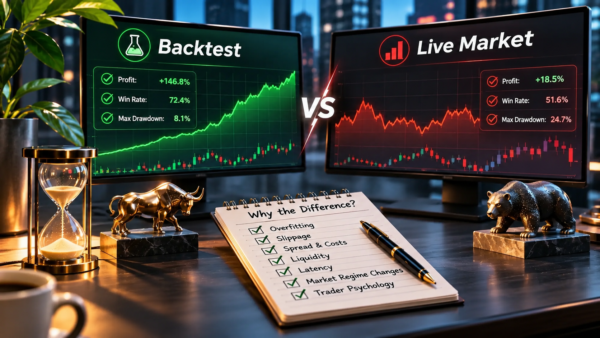
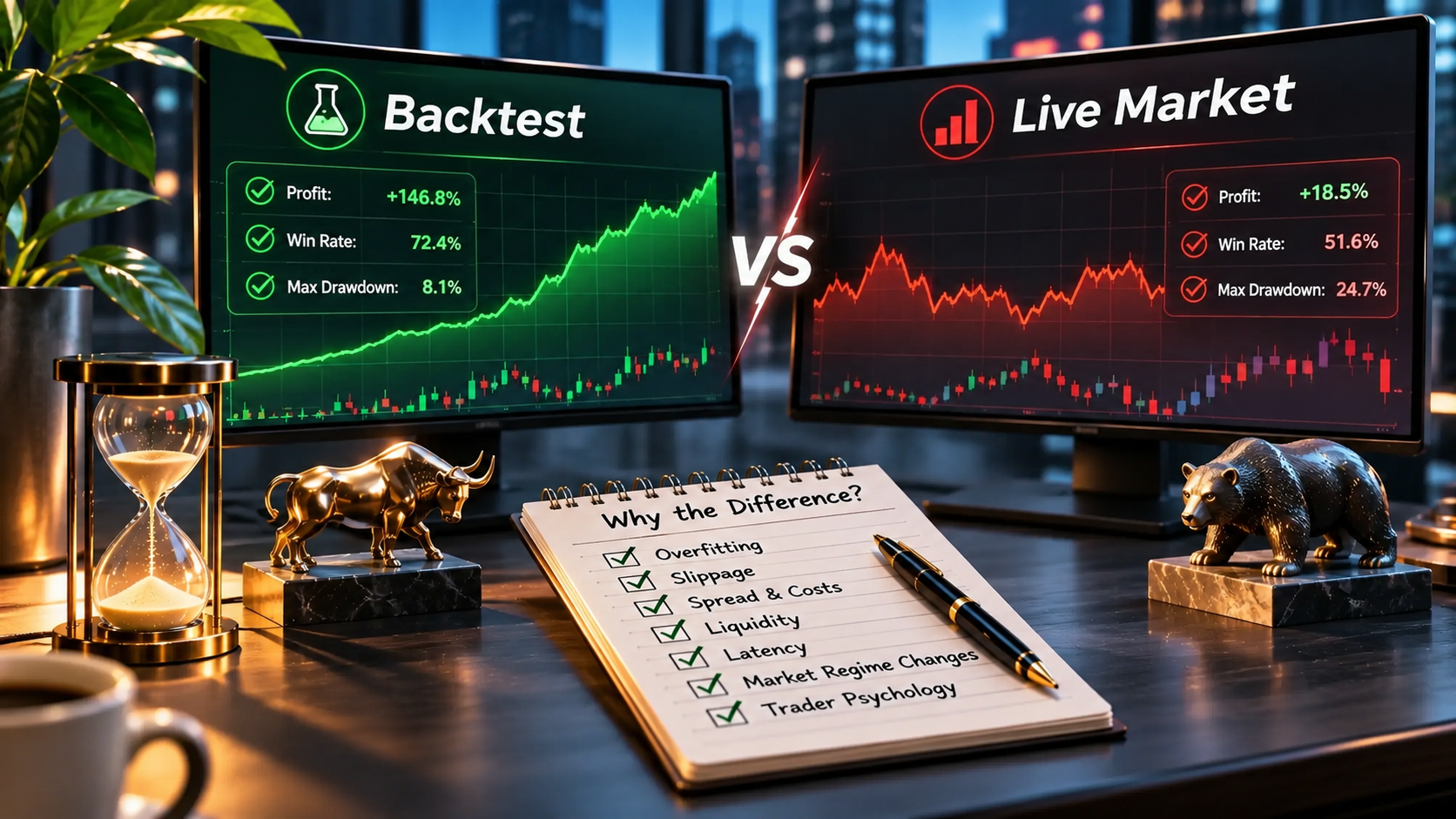
One of the most common issues in trading-system development is that backtest results look significantly better than actual live-market performance.
A strategy may appear extremely profitable on historical charts but fail to reproduce the same results after deployment.
One of the main reasons is that backtesting takes place in an idealized and controlled environment.
In many tests, prices are treated as precise, orders are assumed to execute without delay, and market conditions are simplified.
Live markets are very different.
Backtests often assume that trades are executed exactly at the price where the signal was generated. In reality, Slippage, execution latency, and rapid market movements can cause actual entry and exit prices to differ.
Another major difference is transaction costs.
Many basic backtests either ignore:
- Variable Spread
- Commission
- Slippage
- Liquidity-related execution costs
or use unrealistic fixed assumptions.
Historical data can also look cleaner than live-market information. In a backtest, completed price data is already available, while live markets continuously change as new orders enter the system.
Human emotion is another major difference.
Backtests contain no:
- Fear
- Greed
- Hesitation
- FOMO
- Emotional decision-making
Every rule is followed mechanically.
In live trading, however, psychological pressure can significantly change how a trader executes a strategy.
Another important problem is unintentional optimization.
A trader may repeatedly change strategy parameters until they find a configuration that performs exceptionally well on historical data.
The resulting strategy may simply be adapted to the past rather than genuinely robust.
Finally, markets evolve over time.
A system that worked exceptionally well during one historical period may become much less effective after volatility, liquidity, correlations, or trader behavior change.
Backtests therefore tend to present a cleaner and more idealized version of trading than the one encountered in real markets.
3. Historical Data vs. Live Market Conditions
One of the main reasons backtest vs live trading signals produce different results is the fundamental difference between historical data and live markets.
Historical data represents a completed record.
We already know:
- Where price moved
- Which levels broke
- Which trends developed
- What happened afterward
This makes patterns easier to recognize.
Live markets are completely different.
Nobody knows what the next candle will do.
Prices continuously change in response to:
- Real orders
- Economic news
- Market sentiment
- Liquidity
- Institutional activity
In historical analysis, data is already complete.
In real time, market information is still being formed.
This distinction can make a pattern that looks obvious on a historical chart extremely difficult to identify while it is developing.
For example, a historical breakout may appear perfectly clear after the fact.
During the actual event, however, traders may not know whether it represents:
- A genuine breakout
- Temporary volatility
- A False Breakout
Historical charts remove much of this uncertainty.
Live markets do not.
Historical data also fails to fully represent practical limitations such as:
- Real market depth
- Order-book changes
- Liquidity shortages
- Execution delays
Human behavior is another difference.
Historical analysis can be performed without pressure.
Live decisions involve real capital and real uncertainty.
This means historical data shows what happened, while live trading requires decisions about what is happening right now.
That fundamental difference explains much of the performance gap.
4. The Role of Overfitting in Unrealistic Results
Overfitting is one of the most important reasons a trading signal can look outstanding in backtesting but perform poorly in live markets.
Overfitting occurs when a strategy becomes too closely adapted to historical data.
Instead of identifying a repeatable market behavior, the strategy begins learning historical noise.
This usually happens when traders repeatedly modify:
- Indicator settings
- Entry rules
- Stop Loss levels
- Take Profit levels
- Filters
until historical performance looks nearly perfect.
The final equity curve may appear extremely impressive.
But that does not mean the strategy has discovered a genuine market edge.
It may simply have been optimized to fit past randomness.
For example, a trader may find a very specific combination of parameters that almost eliminates losing trades during one historical period.
The same combination may fail completely under new market conditions.
Overfitting becomes more likely as the number of parameters increases.
Complex systems have more opportunities to accidentally fit historical noise.
Another major issue is that markets change.
A pattern that appeared repeatedly in the past may disappear because of changes in:
- Liquidity
- Economic conditions
- Institutional behavior
- Algorithmic trading
One of the clearest warning signs of Overfitting is:
Excellent Backtest Performance + Poor Out-of-Sample or Live Performance
Overfitting also creates false confidence.
A trader may believe they have created an almost perfect system when the historical results simply reflect excessive optimization.
The objective of strategy development should therefore be to identify robust and general market behavior—not to create the most beautiful historical equity curve possible.
5. How Strategies Become “Beautiful” in Historical Data
Trading strategies often look much cleaner in historical testing than in live markets.
This apparent perfection can be created by the development process itself.
When a strategy is repeatedly adjusted using the same historical dataset, the system gradually becomes better adapted to those exact historical conditions.
This produces increasingly impressive backtest results.
But the strategy may become less capable of dealing with future conditions.
For example, a trader might repeatedly change the rules until the strategy avoids most historical losing trades.
The resulting backtest becomes extremely attractive.
But the system may simply have learned which historical trades failed.
Another problem is the unconscious removal of weak situations during strategy development.
Developers naturally want to improve performance.
But repeatedly changing rules after seeing historical outcomes can create a system that benefits from knowledge unavailable in real time.
This problem is closely related to Lookahead Bias.
Lookahead Bias occurs when information that would not have been available at the time of the trade is indirectly used in historical testing.
The result is an unrealistic advantage.
Historical charts also look more organized because:
- The full candle is visible
- Future price action is known
- Patterns are easier to recognize
Live markets contain much more uncertainty.
Psychological pressure is also absent in backtesting.
There is no fear of losing real money.
No hesitation.
No emotional reaction.
This creates another reason why historical execution looks cleaner.
A beautiful backtest should therefore never be confused with a robust trading system.
6. The Impact of Missing Slippage in Backtests
One major difference between historical testing and live trading is Slippage.
Slippage occurs when an order executes at a different price from the expected price.
Many backtests assume that trades execute exactly at the signal price.
For example:
Signal Entry: 1.2000
Backtest Entry: 1.2000
But in live trading, the real execution could be:
1.2003
or:
1.2005
depending on market conditions.
This difference may look small.
But across hundreds or thousands of trades, small execution differences can significantly affect profitability.
Slippage becomes especially important during:
- Economic news
- High volatility
- Low liquidity
- Fast market movements
Slippage can also affect:
- Entry
- Stop Loss execution
- Take Profit execution
- Manual exit
This means the effect is not limited to one side of the trade.
Strategies with very small profit targets are especially vulnerable.
A system targeting only a few pips per trade may appear profitable in a frictionless backtest but become unprofitable after real Slippage is introduced.
A professional backtest should therefore include realistic Slippage assumptions.
7. Real Liquidity vs. Assumed Liquidity
Liquidity is another major difference between backtests and real markets.
Backtests frequently assume that unlimited liquidity is available at every price.
In reality, every price level contains a limited amount of buying and selling interest.
If an order is larger than the available liquidity, execution may occur across multiple prices.
For example, a backtest may assume that a large BUY order is completely filled at:
1.5000
In the live market, the order may actually execute:
Part at 1.5000
Part at 1.5003
Part at 1.5005
The average entry price becomes worse.
This matters especially for:
- Large orders
- Thin markets
- Low-volume assets
- Periods of reduced liquidity
Liquidity is also dynamic.
It changes throughout the trading day.
It can disappear rapidly during news or market stress.
Simple historical tests rarely capture these changes accurately.
The assumption of unlimited liquidity can therefore make historical performance much better than real-world performance.
8. Fixed Spread and Unrealistic Backtest Results
Another common issue is the use of a Fixed Spread.
Many backtests simplify transaction costs by assuming the same Spread on every trade.
For example:
Spread = 1 pip
for every market condition.
Real markets do not behave this way.
Spread can change because of:
- Volatility
- News
- Liquidity
- Trading session
- Market stress
A pair that normally trades with a 1-pip Spread may temporarily widen to:
5 pips
or even more during major events.
This difference can materially change trade results.
Spread is particularly important for short-term strategies.
Imagine:
Profit target = 5 pips
Spread = 2 pips
A large portion of the potential profit is consumed before the trade even begins.
If a backtest uses an unrealistically small fixed Spread, the strategy may appear profitable when real execution would not be.
9. Why Backtest Order Execution Is More Accurate Than Reality
Historical tests usually assume ideal execution.
If a strategy generates a BUY at:
1.2500
the backtest may execute:
Exactly at 1.2500
without:
- Latency
- Requotes
- Partial fills
- Slippage
- Liquidity limitations
Live execution is different.
Orders travel through:
- Trading platform
- Network
- Broker server
- Liquidity infrastructure
During this process, price can change.
Real orders may also experience Partial Fills.
For example, part of an order may execute at one price and the rest at another.
Simple backtests typically ignore this.
The more sensitive a strategy is to precise entry prices, the greater the difference between historical and live performance.
This is particularly important for Scalping strategies.
10. How Latency Affects Live Signal Performance
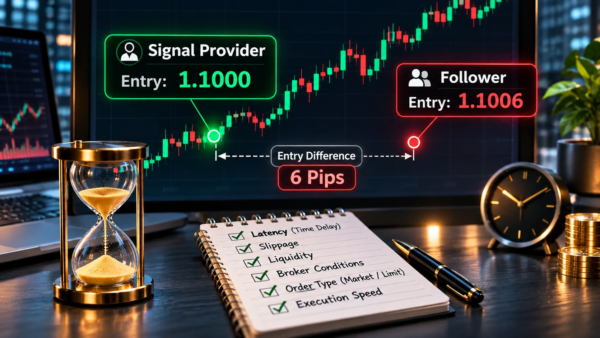
Latency refers to the delay between signal generation and actual order execution.
In backtesting, latency is usually nonexistent.
The strategy identifies a setup and enters immediately.
In real trading, delays can occur at several stages:
Signal generation → Signal transmission → User receipt → Decision → Order submission → Execution
Even a few seconds can matter in a fast market.
Suppose a signal is generated at:
1.3000
but the trader receives and executes it at:
1.3006
The original trade structure has already changed.
Risk may increase.
Potential reward may decrease.
Latency can result from:
- Internet speed
- Broker server speed
- Geographic distance
- Messaging delay
- Human reaction time
Some short-term signals may remain valid for only seconds or minutes.
In these cases, even small latency can destroy the original advantage.
FastPip discusses this execution problem in more detail in:
FastPip – Signal Entry Price Difference
11. Psychology Exists in Live Trading, Not in Backtesting
One of the biggest differences between backtesting and real trading is human emotion.
In a backtest:
- No money feels real
- No fear exists
- No greed exists
- No hesitation exists
The rules are followed exactly.
Live trading is different.
When price moves against the trader, fear may cause an early exit.
When a position becomes profitable, greed may cause the trader to ignore the planned target.
A trader may:
- Move the Stop Loss
- Exit early
- Skip signals
- Increase position size
- Revenge trade
None of these behaviors appear in a mechanical backtest.
A strategy that theoretically produces:
70% winning trades
may produce very different user results if traders repeatedly interfere with execution.
Psychology therefore creates a major gap between theoretical system performance and real trading performance.
12. Trader Behavior in Backtesting vs. Live Markets
Backtesting creates an environment with almost no emotional consequences.
The trader already knows that the historical data is complete.
Mistakes do not cost real money.
Losses are simply numbers.
Live trading creates uncertainty.
The trader does not know what happens next.
Every trade has real financial consequences.
This uncertainty can change behavior significantly.
For example, a trader may allow a historical test to reach the planned Stop Loss without interference.
In live trading, they may close the same trade early because they become uncomfortable with the floating loss.
Discipline also differs.
Backtests typically assume:
100% rule compliance
Live trading rarely achieves this perfectly.
Even experienced traders can sometimes deviate from their rules.
Profit and loss also create emotional responses.
A losing number in a backtest is just data.
A live loss can create:
- Fear
- Anger
- Revenge trading
- Doubt
These behavioral differences can materially change the real performance of a strategy.
13. Why Some Strategies Only Worked in Specific Historical Markets
Some strategies look outstanding in backtests because they were tested during a very favorable market environment.
Markets move through different conditions:
- Trending
- Range-bound
- High volatility
- Low volatility
A strategy may perform exceptionally well in only one of these environments.
For example, a Trend-Following strategy tested mostly during a strong bull market may produce excellent historical performance.
But when the market becomes:
- Sideways
- Choppy
- Bearish
the same strategy may perform poorly.
This means the system did not necessarily discover a universal market edge.
It may simply have matched one historical environment.
This problem becomes more serious when testing data lacks diversity.
A robust strategy should be evaluated across:
- Multiple years
- Different volatility regimes
- Bull markets
- Bear markets
- Range markets
The broader the testing environment, the more meaningful the results become.
14. Market Regime Changes
A Market Regime describes the broader behavior of the market.
Examples include:
- Trending markets
- Range-bound markets
- High-volatility markets
- Low-volatility markets
Markets constantly move between these regimes.
A strategy tested primarily during one regime may fail when conditions change.
For example:
Trend-Following strategy → performs well during trends
The same strategy → produces repeated losses in a range
The backtest may look excellent if most historical data came from trending conditions.
The live environment may be completely different.
Economic conditions can also create regime changes.
Examples include:
- Monetary-policy shifts
- Inflation shocks
- Liquidity changes
- Financial crises
Strategies that do not account for regime changes may gradually lose their edge.
FastPip discusses this issue further in:
FastPip – Signal Strategy Lifespan
15. Limitations of Historical Data
No historical dataset can perfectly recreate the future.
A backtest may use:
- Several months
- Several years
- Even decades
of data.
But those observations still represent only a limited set of market conditions.
One period may contain:
- Strong trends
Another:
- Low volatility
Another:
- Extreme crisis conditions
If a dataset is dominated by one type of market behavior, the results may not generalize well.
Historical data can also lack information such as:
- Real order-book depth
- Large institutional orders
- Temporary liquidity gaps
- Intraday execution conditions
Data quality also differs between providers.
Poor-quality historical data can produce misleading backtests.
Unexpected events are another limitation.
A limited dataset may not include:
- Major crises
- Sudden policy shifts
- Extreme market gaps
Historical data is valuable.
But it is always incomplete.
16. Hidden Trading Costs in Live Performance
Many backtests focus mainly on:
- Spread
- Commission
But real trading includes additional hidden costs.
One of the biggest is Slippage.
Small Slippage on each trade can accumulate into a significant performance drag.
Commissions may also vary depending on:
- Trading volume
- Account type
- Broker
- Market conditions
Liquidity itself creates indirect costs.
Poor liquidity can produce worse entry and exit prices.
Other hidden frictions include:
- Partial fills
- Price gaps
- Variable Spread
- Execution delays
These costs become especially important for high-frequency strategies.
A strategy with a very small edge may appear profitable in backtesting but lose money after realistic friction is included.
17. How Backtesting Can Become Misleading
Backtesting is a useful tool.
But it can become dangerous when its limitations are ignored.
The most common problem is unrealistic assumptions.
Examples include:
- No Slippage
- No latency
- Perfect execution
- Fixed Spread
- Unlimited liquidity
Another issue is selective testing.
A developer may unintentionally choose historical periods where the strategy performs best.
Human behavior is also excluded.
Fear, greed, hesitation, and poor discipline are not reflected in most strategy tests.
Future market conditions are another limitation.
A backtest only explains how the strategy behaved in the past.
It cannot guarantee that similar conditions will continue.
Overfitting can further exaggerate historical results.
The more aggressively a strategy is optimized, the greater the risk that it reflects past noise rather than a genuine edge.
Backtesting should therefore be viewed as:
A model of reality
not:
Reality itself.
18. Forward Testing for More Realistic Validation
One of the best ways to reduce the gap between historical and live performance is Forward Testing.
Forward Testing evaluates a strategy using new market data in real time.
Unlike backtesting:
- Prices are live
- Spread changes
- Slippage exists
- Latency exists
- Liquidity changes
This helps determine whether a strategy can actually be executed under realistic conditions.
For example, a strategy may look excellent historically.
During Forward Testing, traders may discover that:
- Entry prices are consistently worse
- Signals arrive too late
- Spread consumes too much profit
- Slippage destroys short-term trades
Forward Testing can be performed using:
- Demo accounts
- Small real-money accounts
The objective at this stage is not maximum profit.
It is validation.
Forward Testing also introduces psychological factors, particularly when small amounts of real capital are involved.
It helps identify whether both the strategy and trader can function under live-market conditions.
The strongest validation framework usually combines:
Backtesting + Out-of-Sample Testing + Forward Testing + Live Monitoring
19. How to Build Signals That Can Survive Real Markets
A robust trading signal should not only look good in historical testing.
It should also be designed around real-market limitations.
The first principle is simplicity.
Extremely complex systems with many parameters are more vulnerable to Overfitting.
Simple and logically grounded systems are often easier to validate.
Another important principle is to include realistic trading conditions from the beginning.
These include:
- Variable Spread
- Slippage
- Latency
- Liquidity
- Commission
A live-capable signal also needs clear rules.
Entry and exit conditions should be understandable and executable in real time.
The strategy should also be tested under different market regimes:
- Trending
- Range-bound
- High volatility
- Low volatility
- Crisis conditions
Developers should avoid excessive dependence on one historical period.
Out-of-Sample testing helps evaluate whether the strategy can generalize.
Forward Testing should also be completed before deploying significant capital.
The goal is not to find the strategy with the most impressive backtest.
The goal is to find a strategy that remains reasonably effective when exposed to:
real execution + real uncertainty + real market change.
20. Conclusion: Why Past Performance Does Not Guarantee Future Results
The most important lesson in the backtest vs live trading signals comparison is that markets are not static systems.
A strategy that worked in the past is not guaranteed to produce the same results in the future.
Backtesting provides information about:
What happened before.
Live trading requires decisions about:
What will happen next.
Those are fundamentally different environments.
Several factors create the gap between historical and live performance:
- Overfitting
- Slippage
- Variable Spread
- Liquidity
- Latency
- Psychological pressure
- Market Regime Changes
- Hidden trading costs
No backtest can perfectly recreate every element of real-market execution.
Even sophisticated simulations have limitations.
The true value of backtesting is therefore not in guaranteeing future profitability.
Its value is in:
- Rejecting weak strategies
- Understanding historical behavior
- Measuring potential risk
- Creating hypotheses for further testing
The strongest strategy-development process combines:
Backtesting → Out-of-Sample Testing → Forward Testing → Live Validation
Past performance should be viewed as evidence.
Not a guarantee.
Markets remain dynamic, uncertain, and constantly evolving.
That is why a strategy that looks perfect in historical data must still prove itself in the real world.
Frequently Asked Questions
What is a trading signal backtest?
A backtest evaluates how a trading signal or strategy would have performed using historical market data.
Why do backtests often perform better than live trading?
Backtests may assume ideal execution and underestimate Slippage, Spread, liquidity limitations, latency, and psychological effects.
What is Overfitting?
Overfitting occurs when a strategy is optimized too closely to historical data and begins fitting noise instead of a repeatable market pattern.
What is Lookahead Bias?
Lookahead Bias occurs when a historical test uses information that would not actually have been available at the time of the trade.
Does Slippage affect backtest accuracy?
Yes. Ignoring Slippage can make a strategy appear more profitable than it would be in live trading.
Why does liquidity matter?
Limited liquidity can produce worse fills, Partial Fills, and different average execution prices.
Can Fixed Spread make a backtest unrealistic?
Yes. Real Spread changes with market conditions, volatility, news, and liquidity.
Why is live execution different from historical execution?
Live orders face latency, changing prices, broker infrastructure, Slippage, and liquidity limitations.
What is Forward Testing?
Forward Testing evaluates a strategy using new, real-time market data rather than historical data.
Is a good backtest enough to trade a strategy?
No. A strong backtest should ideally be followed by Out-of-Sample Testing and Forward Testing.
Why do some strategies fail after market conditions change?
Strategies are often designed around particular Market Regimes. When the environment changes, their assumptions may no longer hold.
What is a Market Regime?
A Market Regime is a broad market condition such as trending, ranging, high volatility, or low volatility.
Do emotions affect live strategy performance?
Yes. Fear, greed, FOMO, and hesitation can cause traders to deviate from strategy rules.
What trading costs should a realistic backtest include?
At minimum, Spread, Commission, Slippage, and realistic execution assumptions should be considered.
Why are Scalping strategies more sensitive to backtest errors?
Small profit targets mean that even minor Spread, Slippage, and latency can consume a large percentage of expected profit.
What is Out-of-Sample Testing?
It means testing the strategy on historical data that was not used during strategy development or optimization.
Can an excellent backtest be a warning sign?
Sometimes. Extremely perfect results may indicate Overfitting, Lookahead Bias, unrealistic execution assumptions, or selective data.
Should a strategy be tested in different market conditions?
Yes. Robust strategies should ideally be tested in trending, ranging, volatile, and calm markets.
What is the best way to validate a trading strategy?
Use a combination of Backtesting, Out-of-Sample Testing, Forward Testing, realistic execution assumptions, and ongoing live monitoring.
Does past performance guarantee future results?
No. Historical performance is useful evidence, but markets change and past profitability cannot guarantee future outcomes.