How Slippage Turns Winning Signals Into Losing Trades
How Slippage Turns Winning Signals Into Losing Trades
Slippage in trading signals can turn a theoretically profitable setup into a weaker trade—or even a losing one—without changing the original market analysis.
A provider may issue a BUY signal at:
1.1000
with:
Stop Loss: 1.0990
Take Profit: 1.1020
On paper, the trade risks 10 pips to make 20 pips.
Risk/Reward:
1:2
But what happens if the follower’s order is actually executed at:
1.1005?
Potential profit falls to 15 pips while risk increases to 15 pips.
The original 1:2 setup has effectively become:
1:1
The signal itself did not change.
The market direction did not change.
Execution changed.
That is why Slippage is one of the most important hidden variables separating theoretical signal performance from real trading results.
1. What Is Slippage?
Slippage is the difference between the expected execution price of a trade and the actual price at which the order is filled.
For example:
Expected BUY price:
1.1000
Actual execution:
1.1003
Negative Slippage:
3 pips
If the order instead executes at:
1.0998
the trader receives a better price.
That is known as positive Slippage.
Slippage can occur in:
- Forex
- Stocks
- Commodities
- Indices
- Cryptocurrencies
and virtually any market where prices change continuously.
It can also affect:
- Entries
- Exits
- Stop Losses
- Profit-taking orders
Slippage is therefore not simply an entry problem.
It is an execution problem.
2. Expected Price vs. Actual Execution Price
Understanding slippage in trading signals requires separating two prices.
Expected Price
The price displayed in the signal or intended by the trader.
Execution Price
The price at which the transaction actually occurs.
Ideally, both are identical.
In real markets, they may not be.
Suppose a signal says:
BUY EURUSD at 1.2500
But between order submission and execution, price moves to:
1.2504
The trader enters four pips higher.
This matters because the original:
- Stop Loss
- Take Profit
- Position size
- Risk/Reward
were usually calculated from the original entry.
Even a seemingly small difference can therefore alter the entire trade structure.
3. Why Slippage Is Unavoidable
Many inexperienced traders treat Slippage as a technical malfunction.
It usually is not.
Markets operate by matching buyers and sellers.
When a trader sends an order, sufficient opposite-side liquidity must exist at the desired price.
If it does not, the order may execute at the next available price.
Prices also change continuously.
Between:
Price Display → Order Submission → Routing → Execution
the market may move.
Investor.gov explains that trade execution takes time and that investors may receive a different price from the one visible when they submitted the order, especially in fast-moving markets.
This is one reason eliminating Slippage completely is unrealistic.
The objective should be:
Manage Slippage—not pretend it does not exist.
4. Liquidity and Slippage Are Directly Connected
Liquidity is one of the strongest drivers of Slippage.
A highly liquid market contains substantial buying and selling interest around the current price.
This allows orders to execute with relatively small price impact.
A thin market behaves differently.
Suppose you want to buy:
10 units
but only:
3 units
are available at the current price.
The remaining seven units must be filled at higher prices.
Your average execution price changes.
That is Slippage.
High Liquidity Usually Means Better Execution
Deep markets generally provide:
- More available orders
- Narrower price gaps
- Lower market impact
- Better execution quality
Low liquidity can produce:
- Larger gaps
- Wider Spread
- Partial fills
- Greater Slippage
This is why execution quality can change dramatically between trading sessions.
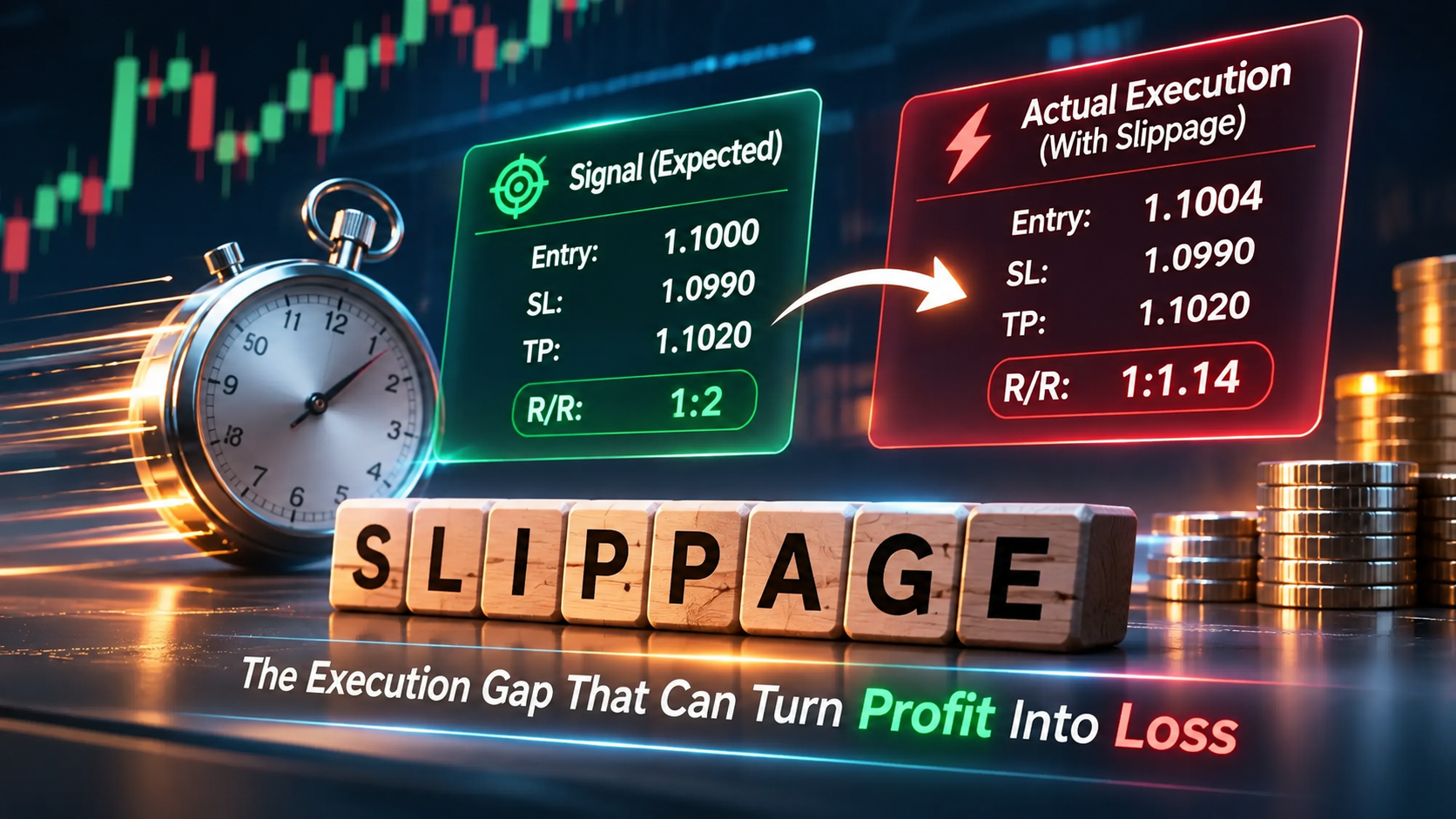
5. How Slippage Changes a Signal Entry
The entry price is the foundation of a trading signal.
Suppose:
Entry: 1.1000
Stop Loss: 1.0990
Take Profit: 1.1020
Risk:
10 pips
Potential reward:
20 pips
Risk/Reward:
1:2
Now suppose negative Slippage causes execution at:
1.1004
Potential reward:
16 pips
Risk to the original Stop:
14 pips
Risk/Reward is now approximately:
1:1.14
The market analysis may still be correct.
But the economics of the trade have deteriorated significantly.
6. How Slippage Changes Risk/Reward
Risk/Reward depends on three variables:
Entry + Stop Loss + Take Profit
Change the entry and the ratio changes.
Consider:
Entry: 1.2000
SL: 1.1990
TP: 1.2020
Risk:
10 pips
Reward:
20 pips
Risk/Reward:
1:2
Now actual execution occurs at:
1.2005
Risk:
15 pips
Reward:
15 pips
Risk/Reward:
1:1
The original statistical advantage has been cut dramatically.
This becomes particularly dangerous when a strategy depends on a precise Risk/Reward structure to remain profitable over hundreds of trades.
7. Slippage Can Increase Stop Losses
A Stop Loss is often misunderstood as a guaranteed exit price.
It may not be.
Investor.gov explains that when a conventional stop order is triggered, it becomes a Market Order, and the eventual execution price may differ significantly from the stop price depending on available liquidity.
Suppose:
BUY entry:
1.3000
Stop Loss:
1.2990
Expected loss:
10 pips
But the market falls sharply and the exit executes at:
1.2986
Actual loss:
14 pips
The trader expected one level of risk.
The execution created another.
8. Slippage Can Affect Profitable Exits Too
Slippage is not limited to losing trades.
Execution conditions can also alter profitable exits.
A trader may expect to exit near a particular target, but rapid market movement or insufficient liquidity can produce a different fill.
For high-frequency strategies, even small differences can accumulate.
This is why professional evaluation should compare:
Theoretical Exit
against:
Actual Fill
rather than simply checking whether price touched the target on a chart.
9. Why Short-Term Strategies Suffer More
Short-term strategies are especially vulnerable to slippage in trading signals because their expected profits are relatively small.
Consider a Scalping signal targeting:
8 pips
Entry Slippage:
2 pips
Exit Slippage:
1 pip
Total execution loss:
3 pips
The strategy has lost:
37.5% of its original target
before considering Spread or Commission.
For a swing trade targeting 300 pips, three pips may be relatively insignificant.
For an eight-pip scalp, they can determine whether the strategy remains profitable.
Frequency Makes the Problem Worse
Scalpers may execute hundreds of trades.
Even if average Slippage is small, its cumulative impact becomes substantial.
This is why short-term strategies should be evaluated using:
Net performance after execution costs
rather than ideal chart performance.
FastPip explains the different requirements of Scalping, Day Trading and longer-term approaches in its Trading Types guide.
10. Slippage During Economic News
Major economic announcements are among the most dangerous periods for Slippage.
Examples include:
- CPI
- NFP
- Interest-rate decisions
- GDP releases
- Central-bank announcements
When major information enters the market, thousands of participants may attempt to trade simultaneously.
Price can move rapidly.
At the same time, available liquidity may temporarily decrease.
The result can be:
Higher volatility + lower liquidity + wider Spread + greater Slippage
News Can Turn a Good Signal Into a Bad Fill
Suppose a BUY signal is expected around:
1.1000
A major release occurs.
Price jumps to:
1.1010
before the order executes.
The trader begins the position:
10 pips worse than expected.
Even if the original analysis was correct, much of the expected opportunity may already be gone.
This is one reason a signal’s analytical quality and its execution quality must be evaluated separately.
11. Positive vs. Negative Slippage
Slippage can occur in both directions.
Positive Slippage
A BUY order expected at:
1.2500
fills at:
1.2498
The trader receives a better entry.
Negative Slippage
The same order fills at:
1.2503
The trader receives a worse entry.
Professional execution analysis should therefore avoid looking only at individual bad fills.
The more useful metric is:
Average Slippage Across Many Trades
This provides a better view of execution quality.
12. Order Size and Slippage
Larger orders require more liquidity.
Suppose only 20 lots are available at:
1.3000
and a trader submits a BUY order for:
50 lots.
The first 20 lots may execute at 1.3000.
The remaining volume must execute at higher price levels.
Investor.gov also notes that parts of a large Market Order can execute at different prices when insufficient liquidity exists at one price level.
This produces a worse average execution price.
For most small retail orders in major liquid markets, this effect may be limited.
For:
- Institutional traders
- Large accounts
- Thin assets
- Low-liquidity periods
it can become significant.
13. How Slippage Makes Backtests Unrealistic
A strategy may look outstanding in historical testing.
Then it performs much worse live.
One reason is that many simple Backtests assume:
Perfect execution.
For example:
Backtest entry:
1.2000
Backtest exit:
1.2020
Profit:
20 pips
But real execution might be:
Entry:
1.2003
Exit:
1.2018
Real profit:
15 pips
A quarter of the theoretical return has disappeared.
Slippage Should Be Included in Strategy Testing
A realistic Backtest should attempt to model:
- Spread
- Commission
- Slippage
- Execution delay
especially for short-term strategies.
FastPip covers this performance gap in:
Backtest vs Live Trading Signals
The key lesson is simple:
A strategy should not only survive historical testing.
It must survive realistic execution assumptions.
14. Slippage and Scalping Signals
Scalping signals are among the most execution-sensitive strategies.
A scalp may aim for:
5–10 pips
A few pips of Slippage can therefore consume a large percentage of expected profit.
Suppose:
Target:
8 pips
Entry Slippage:
2 pips
Exit Slippage:
1 pip
Remaining theoretical profit:
5 pips
Now add:
- Spread
- Commission
The original profitable trade may approach breakeven.
In some cases, it becomes negative.
Scalping Requires an Execution Edge Too
A good analytical setup is not enough.
Scalping requires:
Signal Edge + Execution Edge
This includes:
- Low latency
- Deep liquidity
- Competitive Spread
- Reliable infrastructure
Without these, the mathematical edge shown in a Backtest may disappear.
15. Does the Broker or Exchange Affect Slippage?
Yes.
The market environment creates Slippage, but trading infrastructure can influence how much the trader experiences.
Execution can vary according to:
- Available liquidity
- Routing
- Server performance
- Infrastructure
- Execution model
Investor.gov notes that where and how an order is executed can affect transaction cost and execution price.
Different trading venues can therefore produce different real outcomes from the same analytical signal.
Crypto Exchanges Are a Clear Example
Different cryptocurrency exchanges maintain different:
- Order books
- Trading volumes
- Liquidity
The same large Market Order can therefore produce minimal Slippage on one venue and much greater Slippage on another.
Execution quality should be evaluated separately from signal quality.
16. How to Measure Slippage
Slippage should be measured rather than guessed.
A simple calculation is:
Slippage = Actual Execution Price − Expected Price
For example:
Expected BUY:
1.2500
Actual BUY:
1.2503
Difference:
3 pips
But professionals should go further.
Track Slippage separately for:
- Entry
- Exit
- Stop Loss
- Profit exit
Then calculate average values over many trades.
Measure Slippage Relative to the Target
This can reveal how damaging execution is.
Example:
Target:
20 pips
Total Entry + Exit Slippage:
4 pips
Slippage consumed:
20% of the theoretical target
That is economically meaningful.
Tracking these numbers can reveal whether the problem lies in:
- Strategy
- Broker
- Trading hours
- Market selection
- Execution method
17. How to Reduce Slippage
Slippage cannot be eliminated completely.
But it can often be reduced.
Trade in More Liquid Markets
Greater liquidity generally improves execution.
Trade During Active Sessions
Execution is often better when market participation is high.
Avoid Unnecessary News Exposure
Major announcements can produce extreme price movement and liquidity changes.
Consider Limit Orders
Investor.gov explains that a Limit Order controls the maximum purchase price or minimum sale price, although execution itself is not guaranteed.
Use Appropriate Position Size
Large orders consume more available liquidity.
Monitor Execution Quality
Measure actual fills instead of assuming they match chart prices.
Use Reliable Trading Infrastructure
Lower unnecessary latency where possible.
18. Managing Slippage Through Risk Management
Because Slippage cannot be eliminated, it should be incorporated into risk calculations.
Suppose your planned maximum loss is:
1% of equity.
If Stop Loss Slippage is possible, the real loss can exceed that value.
Risk calculations should therefore acknowledge execution uncertainty.
Reduce Exposure During High-Risk Conditions
Potential approaches include:
- Smaller position sizes around major events
- Avoiding thin markets
- Avoiding extremely tight stops when execution risk is elevated
A trader should also maintain a realistic Slippage allowance when assessing Risk/Reward.
A system that only works when every order receives a perfect fill may not have a robust trading edge.
19. Can Slippage Be Completely Eliminated?
No.
Markets are dynamic.
Prices change.
Liquidity changes.
Orders compete for available execution.
Even the fastest infrastructure cannot guarantee that every Market Order will receive the price displayed a moment earlier.
Investor.gov explicitly distinguishes Market Orders from Limit Orders: Market Orders emphasize execution but do not guarantee execution price, while Limit Orders control price but may not execute at all.
That trade-off is fundamental.
The goal should therefore be:
Reduce + Measure + Manage
—not:
Eliminate.
20. Conclusion: Why Slippage Is a Hidden Enemy of Profitability
Slippage in trading signals may appear to be a small execution difference, but its cumulative impact can materially change strategy performance.
It can affect:
- Entry price
- Exit price
- Stop Loss
- Take Profit
- Risk/Reward
- Actual account risk
A profitable signal on paper can become a weak trade when execution is poor.
A marginally profitable strategy can become unprofitable when repeated Slippage consumes its statistical edge.
This is especially important for:
- Scalping
- Short-term signals
- News trading
- High-frequency strategies
- Large orders
The correct objective is therefore not perfect execution.
It is realistic execution.
Professional traders should measure the difference between expected and actual fills, incorporate execution costs into Backtests, manage position size during high-risk conditions, and evaluate signal performance using actual rather than idealized prices.
The final principle is simple:
A signal is only as profitable as the price at which it can actually be executed.
Frequently Asked Questions
What is slippage in trading signals?
Slippage in trading signals is the difference between the intended signal price and the actual price at which the trader’s order is executed.
Can Slippage turn a profitable signal into a losing trade?
Yes. Negative Slippage can reduce potential reward, increase risk, worsen Risk/Reward and turn a marginally profitable trade into a losing one.
Why does Slippage happen?
It usually occurs because prices move before execution or because insufficient liquidity is available at the expected price.
Is Slippage always negative?
No. Positive Slippage can result in a better execution price, while negative Slippage produces a worse one.
Why is Slippage higher during news?
Major news can increase price speed while simultaneously reducing available liquidity, creating larger execution differences.
Does Slippage affect Stop Loss orders?
Yes. A stop price may trigger an order, but the eventual execution can occur at a worse price during fast-moving or illiquid conditions.
Which strategies are most affected by Slippage?
Scalping and other short-term strategies are particularly sensitive because their profit targets are small.
Does order size affect Slippage?
Yes. Larger orders require more liquidity and may execute across several price levels.
Can a broker affect Slippage?
Execution infrastructure, routing and available liquidity can influence the Slippage a trader experiences.
Should Slippage be included in Backtests?
Yes. Ignoring realistic execution assumptions can make Backtest results overly optimistic.
How do I calculate Slippage?
Compare the expected execution price with the actual fill price and convert the difference into pips, points or monetary value.
Can Limit Orders eliminate Slippage?
They can prevent execution beyond a specified limit price, but they introduce another risk: the order may not execute.
Can Slippage be eliminated completely?
No. It is a natural consequence of changing prices, finite liquidity and real-world order execution.
How can traders reduce Slippage?
Trading liquid markets, using suitable order types, avoiding extreme volatility when unnecessary, controlling order size and improving execution infrastructure can help.
What is the most important lesson about Slippage?
Evaluate trading systems based on actual executable results, not ideal prices shown on historical charts.