Asia Stocks Rise Following Wall Street Rally as High Treasury Yields Cap Gains
Asia stocks rise on Tuesday as investors followed a technology-led rally on Wall Street that pushed the Nasdaq Composite to a fresh record high. However, sharply elevated government bond yields and oil prices near $100 per barrel kept broader risk appetite in check.
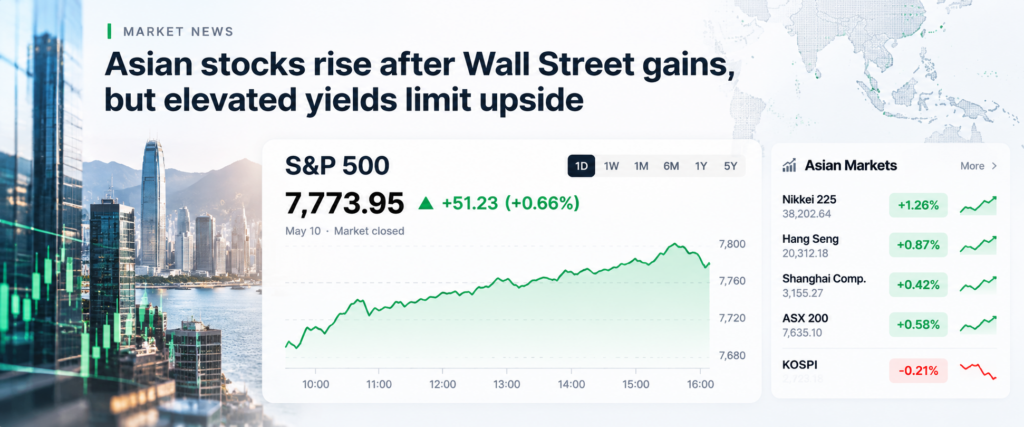
The positive tone followed a strong U.S. session on Monday. The Nasdaq Composite advanced 1.1% to a record close, while the S&P 500 gained around 0.7% and the Dow Jones Industrial Average added approximately 0.2%.
Technology stocks were among the key drivers of the U.S. rally, allowing equity markets to withstand another increase in Treasury yields.
Still, the divergence between rising equity prices and rapidly increasing bond yields remains one of the most important themes facing global financial markets.
Asian Stock Markets Trade Higher but Momentum Remains Uneven
Performance across major Asian equity markets was mixed despite the positive lead from Wall Street.
Japan’s Nikkei 225 and broader TOPIX moved higher, while Hong Kong’s Hang Seng Index also advanced alongside gains in technology shares.
South Korea was a notable exception. The KOSPI fell around 1% after initially opening higher, with major semiconductor stocks including Samsung Electronics and SK Hynix coming under selling pressure.
Mainland China’s financial markets remained closed for the National Day and Golden Week holiday, with trading scheduled to resume on Thursday, October 8
The mixed performance shows that while Wall Street’s technology rally is providing support for global equities, investors remain reluctant to aggressively increase risk exposure.
Treasury Yields Become a Major Risk for Equity Markets
The biggest macroeconomic challenge facing stocks is the continued rise in global government bond yields.
The U.S. 10-year Treasury yield climbed to approximately 5.35%, reaching levels not seen since 2002. Longer-dated Treasury yields have also moved sharply higher amid concerns surrounding inflation, government debt and future monetary policy.
Japanese bond yields also moved higher, adding pressure to financial conditions across Asia.
Higher bond yields matter for stock markets because they increase the risk-free return available to investors while simultaneously raising financing costs for companies.
This dynamic can be particularly important for technology and other growth stocks, whose valuations are more sensitive to changes in long-term interest rates.
For investors, the key question is whether corporate earnings and economic growth can remain strong enough to justify elevated equity valuations while bond yields remain above 5%.
Nasdaq Record Highlights Resilience in Technology Stocks
Despite the bond-market selloff, technology shares have demonstrated considerable resilience.
The Nasdaq’s record close suggests investors continue to favor companies with strong growth prospects, particularly those exposed to artificial intelligence and other structural technology themes.
The market reaction is notable because rising Treasury yields would normally represent a significant headwind for high-duration growth assets.
For now, optimism surrounding technology earnings appears to be offsetting some of the pressure from higher discount rates.
However, if Treasury yields continue rising, valuation pressure could eventually become more difficult for technology stocks to ignore.
RBI Interest Rate Decision in Focus
Attention in Asia is also turning toward the Reserve Bank of India, which will announce its latest monetary policy decision on Wednesday, October 7.
Economists broadly expect the RBI to raise its benchmark repo rate by 25 basis points to 5.50%, although a more aggressive move cannot be completely ruled out.
Higher crude oil prices and renewed inflation pressures have strengthened the case for tighter monetary policy in India
The RBI’s guidance could prove just as important as the rate decision itself.
Investors will be watching for indications of whether a potential October increase represents a precautionary adjustment or the beginning of a broader monetary tightening cycle.
A more hawkish signal could affect Indian equities, government bonds and the rupee.
Fed Minutes Could Shape Expectations for U.S. Interest Rates
Global investors are also preparing for the release of the Federal Reserve’s September meeting minutes on Wednesday.
The document could provide additional insight into how policymakers view inflation risks and the future path of U.S. interest rates.
The Fed outlook has become increasingly important as markets attempt to reconcile relatively resilient equity prices with historically high Treasury yields.
Recent softer U.S. employment data has reduced expectations for an immediate Fed rate increase, but persistent inflation concerns mean investors remain sensitive to any hawkish signals from policymakers. Reuters
If the minutes reveal greater concern about inflation, Treasury yields and the U.S. dollar could receive further support.
Conversely, evidence that policymakers are becoming more cautious about additional tightening could provide relief to equities and other risk assets.
Brent Crude Near $100 Keeps Inflation Risks Elevated
Oil remains another major variable for global markets.
Brent crude continued trading around $100 per barrel after declining on Monday as higher Middle East exports and expectations for additional supply eased some immediate concerns. Reuters
Nevertheless, geopolitical risks surrounding the Middle East continue to create the possibility of renewed supply disruptions.
Sustained oil prices around or above $100 could complicate the inflation outlook for major economies.
Higher energy costs can increase transportation and production expenses, squeeze household disposable income and make it more difficult for central banks to ease monetary policy.
For oil-importing Asian economies, the impact can be particularly significant.
Market Outlook: What Traders Should Watch
The short-term outlook for Asian equities remains caught between two competing forces.
On one side, record levels in the Nasdaq and continued strength in technology shares are supporting global risk sentiment. On the other, Treasury yields around multi-decade highs, elevated crude oil prices and tighter monetary policy expectations are creating increasingly restrictive financial conditions.
For traders, several catalysts deserve particular attention over the coming sessions:
- U.S. Treasury yields: A sustained move above recent highs could increase pressure on global equities.
- Federal Reserve minutes: Hawkish language could strengthen the dollar and push yields higher.
- RBI decision: A 25-basis-point increase is widely expected, making forward guidance particularly important.
- Brent crude: Another move significantly above $100 could revive inflation concerns.
- Technology stocks: Continued Nasdaq strength could support Asian semiconductor and technology shares.
- China reopening: Mainland markets returning after the Golden Week holiday could generate additional volatility across Asian equities.
FastPip Market View
Looking for actionable market opportunities? Explore FastPip Trading Signals for timely trade ideas across major financial markets.
The current environment presents an unusual combination: equity markets remain resilient even as bond yields rise to levels not seen in more than two decades.
For now, strong technology sentiment and expectations for continued corporate earnings growth are helping equities absorb higher borrowing costs.
However, the margin for disappointment is narrowing.
If Treasury yields extend their rise while oil remains near $100, global equity markets may face greater valuation pressure. Conversely, stabilization in yields combined with supportive central-bank communication could allow the Wall Street rally to extend further into Asian markets.
The next major directional signal may therefore come not from equity markets themselves, but from bond yields, central-bank communication and energy prices.
 Check Our
  Whether you’re a day trader or a long-term investor, FastPip gives you the tools to trade smarter, not harder.