European and British wholesale natural gas prices rebounded on Thursday as fading hopes for a rapid diplomatic resolution to the U.S.-Iran conflict renewed risk premiums across energy markets.
The benchmark Dutch front-month TTF contract rose 1.6% to €74.50 per megawatt-hour (MWh), recovering from a recent low that had marked its weakest level in nearly three weeks.
In the UK, the equivalent NBP wholesale gas contract also advanced 1.6% to 185.85 pence per therm, as traders continued to price in risks surrounding liquefied natural gas (LNG) transit routes.
Middle East Tensions Renew LNG Supply Concerns
Market optimism had initially improved on expectations that prospective U.S.-Iran talks could lead to a diplomatic breakthrough and help restore normal shipping conditions through the Strait of Hormuz.
However, those expectations weakened after U.S. President Donald Trump used his United Nations speech to criticize Iran and warned of severe consequences if hostilities escalated.
Iranian officials rejected the threats. Iran’s military leadership and President Masoud Pezeshkian also maintained a firm position, while the Revolutionary Guard warned of potential counter-strikes.
The widening diplomatic impasse has reduced expectations for a quick agreement that could reopen the Strait of Hormuz.
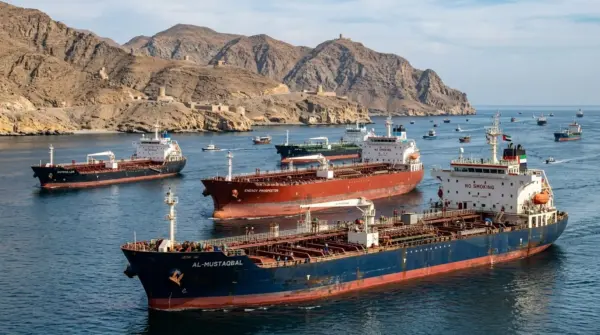
For European energy markets, the development is particularly important because prolonged disruption around the waterway could delay LNG cargoes from Qatar and other Persian Gulf suppliers heading toward European import terminals.
The situation keeps geopolitical risk as an important driver of European gas prices, alongside the region’s underlying supply and storage conditions.
European Gas Storage Remains Below Last Year
Supply fundamentals are adding another layer of sensitivity to the European gas market as the region approaches the winter heating season.
Data from Gas Infrastructure Europe showed that underground gas storage across the European Union was around 70% full. Although inventories are still being replenished, current storage levels remain approximately 12 percentage points below the same period in 2025, according to the source article.
The storage deficit means European energy markets have less room for unexpected supply disruptions as winter demand approaches.
A prolonged disruption to LNG flows could therefore place additional pressure on European buyers, particularly if winter gas demand increases faster than expected.
Why LNG Supply Matters for Europe
Europe relies on a combination of domestic production, pipeline imports and LNG cargoes to meet its natural gas demand.
When LNG shipments from major producing regions face disruption, European buyers may have to compete more aggressively for alternative cargoes.
This can increase wholesale gas prices and raise the importance of European storage inventories as a buffer against supply shocks.
The Strait of Hormuz therefore remains an important variable for European gas traders. Any development that improves shipping conditions could reduce supply concerns, while further disruption could increase the risk premium embedded in European gas contracts.
Higher Energy Prices Could Affect European Inflation
The impact of European gas prices extends beyond the energy market.
Higher wholesale energy costs can eventually feed into consumer prices, particularly through household energy bills and energy-intensive industries.
This makes gas-market volatility relevant for European inflation expectations and monetary policy.
The European Central Bank has recently highlighted the importance of monitoring wholesale energy prices because their transmission to consumer prices remains a source of near-term inflation volatility.
For traders, this creates a connection between European gas prices, inflation expectations, bond yields and interest-rate expectations.
If energy prices remain elevated for an extended period, markets may reassess the inflation outlook and the potential path of monetary policy.
What Traders Should Watch Next
Several factors are likely to remain important for European gas markets:
TTF prices: Further moves above or below recent trading ranges could signal changes in the market’s assessment of supply risk.
European gas storage: The pace of injections will remain important as the heating season approaches.
LNG flows: Any changes in LNG shipments from the Persian Gulf could have a direct effect on European supply expectations.
Strait of Hormuz: Developments affecting shipping through the waterway remain a major geopolitical variable for global energy markets.
European inflation: Persistent energy-price pressure could influence inflation expectations and broader financial-market pricing.
Market Impact
For traders, renewed gains in European gas prices could reinforce European inflation risks, particularly if LNG disruptions persist into the heating season. That could keep pressure on EUR-denominated bond yields and ECB rate expectations, while continued geopolitical uncertainty may also increase volatility across the euro, European equities and broader energy markets. The direction of TTF prices will remain closely tied to LNG flows, storage levels and developments around the Strait of Hormuz.
 Check Our
  Whether you’re a day trader or a long-term investor, FastPip gives you the tools to trade smarter, not harder.