20 Reasons Why Traders Keep Trading After Achieving Financial Freedom
20 Reasons Why Traders Keep Trading After Achieving Financial Freedom
Many people assume that the ultimate goal of trading is financial freedom. Once traders have accumulated enough wealth to cover their expenses and no longer need market income, it seems reasonable to assume that they would simply stop trading.
But this often does not happen.
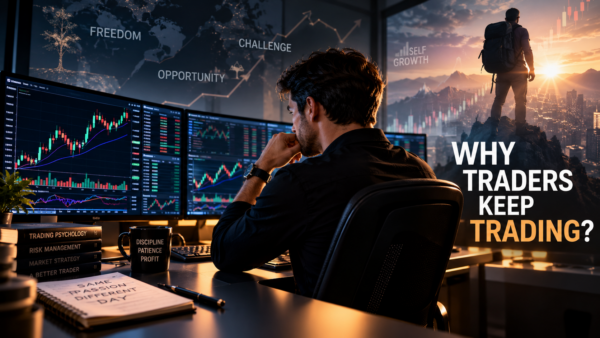
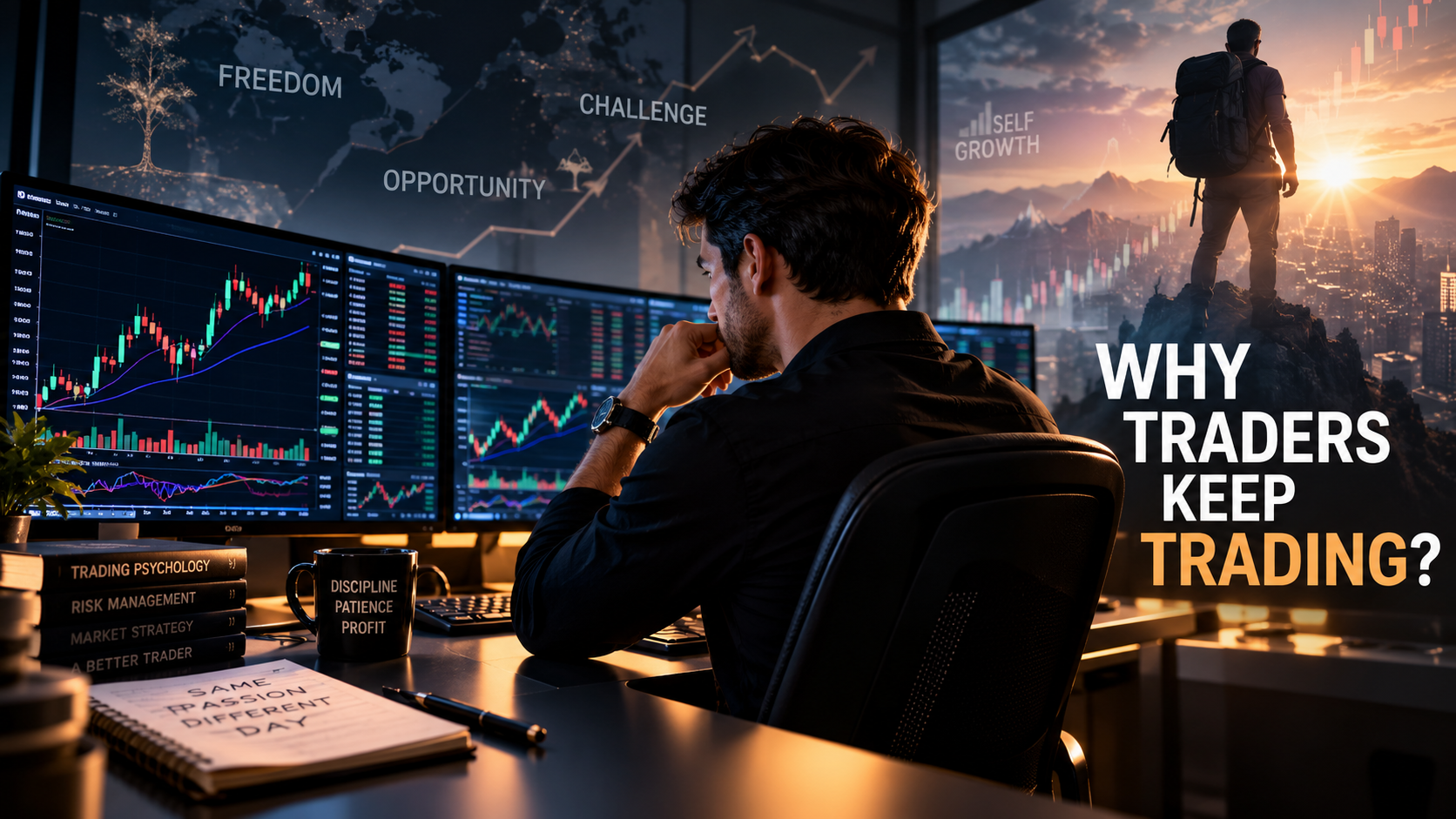
Many successful market participants remain active for years or even decades after becoming financially independent. That raises an important question: why traders keep trading when they no longer need the money?
Understanding why traders keep trading requires looking beyond profit. At the professional level, trading can evolve into an intellectual challenge, a competitive pursuit, a learning environment, a method of capital management, and even an important part of personal identity.
Financial freedom removes the necessity to trade. It does not necessarily remove the desire.
In fact, once financial pressure disappears, some traders find that they enjoy markets even more because their decisions are no longer driven by the need to generate immediate income.
If you are new to financial markets, our complete guide to trading explains how trading works, while our guide to different trading types explores the major approaches traders use.
1. Financial Freedom Changes the Purpose of Trading
In the early stages of a trading career, money usually matters enormously.
Traders may want to improve their lifestyle, achieve independence, support their family, or escape financial pressure.
Once those objectives have been achieved, however, the purpose of trading can change.
A financially independent trader no longer needs to generate a specific amount of money every month.
They can wait.
They can reject mediocre opportunities.
They can reduce position sizes.
They can remain completely out of the market when conditions are unfavorable.
This change in motivation is one of the main reasons why traders keep trading even after achieving financial independence.
They are no longer trading because they have to.
They are trading because they choose to.
2. Trading Becomes an Intellectual Game
Experienced traders often stop viewing financial markets as simple tools for generating income.
Instead, markets become complex systems to understand.
Why did liquidity move toward a particular level?
Why did investors react differently to similar economic data?
How will interest-rate expectations influence currencies, equities, bonds, or gold?
How will institutional investors position themselves?
These questions transform trading into an intellectual exercise.
Behavioral finance research also shows that investment decisions are affected by psychology, emotions, and cognitive biases rather than being completely rational. CFA Institute describes behavioral finance as the study of how these psychological factors influence financial decisions.
For experienced market participants, understanding these dynamics can become as rewarding as the financial outcome itself.
This mental challenge helps explain why traders keep trading long after the original financial objective has been achieved.
3. Successful Traders Often Love the Process
Beginners tend to focus heavily on results.
Daily profit.
Monthly returns.
Win rates.
Account growth.
Professional traders gradually become more focused on process.
They ask:
Did I follow the strategy?
Was my position size appropriate?
Did I respect the risk limit?
Was the trade based on a valid setup?
Did emotion affect my decision?
Was the execution efficient?
This change is fundamental.
A disciplined trader can make a good decision that results in a loss.
They can also make a poor decision that happens to produce a profit.
Professionals understand the difference.
For them, trading becomes an exercise in executing a repeatable decision-making process.
That is another major reason why traders keep trading.
4. Financial Freedom Can Reduce Trading Pressure
Needing money from the market can create significant psychological pressure.
A trader who must generate income may:
- Force trades.
- Overtrade.
- Increase position sizes.
- Close profitable trades too early.
- Hold losing positions too long.
- Take setups that do not meet the strategy rules.
Financially independent traders have greater freedom.
They can wait for exceptional opportunities.
They can accept that there may be no trade today.
This can create a healthier relationship with markets.
5. The Competitive Instinct Does Not Disappear
Many successful traders are highly competitive.
The market gives them a continuous environment in which to test themselves.
There is no permanent championship.
There is no final market level.
There is always another cycle.
Another crisis.
Another change in monetary policy.
Another market regime.
Many professionals are not even competing primarily against other traders.
They are competing against their previous performance.
Can they reduce their drawdown?
Can they improve risk-adjusted returns?
Can they become more disciplined?
Can they adapt faster?
This competitive instinct helps explain why traders keep trading when additional money has limited impact on their lifestyle.
6. Trading Becomes Part of Their Identity
Someone who has spent ten or twenty years trading has invested far more than capital.
They have spent thousands of hours studying markets.
They have experienced losses and recoveries.
They have lived through changing economic cycles.
They have learned to manage uncertainty.
Trading gradually influences how they think about risk, probability, discipline, and decision-making.
Eventually, the distinction between:
“I trade.”
and:
“I am a trader.”
can become significant.
Completely leaving the market may therefore feel like leaving behind part of their professional identity.
7. They Pursue Mastery Rather Than Money
Money has measurable targets.
Mastery does not.
A trader can reach $1 million or $10 million.
But there is no point at which someone can say:
“I have completely mastered financial markets.”
Markets evolve continuously.
Execution can improve.
Risk management can improve.
Psychology can improve.
Portfolio construction can improve.
Macroeconomic interpretation can improve.
This endless pursuit of mastery provides motivation long after financial goals have been achieved.
8. Markets Provide Continuous Learning
Financial markets never stay exactly the same.
Algorithmic trading has changed execution.
Artificial intelligence is influencing analysis.
Digital assets have created new markets.
Liquidity structures evolve.
Central-bank frameworks change.
New geopolitical risks emerge.
For experienced traders, markets become a permanent learning laboratory.
This continuous evolution is one of the strongest reasons why traders keep trading.
For traders interested in short-term market participation, FastPip’s Day Trading Guide also explains how execution, market knowledge, risk management, and discipline interact in intraday trading.
9. Money Eventually Becomes Less Motivating
Money is extremely powerful when it solves real problems.
It provides security.
Housing.
Healthcare.
Education.
Freedom.
But once those needs are comfortably covered, another $10,000 or even another $100,000 may not materially change a wealthy trader’s lifestyle.
At that stage, other motivations become more important:
Mastery.
Challenge.
Recognition.
Learning.
Independence.
Purpose.
The financial reward remains relevant, but it is no longer the only reason to participate.
10. Trading Gives Them Autonomy
Trading offers unusual professional independence.
Traders can decide:
When to participate.
How much capital to allocate.
How much risk to accept.
Which markets to follow.
When to stop.
For people who strongly value autonomy, this level of independence can be extremely attractive.
Even financially independent traders who could outsource their entire portfolio may prefer to manage at least part of their capital personally.
They value the decision-making process.
11. The Market Becomes a Test of Character
Markets reveal personality.
Fear becomes visible.
Greed becomes visible.
Impatience becomes visible.
Overconfidence becomes visible.
Difficulty admitting mistakes becomes visible.
Professional traders often discover that the market is one of the clearest forms of personal feedback.
It teaches:
Patience.
Humility.
Accountability.
Emotional discipline.
Acceptance of uncertainty.
These lessons can remain valuable long after money has ceased to be the primary objective.
12. Some Traders Enjoy Building Wealth More Than Having Wealth
Having money and creating wealth are psychologically different.
Some traders enjoy the construction process.
They enjoy allocating capital.
Managing risk.
Finding opportunities.
Building portfolios.
Protecting assets.
Solving financial problems.
Their satisfaction comes from intelligent capital management rather than consumption.
This helps explain why traders keep trading even after they have accumulated far more wealth than they personally need.
13. Preserving Wealth Requires Risk Management
Achieving financial freedom is not the same as preserving it.
Capital can be damaged by:
Inflation.
Poor diversification.
Currency depreciation.
Market crashes.
Concentration risk.
Bad investment decisions.
FINRA emphasizes that all investments involve risk and identifies asset allocation and diversification as important tools for managing investment risk.
As traders become wealthier, their objective may therefore change.
Earlier, the priority may have been capital growth.
Later, it becomes capital preservation.
Risk management becomes increasingly important.
FastPip’s guide to different trading types also discusses position sizing, stop-losses, leverage risk, and risk-to-reward considerations.
14. Markets Provide Mental Stimulation
A central-bank meeting can change interest-rate expectations.
An inflation report can move currencies and bonds.
A geopolitical crisis can affect commodities.
A change in investor sentiment can move entire asset classes.
For experienced traders, processing these events creates constant intellectual stimulation.
Life after financial freedom can become relatively predictable.
Markets remain unpredictable.
For people who enjoy complex decision-making, that uncertainty can remain highly attractive.
15. They Want to Know Their Skill Still Works
Past performance does not guarantee future competence.
A trader may perform extremely well under one market regime and struggle under another.
Strategies may lose effectiveness.
Volatility may change.
Liquidity may change.
Market structure may change.
Experienced traders therefore need to adapt continuously.
Part of why traders keep trading is the desire to confirm that their knowledge and judgment remain relevant.
16. Success Creates New Goals
Human beings quickly adapt to achievements.
A target that once seemed extraordinary eventually becomes normal.
For traders, the progression may look like:
Become profitable.
Build a larger account.
Achieve financial independence.
Manage larger capital.
Develop more advanced strategies.
Build an investment business.
Mentor other traders.
Create a fund.
Financial freedom can therefore become a milestone rather than the final destination.
17. Trading Can Become a Personal Mission
Some experienced traders eventually move beyond personal trading.
They may:
Teach.
Write.
Mentor.
Build financial technology.
Develop trading systems.
Run investment companies.
Create research.
Their experience becomes part of a larger professional mission.
At this level, why traders keep trading has less to do with personal financial need and more to do with participation, contribution, and purpose.
18. They Want to Build a Legacy
As wealth grows, some successful traders begin thinking about impact rather than accumulation.
What knowledge can they pass on?
Can they help younger traders avoid costly mistakes?
Can they create an investment philosophy?
Can they build a company or institution?
Can their experience benefit future generations?
Legacy can become more important than another percentage point of return.
19. Not Needing Money Can Improve Decision-Making
One of the paradoxes of trading is that people may trade better when they no longer need market income.
A financially independent trader can say:
“No trade.”
“This setup is not strong enough.”
“I will wait.”
“The risk is too high.”
They do not have to force opportunities.
This ability to remain inactive can be a major competitive advantage.
CFA Institute’s materials on trade strategy and execution similarly emphasize matching trading strategy to factors such as risk aversion, urgency, market conditions, and order characteristics rather than treating every trade identically.
20. Financial Freedom Is Really Freedom of Choice
Ultimately, the deepest explanation of why traders keep trading may be freedom itself.
Financial independence does not mean someone must stop working.
It means they no longer have to work for money.
That distinction matters.
A trader who has achieved financial freedom can stop tomorrow.
They can take a year away.
They can trade once a month.
They can manage only part of their capital.
They can completely change their strategy.
But many still choose to remain involved.
That choice reveals the deeper attractions of trading:
Competition.
Curiosity.
Mastery.
Autonomy.
Learning.
Capital management.
Personal growth.
Intellectual challenge.
For many successful traders, financial freedom does not represent freedom from the market.
It represents freedom to participate in the market entirely on their own terms.
Why Do Traders Keep Trading After Financial Freedom?
Understanding why traders keep trading requires recognizing that professional motivation evolves.
At the beginning, money may dominate.
Later, other motivations become more important.
The pursuit of mastery.
The satisfaction of disciplined decision-making.
The challenge of uncertainty.
The desire to protect wealth.
The intellectual stimulation of global markets.
The freedom to manage one’s own capital.
These factors can continue motivating traders for decades.
Frequently Asked Questions
Why do rich traders keep trading?
Rich traders may continue trading because they enjoy market analysis, competition, learning, capital management, and the pursuit of mastery. Money may become less important once financial security has been achieved.
Why traders keep trading even when they have enough money?
One reason why traders keep trading is that the market eventually becomes more than a source of income. It can become an intellectual challenge, a professional identity, and a long-term pursuit of mastery.
Do traders stop after becoming financially independent?
Some do, but others reduce their trading frequency or risk while remaining involved in markets, portfolio management, research, or investing.
Does financial freedom make trading easier?
It can reduce financial pressure. A trader who does not depend on immediate profits may have greater freedom to wait for higher-quality opportunities.
Can professional traders become addicted to trading?
Compulsive trading is possible and can be harmful. However, long-term professional interest in markets should not automatically be considered addiction. Disciplined professionals generally focus on risk control and structured decision-making.
Why is psychology important in trading?
Investor decisions can be influenced by emotions and cognitive biases. Understanding these effects can help traders identify weaknesses in their own decision-making.
Conclusion
There is no single explanation for why traders keep trading after reaching financial freedom.
At first, trading may be primarily about earning money.
Later, the motivation can shift toward mastery, learning, competition, autonomy, intellectual stimulation, wealth preservation, identity, and personal growth.
Successful traders may eventually trade less frequently.
They may become more conservative.
They may move toward portfolio management, mentoring, research, or investing.
But many continue maintaining a connection with financial markets.
Financial freedom removes the need to trade.
It does not necessarily remove the desire to learn, compete, manage capital, or make decisions under uncertainty.
For many professional traders, that is the real benefit of financial freedom:
They are finally free to participate in the market because they want to, not because they have to.