Signal Addiction in Trading: How Dependency Destroys Independent Decision-Making
Signal Addiction in Trading: How Dependency Destroys Independent Decision-Making
Many people enter financial markets because they want to learn how price moves, understand market behavior, develop trading skills, and eventually make their own decisions.
They study charts.
They watch educational videos.
They learn technical analysis.
They follow economic news.
But over time, some traders gradually take a very different path.
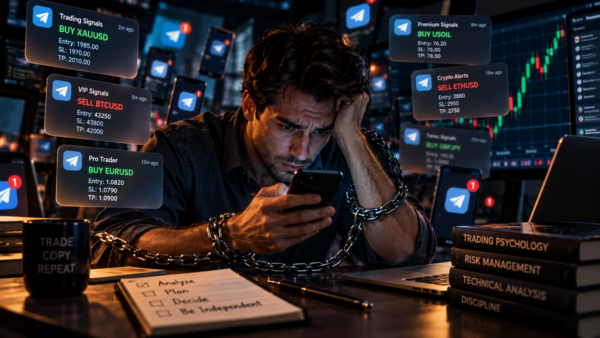
Instead of analyzing the market themselves, they begin waiting for someone else to tell them what to buy, when to enter, where to place the stop-loss, and when to exit.
At first, this can feel efficient.
Why spend hours analyzing the market if someone else can provide a complete trading setup?
But there is a major difference between using trading signals and developing signal addiction in trading.
A trader who uses signals intelligently can still analyze, evaluate risk, and make independent decisions.
A trader who becomes dependent on signals gradually stops thinking.
Eventually, the trader may still be clicking Buy and Sell, but the real decision-making process has been outsourced to someone else.
That dependency can become dangerous when market conditions change, the signal provider experiences a losing period, or the trader suddenly loses access to the source they rely on.
The biggest cost is not always money.
It is the loss of independent thinking.
What Is Signal Addiction in Trading?
1. When a Trader Becomes Only an Executor
Signal addiction in trading does not mean that using trading signals is automatically bad.
Trading signals can be useful.
They can introduce traders to new strategies, highlight market opportunities, provide alternative perspectives, and even accelerate learning.
The problem begins when signals stop being one source of information and become the trader’s entire decision-making system.
A dependent trader may no longer ask:
Why is this trade being taken?
What supports this entry?
Where is the trade invalidated?
How much risk is appropriate?
Instead, the trader asks only:
“Buy or Sell?”
That is the critical difference.
At that point, the trader is no longer evaluating an opportunity.
They are following instructions.
FastPip’s own trading signals are structured with entry logic, targets, risk information, and trade-management guidance so traders can understand the setup rather than simply react to a Buy or Sell command.
Explore FastPip Trading Signals
Internal Link
2. Using Signals vs. Depending on Signals
Using signals can be completely rational.
Professional traders regularly consume:
- Market research
- Analyst opinions
- Economic forecasts
- Technical analysis
- Institutional reports
- Trading ideas
The difference is what happens next.
An independent trader treats a signal as an idea.
They evaluate it.
They compare it with their strategy.
They examine market structure.
They calculate risk.
Then they make their own decision.
A dependent trader treats the same signal as an instruction.
If the signal says Buy, they buy.
If it says Sell, they sell.
They may not know why the trade exists or what would invalidate the setup.
This distinction becomes especially important when the market moves against the position.
An independent trader can reassess the situation.
A dependent trader often has only one option:
Wait for another instruction.
Why Signal Addiction in Trading Develops
3. Why Traders Become Dependent on Signals
Most traders do not become dependent because they are lazy.
The reasons are usually more complicated.
Financial markets are difficult.
Beginners face an overwhelming amount of information:
- Charts
- Indicators
- News
- Economic data
- Technical patterns
- Fundamental analysis
- Risk management
- Trading psychology
A signal simplifies all of that complexity into a single action:
Buy.
Sell.
Wait.
That simplicity can be extremely attractive.
Another major factor is fear of making mistakes.
After several losses, traders may begin to believe:
“My decisions are not reliable.”
They search for someone who appears more experienced.
Initially, this may reduce stress.
But every time the trader delegates another decision, confidence in their own judgment can become weaker.
4. Quick Rewards Reinforce Dependence
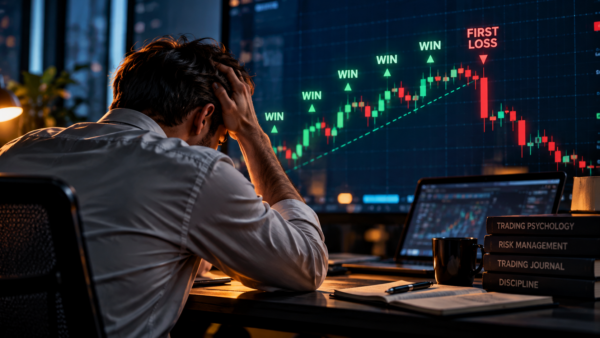
Imagine a beginner receives a signal.
The trade wins.
A second signal wins.
Then another one.
The trader’s brain begins creating a simple association:
Signal → Trade → Profit
The trader did not need to analyze the market.
They did not need to build a strategy.
The reward arrived anyway.
This makes signals psychologically attractive.
Instead of learning a difficult process, the trader has discovered what appears to be an easier route to the same result.
The problem is that the apparent shortcut does not necessarily build any transferable skill.
The trader may earn money from a trade without learning anything about why the trade worked.
5. The Easy Path Is Not Always the Sustainable Path
Trading signals can create the illusion that the difficult parts of trading can be bypassed.
Why spend months learning market structure if someone else can provide the entry?
Why learn risk management if the signal already includes a stop-loss?
Why develop a strategy if someone else provides one?
This logic may work temporarily.
But the important question is:
What happens when the signal stops?
Can the trader still identify opportunities?
Can they assess market conditions?
Can they decide whether a trade is appropriate for their account?
Can they recognize excessive risk?
If the answer is no, the trader has not developed independence.
They have developed dependence.
The Psychological Effects of Signal Dependency
6. The Illusion of Safety
One reason traders become dependent on signals is that following someone else feels safer.
A trader may think:
“This analyst has more experience than I do.”
“Someone professional has already checked the market.”
“If the signal is wrong, it is not really my mistake.”
This creates psychological comfort.
But it does not eliminate financial risk.
The capital is still yours.
The loss is still yours.
The decision to execute the signal is still yours.
No signal provider can remove uncertainty from financial markets.
Behavioral finance research shows that people often rely on mental shortcuts and biases when making complex financial decisions, including confirmation bias, overconfidence, illusion of control, and loss aversion.
CFA Institute – Behavioral Biases of Individuals
External DoFollow Link
7. Escaping Responsibility
Decision-making creates psychological pressure.
If you enter a trade based on your own analysis and lose money, you must accept:
“I made that decision.”
That can be uncomfortable.
Signals create an opportunity to transfer responsibility.
When the trade wins:
“The signal provider is excellent.”
When it loses:
“The signal provider was wrong.”
This protects the trader’s ego in the short term.
But it damages development in the long term.
A trader who never accepts responsibility cannot properly review their decisions.
And without reviewing decisions, improvement becomes extremely difficult.
Professional traders may use external research, but they still accept responsibility for their final actions.
8. When Fear Replaces Analysis
Fear is another major driver of signal addiction in trading.
After several losses, traders may lose trust in their own judgment.
They perform an analysis.
They identify an opportunity.
But before entering, they think:
“What if I’m wrong?”
They then search Telegram channels.
They check social media.
They read other analysts.
They wait for external confirmation.
The trader may still possess analytical knowledge.
What has disappeared is confidence in using it.
This creates a dangerous pattern:
Analysis → doubt → search for confirmation → dependence
Signals become a psychological safety mechanism rather than an analytical tool.
9. How the Brain Becomes Conditioned to Signals
Repeated signal use can reinforce a behavioral pattern.
A notification arrives.
The trader feels anticipation.
The signal produces a profitable trade.
The trader experiences reward.
The next notification becomes even more exciting.
Over time, traders may begin checking channels repeatedly throughout the day.
Even without an open position, they wonder:
“Has a new signal arrived?”
Instead of studying price behavior, they monitor other people’s decisions.
Eventually, the absence of a signal can itself create discomfort.
That is one of the clearest warning signs that a trading tool has become a psychological dependency.
How Signal Addiction Damages Trading Skills
10. Loss of Trading Confidence
Real trading confidence does not mean believing every trade will win.
It means believing that you can:
Analyze a market.
Make a decision.
Accept uncertainty.
Manage risk.
Learn from mistakes.
Adjust when conditions change.
This confidence is built through repeated independent decision-making.
Signal dependency interrupts that process.
When a signal-generated trade wins, the trader often attributes the success to the signal provider.
Confidence in the provider increases.
Confidence in the trader does not.
When the signal loses, the trader again learns very little because responsibility is placed elsewhere.
Over time, a trader can spend years in the market without developing confidence in their own decisions.
11. Why Dependent Traders Stop Reading the Market
Market reading is a skill.
It develops through active observation.
Traders learn to recognize:
- Trends
- Momentum shifts
- Support and resistance
- Volatility changes
- News reactions
- Liquidity behavior
- Market structure
These abilities require participation.
If someone else always determines the entry, stop-loss, and target, the trader’s brain has less reason to analyze the underlying structure.
The trader sees charts.
But they are not truly studying them.
This is similar to using navigation software for every journey.
You may travel the same route hundreds of times while never learning how to navigate it independently.
12. Dependency Can Destroy Trading Identity
Experienced traders gradually develop their own style.
Some prefer:
- Scalping
- Intraday trading
- Swing trading
- Trend following
- Breakouts
- Mean reversion
They also discover which markets, timeframes, and levels of risk suit them.
A signal-dependent trader may never develop this identity.
Today they follow a scalper.
Tomorrow they follow a gold analyst.
Next week they follow a crypto channel.
Their behavior changes according to whoever is providing the next trade.
Without independent evaluation, there is no stable trading process.
13. What Happens When the Signal Provider Is Wrong?
Every trader loses.
Every analyst makes incorrect calls.
Every trading system experiences periods of underperformance.
Problems arise when users expect certainty.
A dependent trader may have built so much confidence in the provider that one losing period causes a psychological crisis.
They think:
“Has the strategy stopped working?”
“Was this provider never good?”
“Should I find someone else?”
Many traders then begin provider hopping.
One channel loses.
They move to another.
The second one experiences drawdown.
They move again.
The trader searches endlessly for a signal provider who never loses.
That person does not exist.
Why Signal Users Can Still Lose Money
14. A Good Signal Does Not Guarantee a Good Result
Even when a trading signal is reasonable, different users may produce very different outcomes.
One trader follows the suggested position size.
Another doubles it.
One respects the stop-loss.
Another moves it.
One takes profits according to the plan.
Another exits emotionally.
One executes every valid trade.
Another skips losing trades randomly and then chases winners.
This is why signal quality alone does not determine profitability.
Risk management, execution, discipline, and psychology remain essential.
FastPip’s trading signal pages explicitly emphasize position sizing, stop-loss discipline, and the fact that traders remain responsible for their decisions.
Signal Addiction in Trading and FOMO
15. Why FOMO Makes Signal Dependency Worse
FOMO—fear of missing out—is closely connected to signal dependency.
Imagine watching a market rise quickly.
You see people posting profits.
A channel announces another winning trade.
Another trader claims to have caught the entire move.
You begin thinking:
“What am I missing?”
Signal-dependent users are particularly vulnerable because they are accustomed to other people identifying opportunities for them.
If no signal appears, they worry that a profitable move is happening somewhere without them.
This creates a cycle:
FOMO → search for signals → more channels → more conflicting information → more anxiety
The trader eventually feels they must monitor everything.
That is impossible.
No trader can capture every market opportunity.
Professional trading requires accepting missed trades.
Social Media and Signal Addiction
16. How Social Media Reinforces Signal Dependency
Social media can dramatically amplify signal addiction in trading.
Traders can now access thousands of:
- Trading channels
- Influencers
- Analysts
- Strategy pages
- Screenshots
- Performance claims
- Buy and Sell recommendations
The problem is not access to information.
The problem is information without context.
Social media naturally favors content that attracts attention.
A screenshot showing a huge profit is likely to receive more engagement than a detailed explanation of risk management.
Winning trades are frequently displayed.
Losses may receive far less attention.
This creates a distorted perception of trading.
FINRA has warned that social-media-based investing information may be inaccurate, incomplete, misleading, or biased, and that overreliance on social-media investment insights can lead investors to make decisions using incomplete information.
FINRA – Social Media-Influenced Investing
FINRA and the SEC have also warned that social-sentiment information can contribute to emotionally driven or impulsive investment decisions.
FINRA – Think Twice Before Trading Based on Social Media
The solution is not to avoid social media entirely.
It is to prevent social media from becoming the primary decision-maker.
Can Copy Trading Create the Same Dependency?
17. Copy Trading and Signal Dependency
Copy trading is not inherently the same as signal addiction.
It is a tool.
Used correctly, it can provide exposure to another trader’s strategy while allowing the investor to evaluate performance, risk, drawdown, and suitability.
But psychologically, the same dependency can develop.
A user may begin thinking:
“I don’t need to understand the market because someone else trades for me.”
The problem becomes even less visible because execution is automated.
The investor may stop following market conditions entirely.
Everything works smoothly until the copied trader enters a difficult period.
Then important questions appear:
Should I stop copying?
Is this drawdown normal?
Has the strategy changed?
Is risk increasing?
Without understanding how to evaluate the system, the investor may panic.
FastPip provides a dedicated Copy Trading section where investors can compare trading accounts and performance rather than treating copy trading as a guaranteed-return mechanism.
Copy trading should therefore be treated as an investment tool—not as a replacement for understanding risk.
Warning Signs of Signal Addiction in Trading
18. How to Know If You Are Becoming Dependent
Ask yourself these questions.
Do you feel uncomfortable when no signal is available?
Do you repeatedly check channels for new trades?
Can you enter a trade without someone else’s confirmation?
Do you understand why your current trades were opened?
Can you define the conditions that would invalidate the setup?
Do you follow multiple signal channels because you fear missing opportunities?
Do you frequently change providers after losses?
Do you blame signal providers for every losing trade?
Have you stopped studying markets because signals feel easier?
Can you analyze a chart without first looking at someone else’s opinion?
The most important question is:
If every signal channel disappeared tomorrow, could you still trade?
If the answer is no, dependency may already be deeper than you realize.
How to Break Signal Addiction in Trading
19. Rebuild Independent Decision-Making
Breaking signal addiction in trading does not require deleting every signal source immediately.
A gradual transition is often more practical.
Start by accepting full responsibility for every trade.
Even if the original idea came from someone else, you chose to execute it.
That makes it your decision.
Next, change the role of signals.
Instead of treating a signal as:
“Enter this trade.”
Treat it as:
“Here is an idea worth investigating.”
Before executing, answer:
Why does this trade make sense?
What supports the setup?
Where is the invalidation level?
What is the risk?
Does this trade fit my strategy?
Would I take this trade if I did not know who published it?
These questions force the brain back into the analytical process.
20. Reduce the Number of Signal Sources
More information does not always create better decisions.
Following ten signal channels can create:
- Contradictory setups
- Information overload
- FOMO
- Overtrading
- Confusion
- Reduced confidence
Reduce the number of sources you follow.
Focus on quality rather than quantity.
The objective is to regain mental space for independent thinking.
21. Use Smaller Positions While Rebuilding Confidence
Some traders are afraid to make independent decisions because they fear losing money.
One solution is to reduce position size.
Smaller risk reduces psychological pressure.
The objective during this phase is not maximizing profit.
It is rebuilding decision-making ability.
A small independently analyzed trade may be more valuable educationally than a large profitable trade copied blindly from someone else.
Turn Signals Into an Educational Tool
22. Study the Signal Before Executing It
The goal is not necessarily to stop using signals.
The goal is to change your relationship with them.
Before executing a signal:
- Open the chart.
- Identify the trend.
- Mark relevant support and resistance.
- Examine the entry.
- Study the stop-loss.
- Calculate the risk-to-reward ratio.
- Write down why you agree or disagree.
Then compare your interpretation with the signal provider’s logic.
This turns a signal into a case study.
Over time, you begin recognizing similar setups yourself.
That is how dependence becomes learning.
23. Keep a Trading Journal
A trading journal is one of the most useful tools for rebuilding independence.
Before each trade, write:
- Why you are entering
- Whether the idea came from you or a signal
- Why you agree with the setup
- Position size
- Stop-loss
- Target
- Emotional state
- Market conditions
After the trade, record:
- Result
- Execution quality
- Mistakes
- Lessons learned
- Whether you followed your rules
FastPip’s detailed Trading Journal guide explains how recording reasoning, emotions, outcomes, and mistakes can transform individual trades into long-term learning.
Trading Journal Writing – FastPip
This process converts trading experience into usable data.
Signals Should Be a Tool, Not a Crutch
24. From Signal Consumer to Independent Trader
Two traders can receive exactly the same signal.
Trader A executes immediately.
They do not understand the setup.
They wait for the result.
Trader B opens the chart.
They review the market structure.
They examine the entry.
They evaluate the risk.
They compare the signal with their own analysis.
Even if both trades produce the same financial result, the traders have gained completely different things.
Trader A gained an outcome.
Trader B gained experience.
That difference compounds over time.
After hundreds of trades, one person may remain dependent.
The other may be capable of identifying the same opportunities independently.
Conclusion: Trading Means Making Decisions, Not Just Executing Them
Signal addiction in trading is not fundamentally about signals.
It is about decision-making.
Trading signals can be useful.
Market analysis from other traders can be useful.
Copy trading can be useful.
Social media can be useful.
None of these tools are automatically harmful.
The danger begins when a trader stops using these resources as inputs and starts treating them as replacements for thinking.
Dependency can gradually weaken:
- Analytical skills
- Confidence
- Risk awareness
- Responsibility
- Market-reading ability
- Emotional control
- Independent judgment
And because the process is gradual, traders may not recognize what is happening until the external source disappears or fails.
The solution is not isolation.
Professional traders use information from many sources.
The difference is that they remain responsible for the final decision.
A signal can suggest an opportunity.
It should not remove the need to think.
A signal can teach a setup.
It should not replace learning.
A copy-trading system can provide exposure to another strategy.
It should not eliminate the need to understand risk.
Social media can provide information.
It should not determine your trades.
The long-term objective should therefore be simple:
Use signals to become a better trader—not to avoid becoming one.
The real test is this:
If every signal provider disappeared tomorrow, would you still know how to evaluate the market and make a decision?
If the answer is yes, signals are probably functioning as tools.
If the answer is no, it may be time to rebuild the skills that trading dependency has gradually replaced.
Trading, at its deepest level, is the ability to observe, analyze, decide, manage risk, and accept responsibility for the outcome.
That ability is worth far more than any individual signal.
Frequently Asked Questions
What is signal addiction in trading?
Signal addiction in trading is a psychological and behavioral dependency in which traders rely heavily on external trading signals and lose confidence in their own ability to analyze markets or make decisions.
Is using trading signals bad?
No. Trading signals can be useful when they are treated as ideas or educational tools. Problems begin when traders execute them blindly and become unable to trade without external guidance.
How do I know if I am dependent on trading signals?
Warning signs include constantly checking signal channels, feeling anxious when no signal is available, needing confirmation before every trade, following many providers, and being unable to analyze a market independently.
Can signal addiction reduce trading skills?
Yes. If traders repeatedly outsource analysis and decision-making, they have fewer opportunities to practice market reading, strategy development, and independent risk assessment.
Why do traders become addicted to signals?
Common causes include fear of making mistakes, lack of confidence, information overload, FOMO, quick rewards from successful signals, and the psychological comfort of transferring responsibility to another person.
Can social media increase signal addiction?
Yes. Social media can expose traders to constant signals, profit screenshots, conflicting opinions, and emotionally charged content, increasing FOMO and pressure to follow others.
Can copy trading create the same problem?
It can. Copy trading itself is only a tool, but dependency may develop if investors stop understanding risk, evaluating performance, or taking responsibility for their own capital.
How can I break signal addiction in trading?
Start by taking responsibility for every trade, reduce the number of signal sources, analyze each signal before executing it, lower position size while rebuilding confidence, and keep a trading journal.
Should I stop using signals completely?
Not necessarily. A better goal is to change how you use them. Treat signals as market ideas to analyze rather than instructions that must be followed.
Can a trading journal help reduce signal dependency?
Yes. Recording your reasoning, emotions, execution, and results helps you evaluate your own decision-making and gradually build confidence in your trading process.
What is the healthiest way to use trading signals?
Use signals as one input among several. Understand the setup, assess the risk, compare it with your own strategy, and make the final decision yourself.