
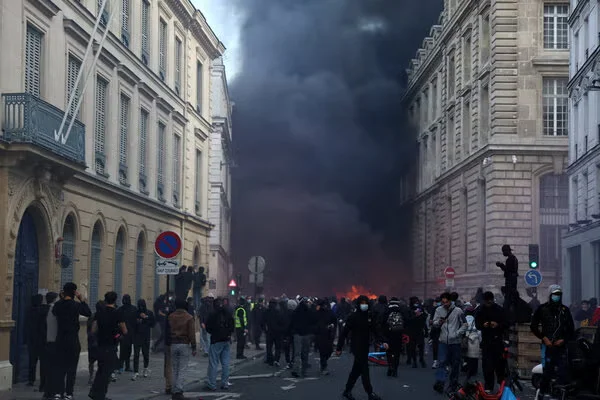
France is facing its worst unrest in years after nationwide protests over the cost of living and declining public services escalated into violence, putting further pressure on President Emmanuel Macron’s government ahead of a crucial vote on the 2027 budget.
Around 550,000 people took part in demonstrations across the country on Saturday, including approximately 110,000 in Paris, according to authorities. Nearly 2,400 people were arrested, while almost 1,000 police officers and gendarmes were injured, the Interior Ministry said.
The unrest has left shops and public buildings damaged, intensified political tensions and raised concerns about the economic consequences of the demonstrations.
Macron Vows Tough Response to Violence
Macron condemned what he described as “unbridled” violence in a televised address on Sunday, pledging an “uncompromising” response against those responsible.
The president also ordered a review of whether intelligence-gathering failures or inadequate police preparedness had contributed to the unrest. He asked the government to bring together students, teachers, lawmakers, unions and business leaders this week to develop concrete proposals to address the crisis.
Macron stopped short of declaring a state of emergency or imposing a curfew. However, he said prefects and mayors would be given the power to ban certain gatherings when necessary to protect public buildings and local businesses.
The demonstrations followed a month-long student movement over teacher shortages and school conditions, alongside broader dissatisfaction among unions and the public.
While hundreds of thousands of people protested peacefully, violent groups clashed with police, looted shops and targeted public buildings in several cities.
Looking to understand currency pair movements through technical indicators and fundamental economic factors? Explore our Market Analysis section for in-depth forex analysis, market trends, and insights to support more informed trading decisions.
Riots Cause Damage Across French Cities
The violence caused significant damage in several parts of France.
In Limoges, central France, a town hall that was 143 years old was set ablaze and largely destroyed in an arson attack. Mayor Guillaume Guérin said there had been a clear intention to burn down the building and that people inside had feared for their lives.
In Marseille, protesters forced their way into the city’s town hall, while a tourist office in Lyon was set on fire.
Interior Minister Laurent Nuñez said several hundred shops had suffered considerable material damage. In Bordeaux, Mayor Thomas Cazenave said up to 100 stores had been looted.
Police also used tear gas and stun grenades to disperse demonstrators at Place de la République in Paris on Sunday afternoon, while bicycles were set on fire. Police said one protester had died of cardiac arrest during demonstrations in the capital, but provided no further details.
Economy Minister Roland Lescure pledged government support for business owners affected by the violence. He also warned that those responsible for damaging property would be held accountable and required to repair the damage.
France’s €54 Billion Budget Savings Plan Faces Pressure
The unrest comes as Prime Minister Sébastien Lecornu’s minority government attempts to secure €54 billion ($61 billion) in fiscal savings under its 2027 budget plan.
The government is seeking to narrow France’s growing budget deficit as public debt and financing costs continue to weigh on the country’s public finances. The National Assembly is scheduled to hold a formal vote on the first part of the budget bill on Tuesday.
France’s public debt reached a record €3.6 trillion in the second quarter, equivalent to 119% of gross domestic product (GDP), according to the figures cited in the report.
The country’s rising debt burden has become more expensive to service as interest rates increase globally, adding to the pressure on policymakers to control government spending.
The proposed savings plan has become a central political challenge for Lecornu’s government. With public dissatisfaction growing and protests spreading, the upcoming parliamentary vote is taking place against a backdrop of heightened social and political tensions.
The unrest does not determine the outcome of the vote, but it adds another challenge for a minority government already facing pressure over its fiscal policy.
Political Opposition Intensifies Criticism of Macron
The demonstrations have also intensified criticism of Macron’s leadership as political tensions build ahead of next year’s presidential campaign.
Marine Le Pen, the far-right opposition leader and a leading contender in the upcoming presidential race, described Macron’s government as exhausted and disoriented.
Jean-Luc Mélenchon, a far-left leader who is also running for president, argued that Macron needed to respond to the demands of protesting high-school students. He warned that France could be heading toward events that might eventually become uncontrollable.
The contrasting reactions underline the political pressure surrounding the government’s response to the protests, as well as the challenge of addressing public grievances while pursuing spending reductions.
Market Impact: What France’s Unrest Could Mean for the Euro
The combination of political instability, widespread protests and uncertainty surrounding France’s budget could become a source of concern for financial markets.
For the euro, the key issue is whether the unrest and the budget dispute develop into a broader challenge to fiscal stability or government policymaking. Prolonged uncertainty could weigh on investor sentiment toward French assets and potentially influence the wider eurozone outlook.
Investors may also monitor French government bond yields and the spread between French and German borrowing costs for signs of changing perceptions of fiscal and political risk.
However, the protests alone do not establish a clear direction for the euro. Market reactions will depend on subsequent political developments, the outcome of the budget vote, changes in fiscal expectations and broader economic conditions.
Traders should watch for official updates on the parliamentary vote, further government measures and any reliable market data showing how investors are responding.
What Happens Next?
The immediate focus is on Tuesday’s budget vote and the government’s efforts to respond to the unrest. Discussions involving students, teachers, unions, lawmakers and business leaders are also expected to shape the next phase of the government’s response.
Whether the government can advance its fiscal plans while addressing public dissatisfaction remains uncertain. The outcome could have implications for France’s political outlook, business confidence and perceptions of fiscal risk across the eurozone.
For financial markets, the key developments to monitor are the budget vote, the government’s next policy steps and any sustained change in investor sentiment toward French assets and the euro.
 Check Our
 Whether you’re a day trader or a long-term investor, FastPip gives you the tools to trade smarter, not harder.