When to Stop Following a Signal Provider: 12 Signs You Should Not Ignore
When to Stop Following a Signal Provider: 12 Signs You Should Not Ignore
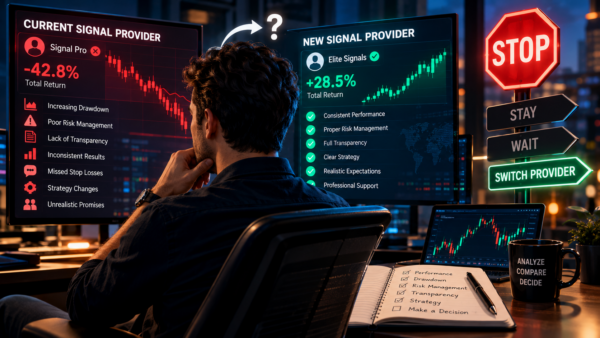
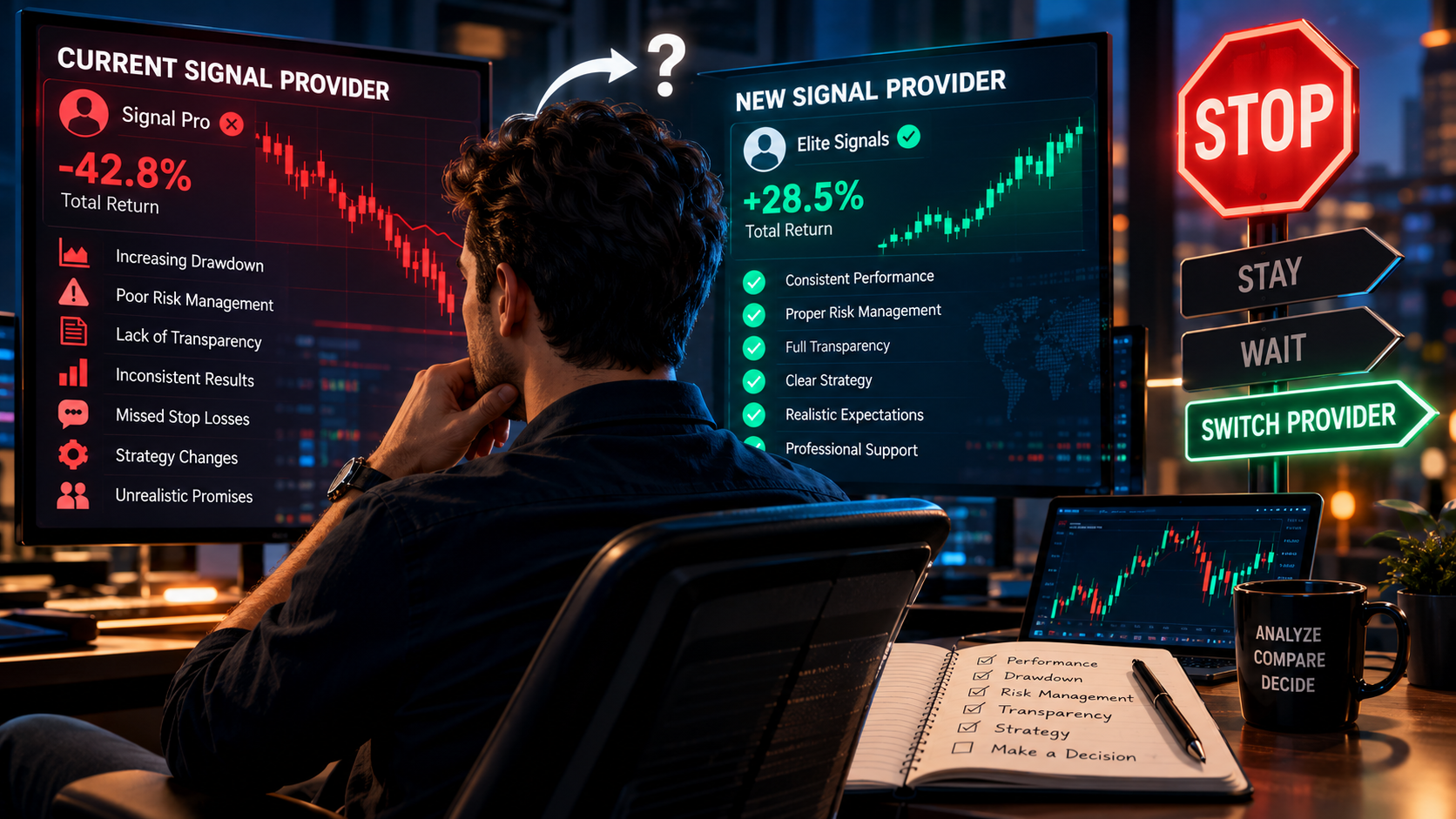
Choosing a trading signal provider is important.
Knowing when to stop following a signal provider can be even more important.
Many traders make one of two mistakes.
Some leave a service immediately after a few losing trades.
Others remain loyal for far too long, even when risk management deteriorates, drawdown rises, transparency disappears, or the provider begins behaving very differently from the strategy users originally selected.
Neither approach is ideal.
Losses are a normal part of trading.
A professional signal service can experience:
- Losing streaks
- Temporary drawdowns
- Difficult market conditions
- Periods of lower win rate
- Changes in volatility
These events alone do not prove that a provider has become unreliable.
The real concern begins when several deeper warning signs appear together.
These may include:
- Drawdown moving far beyond historical levels
- Repeated violations of Stop Loss rules
- Increasing position size after losses
- Sudden strategy changes
- Selective performance reporting
- Unrealistic marketing claims
- Declining long-term expectancy
- Reduced communication and transparency
The purpose of this guide is therefore not to tell traders to leave a signal service after every difficult month.
It is to help distinguish a normal losing period from a structural decline in signal quality.
That distinction can protect traders from both emotional switching and remaining in a deteriorating service for too long.
Why Choosing the Right Signal Provider Matters
When you follow a signal provider, you are effectively allowing another person’s analysis to influence your financial decisions.
Even if you execute trades yourself, the provider may determine:
- Market direction
- Entry area
- Stop Loss
- Take Profit
- Trade timing
- Risk structure
- Trade management
This creates a meaningful dependency.
A strong provider should therefore demonstrate more than occasional profitable trades.
You should evaluate:
- Transparency
- Consistency
- Risk management
- Historical drawdown
- Long-term performance
- Strategy discipline
- Communication quality
FastPip’s trading signals are presented with structured entry, Stop Loss, Take Profit and risk information so that traders can evaluate the setup rather than focusing only on a headline result.
Explore FastPip Trading Signals
1. A Few Losing Trades Are Not Enough Reason to Leave
One of the biggest mistakes traders make is abandoning a provider after a short losing streak.
No trading strategy wins all the time.
Suppose a system has a long-term win rate of:
60%
That does not mean exactly six of every ten trades will win in a perfectly alternating sequence.
You may still experience:
- 3 consecutive losses
- 4 consecutive losses
- Occasionally an even longer losing sequence
Probability does not distribute wins and losses evenly.
That is why short-term results can be misleading.
The correct question is not:
“Did the last three trades lose?”
It is:
“Is the current performance still within the normal historical behavior of the strategy?”
That is a much more professional way to evaluate a signal provider.
Do Not Chase Performance
A trader often leaves Provider A after a losing month and immediately joins Provider B because Provider B has just experienced an excellent month.
Then Provider B enters a drawdown.
The user moves again.
This creates a cycle known as performance chasing.
Instead of participating in the complete statistical behavior of one strategy, the trader repeatedly enters services after strong periods and exits after weak ones.
Ironically, this can produce worse results than remaining disciplined.
2. Rising Drawdown Is One of the Strongest Warning Signs
Drawdown measures the decline from a previous account peak.
For example:
Peak Account Value: $10,000
Lowest Subsequent Value: $8,500
Drawdown:
15%
Drawdown is normal.
The important question is whether it remains consistent with the provider’s historical profile.
Suppose a provider historically experienced:
8%–12% maximum drawdown
and suddenly reaches:
30%
That deserves serious attention.
The provider may still recover.
But the risk characteristics of the service may have changed.
Why Abnormal Drawdown Matters
A major increase in drawdown can indicate:
- Strategy deterioration
- Poor market adaptation
- Larger position sizes
- Excessive leverage
- Stop Loss violations
- Revenge trading
- Martingale
- Averaging into losing positions
The larger a drawdown becomes, the more difficult recovery becomes.
A 50% loss requires a 100% gain to return to the original account value.
This is why capital protection should receive more attention than spectacular short-term profits.
3. Learn When to Stop Following a Signal Provider by Watching Risk Management
Risk management is one of the clearest measures of provider quality.
A professional service normally has consistent rules regarding:
- Position sizing
- Stop Loss
- Maximum exposure
- Risk per trade
- Correlated positions
- Maximum acceptable drawdown
Problems begin when these rules suddenly change.
For example:
The provider historically risks 1% per trade.
After several losses, risk rises to 3%.
Then 5%.
Then larger trades appear in an attempt to recover previous losses quickly.
This behavior can indicate emotional decision-making rather than disciplined trading.
Moving Stop Losses Is a Serious Red Flag
Suppose a signal says:
Stop Loss: 1.0850
Price approaches 1.0850.
The provider changes the Stop Loss to:
1.0800
Price continues falling.
The Stop Loss is moved again.
The provider may argue:
“The trade just needs more time.”
Occasional tactical adjustments can be legitimate.
Repeatedly widening risk simply to avoid recording a loss is different.
A provider unwilling to accept a normal losing trade can eventually create a much larger loss.
4. Lack of Transparency Should Not Be Ignored
Transparency is one of the foundations of trust in a signal service.
You should be able to evaluate:
- Winning trades
- Losing trades
- Entry prices
- Exit prices
- Stop Losses
- Results
- Drawdown
- Historical performance
A provider becomes harder to evaluate when this information starts disappearing.
Warning signs include:
- Losing trades deleted from Telegram
- Previous messages edited
- Only profitable trades shown
- Missing monthly reports
- Unclear entries and exits
- No explanation of losses
- Screenshots instead of complete performance data
If transparency declines while performance also deteriorates, the combination is particularly concerning.
Pay Attention to How Losses Are Reported
Anyone can proudly publish a winner.
Professionalism is easier to evaluate after a loss.
A credible provider should be comfortable saying:
“This trade reached the Stop Loss.”
They should not need to hide or rewrite the outcome.
The way losses are handled can tell you more about a signal service than its best winning trade.
5. A Sudden Strategy Change Can Signal Trouble
Strategies evolve.
That is normal.
Markets change, volatility regimes change, and professional traders sometimes adapt.
But there is an important difference between:
Controlled strategy adaptation
and:
Reactive strategy abandonment
Suppose you selected a provider because it historically used:
- Low risk
- 1–2 trades per day
- Forex majors
- Defined Stop Losses
Then suddenly it begins:
- Trading 10 times per day
- Using larger positions
- Trading unfamiliar cryptocurrencies
- Holding losing trades without stops
You are no longer following the strategy you originally evaluated.
Historical Performance May No Longer Apply
This is crucial.
If the strategy fundamentally changes, old performance statistics may become much less relevant.
For example:
Three years of performance from a conservative Forex strategy do not validate a new high-leverage crypto strategy.
Whenever a provider materially changes:
- Market
- Timeframe
- Position size
- Risk
- Execution style
- Trade frequency
you should reassess the service almost as if evaluating a new provider.
6. Ignoring Risk Management Can Be a Reason to Leave
A provider can recover from a difficult month.
Recovering from destroyed risk discipline is much more concerning.
Important warning signs include:
Position Sizes Suddenly Increase
This may indicate an attempt to recover previous losses quickly.
Stop Losses Disappear
Open-ended risk can dramatically change the strategy.
Losing Trades Are Averaged Aggressively
Additional positions increase exposure while the original trade is already wrong.
Martingale Appears
Increasing position sizes after losses can create extremely high tail risk.
Risk-to-Reward Deteriorates
The service may begin risking large amounts to capture very small profits.
Any one of these deserves examination.
Several appearing simultaneously may indicate a structural problem.
7. Unrealistic Promises Are a Major Warning Sign
Professional traders understand uncertainty.
They do not need to promise:
- Guaranteed profits
- 100% accuracy
- No losing trades
- Risk-free income
- Daily guaranteed returns
- Rapid account doubling
Financial markets do not work that way.
The UK Financial Conduct Authority has specifically warned about promotions that promise unrealistic returns through copy trading, managed accounts and daily trading tips.
FCA – Warning on Unrealistic Trading Returns
Aggressive promises should therefore make you more cautious rather than more confident.
Marketing Should Not Replace Evidence
There is nothing wrong with marketing.
The problem begins when advertising becomes stronger while verifiable performance becomes weaker.
Be cautious when a provider increasingly relies on:
- Luxury imagery
- Profit screenshots
- “VIP” claims
- Limited-time pressure
- Huge percentage returns
- Constant success stories
while providing less information about:
- Drawdown
- Losses
- Risk
- Complete trade history
Data should support the marketing.
Marketing should not replace the data.
8. Declining Long-Term Performance Matters More Than One Bad Week
A signal service should be evaluated using a meaningful sample.
Depending on trading frequency, this may require:
- Several weeks
- Several months
- Dozens of trades
- Hundreds of trades
The exact period is not universal.
A scalping provider generating hundreds of trades can be evaluated faster than a swing strategy producing three trades per month.
The important principle is:
Do not make a long-term decision from a tiny sample.
Metrics to Monitor
Track:
- Net return
- Win rate
- Average win
- Average loss
- Risk-to-reward
- Expectancy
- Maximum Drawdown
- Drawdown duration
- Number of trades
You are looking for deterioration across multiple measures.
9. How Long Should You Evaluate a Signal Provider?
There is no universal number of days.
A more useful approach is to combine:
Time + Number of Trades + Market Conditions
For example, evaluating only ten trades may provide very little information.
Fifty or one hundred trades can provide a much stronger sample, depending on the strategy.
You should also ask whether those trades occurred under different market environments.
A strategy tested only during a strong trend may behave very differently during consolidation.
Continue Monitoring Even After You Trust the Provider
Evaluation should not stop once a provider has performed well for six months.
Strategies change.
Markets change.
Traders change.
Risk behavior can change.
Performance monitoring should therefore be continuous.
10. Natural Drawdown vs. Structural Strategy Failure
This is perhaps the most important distinction in the entire article.
A natural losing period typically looks like this:
- Drawdown remains near historical ranges
- Risk per trade remains stable
- Stop Loss rules remain unchanged
- Strategy structure remains consistent
- Transparency continues
- Communication remains professional
A structural problem may look like:
- Drawdown repeatedly breaks historical levels
- Risk suddenly increases
- Stop Losses are removed or widened
- Strategy changes without explanation
- Win rate and expectancy remain depressed for a long period
- Losses are hidden
- Reporting becomes less transparent
The first situation may simply require patience.
The second may justify reducing exposure or leaving the provider.
11. When to Stop Following a Signal Provider and Withdraw Capital
You should consider reducing or ending exposure when several strong warning signs appear together.
For example:
Drawdown Breaks Historical Limits
A service historically staying below 12% drawdown suddenly reaches 30%.
Risk Management Changes
The provider starts increasing trade size after losses.
Transparency Falls
Reports become incomplete and losses disappear.
Strategy Changes
The provider begins using a completely different approach.
Performance Deteriorates Persistently
Results remain outside historical norms for a meaningful sample.
Communication Becomes Defensive
Reasonable questions about performance are avoided.
Any one event may have an explanation.
Multiple simultaneous events are much more significant.
You Do Not Always Need to Exit All at Once
Sometimes the most rational response is reducing exposure.
For example:
Previous allocation: $10,000
Reduced allocation: $5,000
This allows you to continue monitoring the provider while lowering risk.
A staged approach can be useful when evidence is concerning but not yet definitive.
12. Make the Decision With Data, Not Emotion
Before changing providers, ask:
Has Long-Term Performance Actually Changed?
Compare current results with historical averages.
Has Drawdown Changed?
Compare current drawdown with previous maximum drawdowns.
Has Risk Per Trade Changed?
Look for increased position sizing or leverage.
Has the Strategy Changed?
Compare current trades with the strategy you originally selected.
Has Transparency Changed?
Review reporting quality.
Is the Problem Actually My Execution?
Perhaps your results differ because of:
- Late entries
- Broker spreads
- Slippage
- Incorrect position sizing
The provider may not be the problem.
13. Common Mistakes When Leaving a Signal Provider
Leaving a poor provider can be correct.
Leaving badly can still create problems.
Leaving After Three Losing Trades
This may be emotionally driven.
Immediately Joining the Best Recent Performer
This is performance chasing.
Ignoring Personal Execution Problems
Changing providers will not solve poor risk management.
Choosing a Replacement Without Research
The new provider may be worse.
Focusing Only on Profit
A lower-return provider with much better risk control may be superior.
Ignoring Switching Costs
Constantly changing providers consumes:
- Time
- Subscription costs
- Learning effort
- Mental energy
Frequent provider hopping is not a strategy.
14. Keep Your Own Signal Performance Journal
Do not rely only on the provider’s statistics.
Create your own record.
For each signal, track:
- Date
- Symbol
- Direction
- Entry
- Stop Loss
- Take Profit
- Position size
- Result
- Provider result
- Your result
- Slippage
- Notes
Then calculate:
- Win rate
- Average win
- Average loss
- Maximum drawdown
- Net result
- Execution difference
FastPip’s Trading Journal guide explains how maintaining consistent records helps traders evaluate strategies and identify behavioral patterns.
FastPip – Trading Journal Writing
Internal Link
This information makes decisions much more objective.
15. Should You Follow Multiple Signal Providers?
Diversifying providers can reduce dependency on one strategy.
But it can also increase complexity.
Potential advantages:
- Different strategies
- Different markets
- Reduced dependence on one provider
Potential disadvantages:
- Conflicting signals
- Duplicate exposure
- More subscription costs
- Harder risk management
- Information overload
For example:
Provider A: BUY XAUUSD
Provider B: SELL XAUUSD
What should the user do?
Without a clear portfolio framework, multiple providers can create confusion rather than diversification.
Diversification Must Be Real
Following three providers who all:
- Trade Gold
- Use the same timeframe
- Trade breakouts
- Take similar positions
does not create much diversification.
True diversification requires differences in:
- Strategy
- Market
- Timeframe
- Risk structure
16. Signal Provider Health Checklist
Use this checklist periodically.
1. Is Long-Term Performance Still Acceptable?
Look beyond recent trades.
2. Is Drawdown Still Within Historical Limits?
A sudden increase deserves investigation.
3. Is Risk Management Still Consistent?
Position sizing and Stop Loss rules should remain disciplined.
4. Are All Trades Reported Transparently?
Both winners and losers matter.
5. Has the Strategy Changed?
If yes, understand why.
6. Are Position Sizes Increasing After Losses?
This can signal revenge trading or martingale behavior.
7. Are Stop Losses Respected?
Repeated widening is concerning.
8. Are Marketing Claims Becoming More Extreme?
Be cautious with guaranteed-return language.
9. Is Communication Still Professional?
The provider should answer reasonable questions.
10. Are Results Based on a Meaningful Sample?
Do not judge from a handful of trades.
11. Are Your Personal Results Similar to the Provider’s?
Large persistent differences require investigation.
12. Would You Select This Provider Today?
This is a powerful question.
Forget your previous subscription fees and past loyalty.
Based only on current data:
Would you choose this provider again today?
If the answer is consistently no, reconsideration may be justified.
How Often Should You Review a Signal Service?
A structured schedule helps reduce emotional decisions.
For example:
Weekly
Review:
- Trade execution
- Major rule violations
- Unusual risk
Monthly
Review:
- Net performance
- Win rate
- Risk-to-reward
- Drawdown
Quarterly
Review:
- Strategy consistency
- Long-term expectancy
- Provider quality
- Whether the service still fits your objectives
This prevents one losing trade from triggering an emotional exit.
Why Trading Journals Matter in This Decision
A trading journal creates evidence.
Without one, traders often rely on memory.
Memory is selective.
Recent losses may feel more significant than older winners.
Likewise, one large winning trade may hide months of mediocre performance.
FastPip’s journal framework encourages traders to record both quantitative results and behavioral decisions.
Read FastPip’s Trading Journal Guide
This gives you a factual basis for deciding when to stop following a signal provider.
Do Not Confuse Lower Profit With Lower Quality
Imagine:
Provider A
Annual Return: 80%
Maximum Drawdown: 55%
Provider B
Annual Return: 35%
Maximum Drawdown: 10%
Provider A earned more.
But it may not necessarily be the better provider.
Risk-adjusted performance matters.
A provider becoming more conservative may produce lower returns while actually improving account stability.
Do not automatically leave simply because profits fall.
Investigate why they fell.
When Lower Performance Becomes Concerning
Lower returns become more concerning when combined with:
- Larger losses
- Higher Drawdown
- More risk
- Reduced transparency
- Strategy drift
- Poorer discipline
This combination suggests that you are not merely experiencing a slower market period.
The quality of the system itself may be changing.
Check the Provider’s Regulatory and Promotional Claims
If a provider presents itself as regulated, verify those claims through the relevant regulator rather than relying on logos or marketing material.
The FCA advises consumers to be cautious with online trading promotions promising returns that sound too good to be true and to verify firms through official regulatory channels.
FCA – Online Trading Scam Guidance
This is particularly important when money is being sent directly to a service provider rather than remaining in your own brokerage account.
When to Stay With a Signal Provider
This article focuses heavily on exit signals, but it is equally important to identify situations where staying may be reasonable.
Consider staying when:
- Losing periods remain within historical norms
- Risk management is unchanged
- Drawdown remains controlled
- Strategy rules are respected
- Reporting remains transparent
- The provider communicates clearly
- Long-term expectancy remains positive
A few bad trades do not invalidate a well-managed strategy.
When to Stop Following a Signal Provider Immediately
Some behaviors deserve faster action.
These include:
- Refusal or inability to process withdrawals where the provider controls funds
- Evidence of manipulated results
- Materially false regulatory claims
- Sudden disappearance of reporting
- Extreme unannounced increase in risk
- Removal of Stop Losses combined with increasing exposure
- Pressure to deposit more money to recover losses
These are more serious than an ordinary losing streak.
They concern trust, operational risk and capital safety.
Conclusion: Know the Difference Between a Losing Period and a Broken Process
Knowing when to stop following a signal provider requires more than looking at the last few trades.
Temporary losses are normal.
Drawdowns are normal.
Periods of lower performance are normal.
What is not normal is a sustained breakdown in the process.
The most important warning signs include:
- Abnormal Drawdown
- Deteriorating risk management
- Hidden losses
- Declining transparency
- Sudden strategy changes
- Increasing position sizes
- Stop Loss violations
- Unrealistic marketing
- Persistent long-term performance decline
The strongest evidence usually comes from several warning signs appearing together.
A professional decision should therefore be based on:
Performance + Risk + Drawdown + Transparency + Strategy Discipline
not emotion.
Do not leave a good provider simply because it had a difficult week.
But do not remain with a deteriorating provider merely because it performed well in the past.
Your previous profits, subscription fees and time invested are already sunk costs.
The important question is:
Based on the provider’s current performance and risk profile, would you still choose this service today?
If the answer remains no after a structured review, it may be time to move on.
The objective is not loyalty to a provider.
The objective is protecting capital and maintaining exposure only to trading processes that remain disciplined, transparent and consistent.
Frequently Asked Questions
When should I stop following a signal provider?
You should consider leaving when several persistent warning signs appear, such as rising drawdown, poor risk management, declining transparency, strategy changes and long-term deterioration in performance.
Should I leave after several losing trades?
Not necessarily. Losing streaks are a normal part of trading. Evaluate whether the losses remain consistent with the strategy’s historical behavior.
Is increasing drawdown a warning sign?
Yes, especially when drawdown rises far beyond historical levels or appears together with increased risk-taking.
Should a signal provider publish losing trades?
A transparent provider should present a representative record that includes losses as well as winning trades.
Is moving a Stop Loss always bad?
No. Legitimate trade management may occasionally require adjustments. Repeatedly widening stops simply to avoid taking losses is much more concerning.
How long should I evaluate a signal provider?
The answer depends on trading frequency, but decisions should generally be based on a meaningful sample of trades rather than several days or a handful of positions.
What is strategy drift?
Strategy drift occurs when a provider gradually or suddenly changes its trading style, risk level, instruments or execution approach from the strategy users originally selected.
Can a provider recover after a large drawdown?
Yes, but recovery becomes increasingly difficult as drawdown grows. A 50% loss requires a 100% gain to return to the original balance.
Should I follow multiple signal providers?
It can provide diversification if the strategies are genuinely different, but it can also create conflicting trades, duplicate exposure and more complex risk management.
How can I compare my results with the provider?
Keep a trading journal containing the provider’s entries and exits, your actual execution, risk, slippage and final results.
Are guaranteed-profit claims a red flag?
Yes. Financial markets involve uncertainty, and claims of guaranteed or risk-free trading returns should be treated with significant caution.
Should I reduce capital before leaving completely?
In uncertain situations, reducing exposure while continuing to monitor performance can sometimes be more rational than an immediate all-or-nothing decision.
What is the strongest reason to leave a signal provider?
A sustained breakdown in risk management combined with declining transparency is one of the strongest warning combinations.
What should I check before switching providers?
Review long-term results, drawdown, risk per trade, transparency, strategy stability and whether the replacement provider is genuinely superior rather than simply having a recent winning streak.