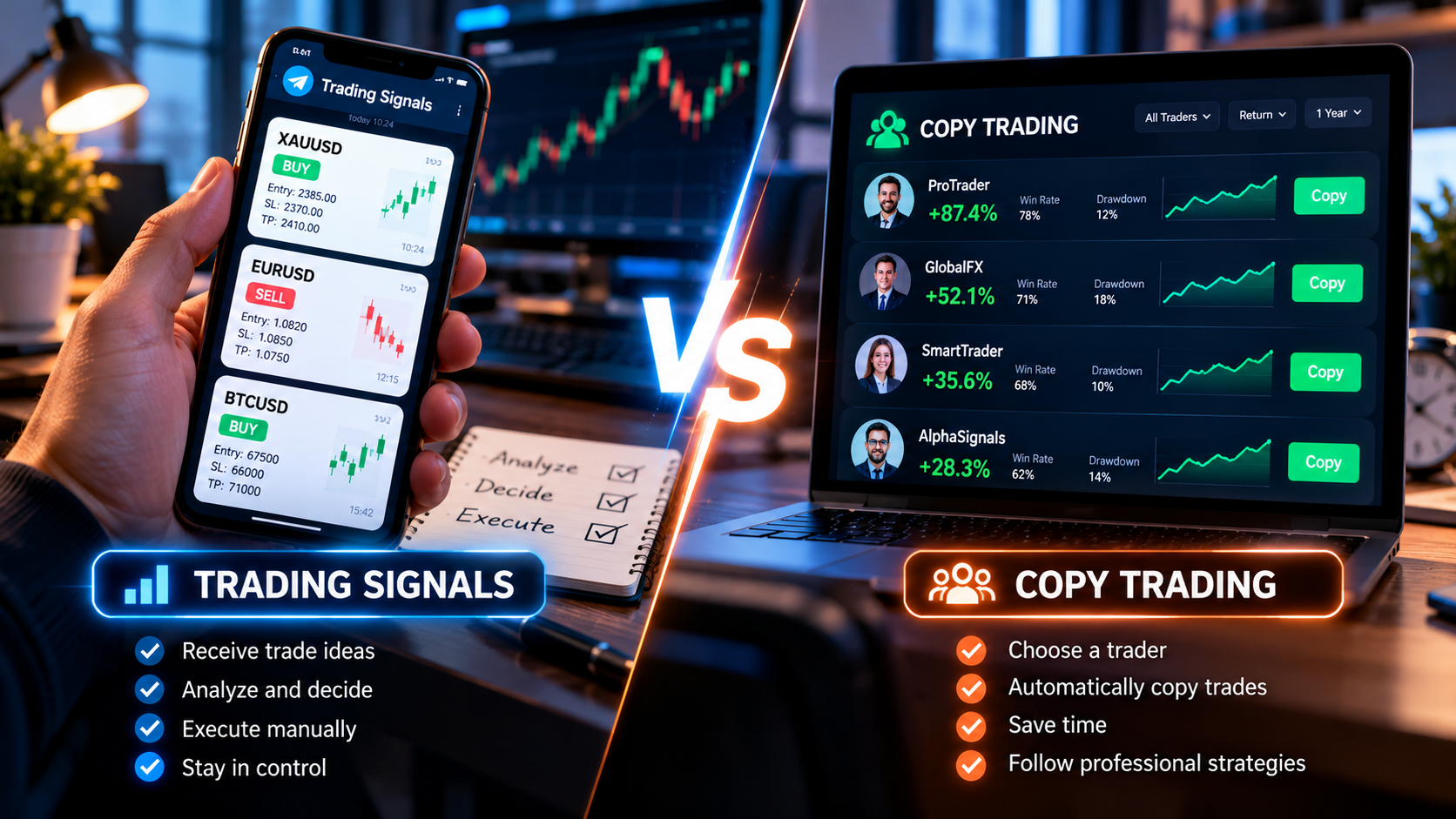
Signal vs Copy Trading: Which Is Better for Your Trading Style?
Signal vs Copy Trading: Which Is Better for Your Trading Style?
Should you follow trading signals manually or let a copy trading system replicate another trader’s positions automatically?
The signal vs copy trading debate has become increasingly important as traders look for ways to participate in Forex and other financial markets without analyzing every market opportunity from scratch.
Both approaches allow traders to benefit from someone else’s market analysis or trading decisions.
But they work very differently.
With trading signals, you normally receive information such as:
- Instrument
- Buy or Sell direction
- Entry price
- Stop Loss
- Take Profit
- Trade-management updates
You then decide whether to execute the trade.
With copy trading, the process is much more automated. You choose a trader or strategy, allocate capital, and the platform attempts to replicate that trader’s activity in your own account.
That creates a fundamental distinction:
Trading Signals = Information + Your Decision + Your Execution
Copy Trading = Trader Selection + Automated Replication
Neither method is automatically better.
The right choice depends on:
- Your experience
- Available time
- Desire to learn
- Need for control
- Risk tolerance
- Trading psychology
- Execution infrastructure
- Investment objectives
This guide compares signal vs copy trading across all of these factors so you can decide which approach fits your needs.
What Are Trading Signals?
A trading signal is a suggested market opportunity generated by an analyst, trader, strategy, algorithm, or research service.
A typical signal may look like this:
XAUUSD – BUY
Entry: 4,120
Stop Loss: 4,105
Take Profit 1: 4,140
Take Profit 2: 4,160
The provider identifies the opportunity.
But you remain responsible for deciding whether to take the trade.
This distinction is essential.
A trading signal is not an automatic guarantee of profit.
It is information that can support a trading decision.
FastPip provides market-based trading signals designed to give traders structured trade ideas while allowing users to retain control over execution and risk management.
Explore FastPip Trading Signals
Internal Link
How Trading Signals Work
Signals can be generated using:
- Technical analysis
- Fundamental analysis
- Price action
- Indicators
- Quantitative models
- Algorithmic systems
- Artificial intelligence
- A combination of several methods
They may be distributed through:
- Telegram
- Mobile applications
- Websites
- Trading platforms
- APIs
- Automated notification systems
Once the signal is received, the user normally needs to execute the trade manually unless some form of automation has been integrated.
That gives the trader greater control—but also creates greater responsibility.
Main Advantages of Trading Signals
You Keep Control
The trader decides whether a signal should be executed.
You can reject a trade if:
- Market conditions have changed
- The entry has already moved too far
- Your risk exposure is too high
- You already have correlated positions
- The trade does not fit your strategy
That flexibility is one of the biggest advantages of trading signals.
Signals Can Support Learning
Trading signals can also become educational tools.
Instead of blindly copying an entry, you can ask:
Why is this level important?
Why was this Stop Loss selected?
What market structure supports the trade?
What changed after entry?
By comparing the signal with your own analysis, you can gradually improve your understanding of the market.
FastPip’s guide to different trading styles can also help users understand how signals fit into scalping, day trading, swing trading and other approaches.
Internal Link
You Can Adjust Risk
Suppose the provider uses 1% risk.
You may choose:
0.5%
or:
0.25%
depending on your own account size and risk tolerance.
This gives signal users considerable flexibility.
Main Disadvantages of Trading Signals
Greater control also creates more opportunities for mistakes.
Signal users may:
- Enter late
- Use the wrong volume
- Move the Stop Loss
- Exit too early
- Miss updates
- Chase price
- Skip profitable signals
- Increase risk emotionally
This means the quality of the signal is only part of the final outcome.
Execution quality matters too.
What Is Copy Trading?
Copy trading allows an investor to automatically replicate the trades of another trader or strategy provider.
Instead of receiving an instruction and entering the position manually, the trading activity is transmitted through a copy trading platform.
A simplified process looks like:
Trader opens position → Copy system detects trade → Follower account replicates position
The UK’s Financial Conduct Authority describes copy trading as a system in which users select signal providers and trades may then be transformed into orders and executed without further manual intervention from the follower.
External DoFollow Link
FastPip also provides a dedicated environment for traders interested in this approach.
Internal Link
How Copy Trading Works
The process generally begins by selecting a trader.
Depending on the platform, users may evaluate information such as:
- Historical return
- Maximum Drawdown
- Number of trades
- Trading history
- Risk level
- Average holding period
- Instruments traded
- Win rate
- Strategy style
After choosing a trader, the user allocates capital.
When the master trader opens or closes positions, the copy trading system attempts to reproduce those actions on the follower account.
Position sizes may be scaled according to account size or allocation rules.
Signal vs Copy Trading: The Main Difference
The fundamental difference is who handles execution.
Trading Signals
The provider identifies the opportunity.
The user decides whether to trade and normally executes manually.
Copy Trading
The user selects a trader or strategy.
The platform then automates most day-to-day trade execution.
In simple terms:
| Factor | Trading Signals | Copy Trading |
|---|---|---|
| Trade selection | Provider suggests | Master trader decides |
| Final execution | Usually user | Usually automated |
| User control | High | Lower |
| Time requirement | Higher | Lower |
| Learning potential | Higher | Usually lower |
| Human execution errors | More likely | Reduced |
| Dependency | Signal provider | Master trader + platform |
| Automation | Low/optional | High |
Signal vs Copy Trading: Which Gives You More Control?
Trading signals provide more direct control.
A signal user can decide:
- Whether to enter
- When to enter
- Position size
- Whether to reduce risk
- Whether to skip a trade
- Whether to take partial profit
- Whether to close early
Copy trading deliberately removes much of that decision-making.
Once a trader has been selected, transactions are generally copied automatically.
This is useful for investors who want less day-to-day involvement.
But it also means accepting more dependence on another person’s strategy.
When More Control Is an Advantage
Greater control can help experienced traders.
Suppose a signal says BUY.
But you notice:
- Major news is approaching
- Spread has widened
- Price has already moved beyond the entry
- You already have excessive exposure
You can simply skip the trade.
Copy trading may execute the position automatically before you make such an assessment.
When More Control Becomes a Problem
Control is not always beneficial.
An inexperienced trader may receive a perfectly structured signal and then:
- Increase the volume
- Remove the Stop Loss
- Close too early
- Hold a losing position too long
In that situation, manual control damages performance.
Automation can sometimes improve discipline precisely because it reduces unnecessary intervention.
Signal vs Copy Trading for Beginners
For beginners, copy trading initially appears easier.
The user does not necessarily need to:
- Analyze charts
- Identify entries
- Monitor every setup
- Manually execute every position
However, simpler execution does not mean simpler risk.
A beginner still needs to understand:
- Drawdown
- Risk allocation
- Historical performance
- Leverage
- Position sizing
- Strategy behavior
Selecting the wrong trader can be just as dangerous as selecting the wrong signal provider.
The FCA has also warned consumers about promotions promising unrealistic returns through copy trades, managed accounts and trading tips.
FCA – CFD and Copy Trading Risk Warning
External DoFollow Link
Which Is Better for Beginners Who Want to Learn?
Trading signals may provide more educational value.
Why?
Because the user remains involved.
They see:
- Entry
- Stop Loss
- Targets
- Trade updates
- Market reaction
They can then study why the trade succeeded or failed.
Copy trading can become much more passive.
That may be ideal for someone who does not want to become a trader.
But it offers fewer incentives to develop independent analysis skills.
Time Required: Signal vs Copy Trading
Time is one of the clearest differences.
Trading Signals Require More Attention
Signal users may need to:
- Monitor notifications
- Check current prices
- Calculate position size
- Enter trades
- Apply updates
- Move Stop Losses
- Take partial profits
- Close positions
Some signals may remain valid for a long time.
Others may expire within minutes.
Copy Trading Requires Less Daily Involvement
After setup, copy trading is largely automated.
The user should still monitor:
- Trader performance
- Drawdown
- Risk changes
- Strategy changes
- Capital allocation
But constant manual execution is normally unnecessary.
Therefore, for someone with a demanding full-time schedule:
Copy Trading generally requires less daily attention.
Execution Speed: An Important Difference
This can significantly affect signal vs copy trading performance.
With manual signals:
Provider enters → Signal is published → User receives signal → User enters.
Every step creates potential delay.
With copy trading:
Provider enters → System automatically sends order → Follower account executes.
Human reaction time is reduced.
This can make copy trading particularly useful for:
- Scalping
- Short-term trading
- Fast-moving markets
However, automated execution still cannot guarantee identical results.
Differences may remain because of:
- Latency
- Broker pricing
- Spread
- Slippage
- Liquidity
- Account size
FastPip’s recent guide on different trading styles explains why short-term strategies are particularly sensitive to execution costs and speed.
Internal Link
Signal vs Copy Trading: Which Is More Profitable?
There is no universal answer.
The statement:
“Copy trading is more profitable.”
is incorrect.
So is:
“Signals are more profitable.”
Profitability depends on:
- Quality of the provider
- Strategy expectancy
- Risk management
- Drawdown
- Execution
- Costs
- Market conditions
An excellent signal service can outperform a weak copy trader.
An excellent copy trader can outperform a weak signal provider.
The delivery method itself does not create profitability.
Why Signals Can Sometimes Perform Better
An experienced user can filter opportunities.
For example, the trader may choose not to execute a signal because:
- Entry has expired
- Market conditions changed
- A major event is approaching
- Portfolio exposure is too high
This discretion can improve results when the trader genuinely understands the market.
Why Copy Trading Can Sometimes Perform Better
Copy trading removes many user mistakes.
It can reduce:
- Late entry
- Emotional hesitation
- Missed trades
- Incorrect order parameters
A strong strategy executed consistently can outperform the same strategy when users constantly interfere with it.
Risk Management in Signal vs Copy Trading
Risk management remains essential in both methods.
Neither signals nor copy trading remove market risk.
Risk Management With Trading Signals
The user normally controls:
- Position size
- Risk per trade
- Maximum exposure
- Number of simultaneous positions
This gives the user substantial flexibility.
But it also means mistakes are their responsibility.
Risk Management With Copy Trading
Risk management operates more at the allocation level.
The investor decides:
- How much capital to allocate
- Which trader to follow
- Whether to diversify
- When to stop copying
The trader or strategy provider usually determines the individual trade decisions.
Drawdown Matters More Than Headline Profit
Imagine:
Trader A
Annual Return: 80%
Maximum Drawdown: 55%
Trader B
Annual Return: 50%
Maximum Drawdown: 12%
Trader A appears more profitable.
But Trader B may have a much more attractive risk profile.
This principle applies equally to signal providers and copy traders.
Do not compare services using return alone.
Hidden Risks of Trading Signals
Signal Dependency
A user may gradually stop analyzing markets independently.
The signal becomes the entire decision-making process.
Execution Delay
Manual entry can produce worse prices than the provider.
Poor Risk Adjustment
Some users blindly copy lot sizes rather than calculating account-relative risk.
Selective Reporting
Some providers may focus marketing on successful trades.
Users should examine complete performance records where available.
Emotional Intervention
Users can modify otherwise valid trades because of fear or greed.
A detailed trading journal can help identify these behaviors.
FastPip – Trading Journal Writing
Internal Link
Hidden Risks of Copy Trading
Copy trading eliminates some manual problems but introduces others.
Dependence on the Master Trader
When the trader makes poor decisions, followers participate in those decisions.
Strategy Drift
A trader may change:
- Risk levels
- Instruments
- Position sizing
- Strategy style
Past performance may therefore stop representing current behavior.
Drawdown Risk
High historical returns may hide aggressive risk-taking.
Concentration Risk
Allocating all capital to one trader creates dependency on one strategy.
Technical Risk
Copy systems can experience:
- Latency
- Connection problems
- Execution differences
- Software errors
Performance Differences
Follower results may differ from master-account results due to execution conditions.
The FCA’s regulatory description of copy trading also makes clear that copy platforms convert a provider’s signals into orders for execution, meaning there is still an execution layer between the original decision and the follower account.
Signal vs Copy Trading and Trading Psychology
Psychology produces another major difference.
Signals Require More Emotional Discipline
The user sees every trade and makes the final decision.
This creates opportunities for:
- Fear
- FOMO
- Greed
- Revenge trading
- Hesitation
- Overconfidence
A trader may skip the next signal after two losses.
Ironically, that trade may be the winner that was statistically expected to recover part of the drawdown.
Copy Trading Reduces Day-to-Day Decisions
Because execution is automated, the user has fewer opportunities to interfere with individual positions.
That may reduce:
- Hesitation
- Early exits
- FOMO entries
- Emotional Stop Loss changes
But emotions are not eliminated.
A follower may still panic during drawdown and stop copying at the worst possible time.
Learning Potential: Signal vs Copy Trading
If your long-term goal is to become an independent trader, signals usually offer greater learning potential.
You can analyze:
- Why the provider entered
- Market structure
- Stop placement
- Target selection
- Trade management
- Outcome
Over time, patterns may become recognizable.
Copy Trading Is More Focused on Delegation
Copy trading is typically better suited to someone who wants exposure without making every trading decision personally.
It is therefore closer to a delegation model.
That can be useful.
But it should not be confused with learning how to trade independently.
Cost of Trading Signals
Signal services may involve:
Subscription Fees
Monthly, quarterly or annual payments.
Spread
Paid through the trading account.
Commission
Depending on broker and account type.
Slippage
A hidden execution cost.
Time
Manual management itself has an opportunity cost.
For smaller accounts, subscription fees can represent a meaningful percentage of available capital.
Cost of Copy Trading
Copy trading fee models vary significantly.
Depending on the platform, costs may include:
- Performance fees
- Management fees
- Spread
- Commission
- Platform fees
- Other service charges
You should therefore calculate net return after all costs, not simply gross reported performance.
There is no universal rule that makes either signals or copy trading cheaper.
Signal vs Copy Trading Comparison Table
| Feature | Trading Signals | Copy Trading |
|---|---|---|
| Manual execution | Usually yes | Usually no |
| Control | High | Lower |
| Time requirement | Higher | Lower |
| Learning potential | High | Moderate/Low |
| Emotional involvement | Higher | Lower |
| Execution delay | Potentially higher | Usually lower |
| Strategy selection | Signal provider | Master trader |
| Trade-by-trade choice | Yes | Usually limited |
| Automation | Optional | Core feature |
| Dependency risk | Signal provider | Master trader/platform |
| Risk control | Per trade | Mainly allocation/system level |
| Best suited to | Active users | More passive users |
Who Should Choose Trading Signals?
Signals may be a better fit if you:
- Want to learn trading
- Want control over every position
- Understand risk management
- Have time to monitor signals
- Want to filter trades
- Prefer manual execution
- Want to combine external analysis with your own
For these users, a signal is an input into the decision-making process.
It does not replace the trader.
Who Should Choose Copy Trading?
Copy trading may be more suitable if you:
- Have limited time
- Prefer automation
- Do not want to monitor every signal
- Are comfortable delegating trading decisions
- Want to follow an established strategy
- Understand how to evaluate traders and drawdown
Automation is the primary benefit.
But you still need to evaluate risk.
Who Should Avoid Blindly Using Either Method?
You should be cautious if your decision is based mainly on claims such as:
- “Guaranteed profit”
- “95% win rate”
- “No losses”
- “Risk-free trading”
- “Make money every day”
- “Copy this trader and become profitable automatically”
The FCA has specifically warned about unrealistic-return promotions connected with copy trades, managed accounts and daily trading tips.
Always investigate the actual service or provider rather than trusting promotional claims.
Can You Use Trading Signals and Copy Trading Together?
Yes.
They solve different problems.
A trader might:
- Allocate part of the account to copy trading
- Use another portion for manually executed signals
- Continue learning independent analysis
This can create diversification across execution styles.
However, there is an important risk:
Overlapping exposure.
Suppose your copy trader buys gold.
Then you manually execute a Gold BUY signal.
Your total XAUUSD exposure may become much larger than intended.
Therefore, users combining both approaches should monitor overall portfolio risk.
Signal vs Copy Trading for Small Accounts
Account size can affect the economics of each method.
With signals, a fixed monthly subscription can represent a relatively large percentage of a small account.
For example:
Account size: $500
Subscription: $50/month
The service costs:
10% of the account every month
before any trading profit or loss.
That is significant.
Copy trading may use a different fee structure, but minimum allocation requirements and position-size rounding can also matter.
Small accounts should therefore evaluate costs especially carefully.
Signal vs Copy Trading for Experienced Traders
An experienced trader may prefer signals because they can use the provider’s analysis as a second opinion.
For example:
The trader receives a BUY signal.
They examine their own analysis.
If both align, they execute.
If not, they skip it.
This creates a hybrid decision process.
For an experienced trader, the extra control can be valuable.
Signal vs Copy Trading for Busy Investors
For people with limited time, copy trading normally has the stronger advantage.
Manual signals require timely action.
A trader cannot always respond immediately while:
- Working
- Travelling
- Sleeping
- In meetings
Copy trading removes much of this timing problem.
But it does not eliminate the need for periodic oversight.
How to Evaluate a Signal Provider
Before paying for trading signals, check:
Track Record
Is the history long enough to evaluate?
Drawdown
What was the worst decline?
Risk Per Trade
How much capital is typically exposed?
Losing Trades
Are losses shown transparently?
Execution Sensitivity
Does the strategy depend on extremely fast entry?
Risk-to-Reward
Are average winners and losers reasonable?
Trading Style
Is it scalping, intraday, swing, or another method?
Transparency
Are rules and results understandable?
How to Evaluate a Copy Trader
Before allocating capital, check:
Length of History
A few weeks of performance are not enough.
Maximum Drawdown
Large returns with extreme drawdown deserve caution.
Number of Trades
Look for a meaningful sample.
Strategy Consistency
Has the trader suddenly changed style?
Risk Per Position
How aggressive is exposure?
Leverage
Does the trader depend heavily on leverage?
Martingale or Averaging
Determine whether losing positions are repeatedly increased.
Recovery Time
How long did previous drawdowns take to recover?
Transparency
Can you understand how the performance was generated?
Avoid Choosing Based Only on Win Rate
A trader with a 90% win rate is not automatically superior.
Consider:
Strategy A
Win Rate: 90%
Average Win: $10
Average Loss: $150
Strategy B
Win Rate: 45%
Average Win: $100
Average Loss: $40
Strategy B may have substantially better expectancy despite losing more often.
This applies both to signal providers and copy traders.
Keep a Trading Journal Even When Copying Others
A journal is useful even when you are not making every trade yourself.
Record:
- Provider or trader followed
- Allocation
- Drawdown
- Monthly result
- Changes in strategy
- Risk level
- Reasons for continuing or stopping
For signal users, also record individual execution details.
FastPip’s Trading Journal guide explains how systematic records can help traders identify behavioral and performance patterns.
FastPip – Trading Journal Writing
Internal Link
Professional Checklist: Signal vs Copy Trading
Before choosing between the two, answer these questions.
1. Do You Want to Learn Trading?
Yes → Signals may offer more learning opportunities.
No → Copy trading may be more suitable.
2. How Much Time Do You Have?
Plenty → Signals are practical.
Very little → Copy trading has an advantage.
3. Do You Want Full Trade Control?
Yes → Signals.
No → Copy trading.
4. Can You Execute Quickly?
If not, automated copying may reduce execution delay.
5. Can You Manage Your Emotions?
Signal execution requires greater behavioral discipline.
6. Can You Evaluate Another Trader’s Risk?
This is essential for copy trading.
7. Can You Manage Position Size?
This remains essential in either method.
8. Are You Comfortable With Drawdown?
Neither method avoids losing periods.
9. Do You Want Passive or Active Participation?
Active → Signals.
More passive → Copy trading.
10. Are Costs Reasonable for Your Account Size?
Calculate all subscription, performance, spread and commission costs before deciding.
Which Method Is Better?
There is no universal winner in signal vs copy trading.
The better method is the one aligned with the user.
Choose Trading Signals if you value:
- Control
- Learning
- Flexibility
- Manual decision-making
- Custom risk management
Choose Copy Trading if you value:
- Automation
- Lower time commitment
- Reduced manual execution
- Less day-to-day decision-making
- Delegation to another trader
The key is not to ask:
“Which method makes more money?”
Instead ask:
“Which method can I use correctly, consistently, and with controlled risk?”
That question is much more useful.
Conclusion: Signal vs Copy Trading Is About Fit, Not a Universal Winner
The signal vs copy trading comparison does not produce a single answer for every trader.
Trading signals provide more control.
They allow users to:
- Decide whether to enter
- Adjust position size
- Evaluate the trade
- Learn from the setup
- Develop independent skills
But they also require:
- More time
- Faster reactions
- Better discipline
- Greater involvement
- More responsibility
Copy trading offers:
- Automation
- Reduced manual execution
- Lower daily time commitment
- Less trade-by-trade decision-making
But users become more dependent on:
- The selected trader
- The copy trading platform
- The trader’s risk management
- Technical execution
The FCA’s description of copy trading reflects this distinction clearly: once the user selects a provider, the system may transform the provider’s signals into orders automatically rather than requiring manual input for every trade.
Neither model eliminates risk.
Neither guarantees profit.
And neither replaces proper capital management.
If your goal is to become an independent trader and understand the market deeply, trading signals may be the stronger educational tool.
If your primary objective is lower involvement and automated execution, copy trading may be the more practical choice.
Some traders may even use both.
What matters most is understanding exactly what you are delegating, what you still control, and how much risk you are accepting.
A professional trader does not choose between signals and copy trading because one sounds easier.
They choose the approach that fits their:
Time + Knowledge + Risk Tolerance + Objectives + Trading Psychology
That is the real answer to signal vs copy trading.
Frequently Asked Questions
What is the difference between signal vs copy trading?
Trading signals provide trade information that users normally execute themselves. Copy trading automatically replicates the trades of another selected trader or strategy.
Is copy trading better than trading signals?
Not universally. Copy trading is generally more automated and requires less daily involvement, while signals offer greater control and learning opportunities.
Are trading signals better for learning?
Usually yes. Signal users remain involved in entry, risk management and trade evaluation, making it easier to study the logic behind individual positions.
Is copy trading suitable for beginners?
It can be simpler operationally, but beginners still need to understand risk, drawdown, leverage and how to evaluate the trader being copied.
Which is more profitable, signals or copy trading?
Neither method is inherently more profitable. Performance depends mainly on strategy quality, risk management, execution, costs and market conditions.
Which requires less time?
Copy trading normally requires less daily involvement because trades are executed automatically.
Which gives the trader more control?
Trading signals generally provide more control because users can decide whether to execute each trade and how much risk to take.
Is copy trading risk-free?
No. Followers participate in the losses as well as the gains of the trader they copy, and technical or execution differences can also affect results.
Can trading signals guarantee profit?
No. Signals identify potential opportunities, but every trade remains exposed to market risk.
Can I use trading signals and copy trading together?
Yes, but total portfolio exposure must be monitored carefully to prevent overlapping positions or excessive risk.
Does copy trading eliminate emotional trading?
It reduces the number of trade-by-trade decisions users need to make, but investors can still react emotionally to drawdowns or poor performance.
What should I check before choosing a signal provider?
Review track record, drawdown, risk per trade, transparency, losing trades, risk-to-reward and execution requirements.
What should I check before choosing a copy trader?
Examine historical performance, drawdown, trading history, risk level, leverage, strategy consistency, position sizing and whether martingale or aggressive averaging is used.
Is copy trading regulated?
Regulatory treatment depends on jurisdiction and how the service operates. In the UK, the FCA explains that some forms of automatic copy trading can fall within portfolio or investment management requirements.
Which is better for someone with a full-time job?
Copy trading may be more practical because it removes much of the need to react manually to trading opportunities during the day.