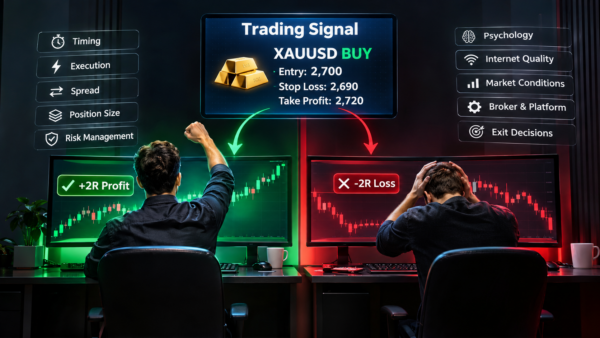
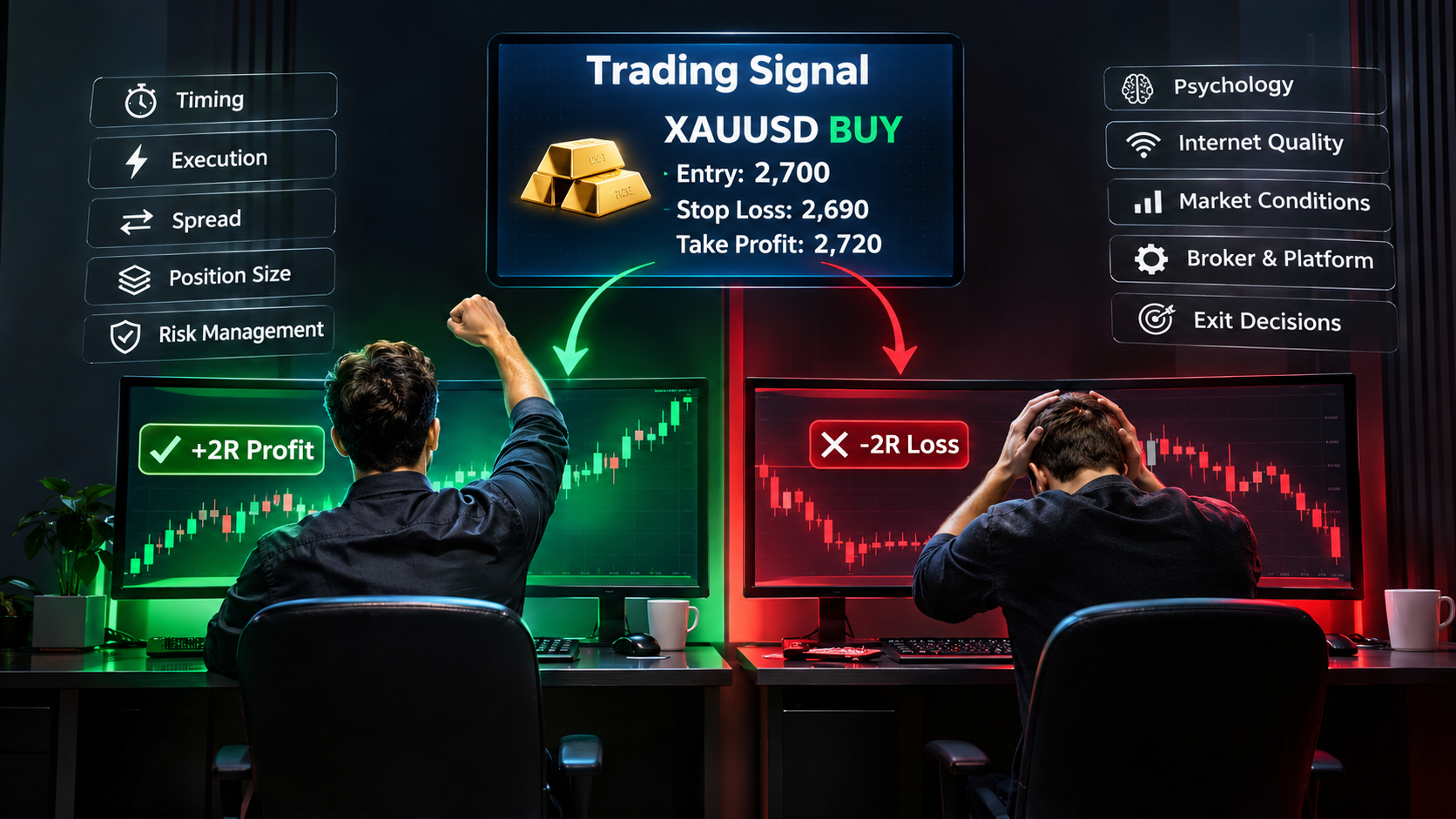
Why the Same Trading Signal Produces Different Results
Why the Same Trading Signal Produces Different Results
Two traders receive exactly the same trading signal.
Same market.
Same direction.
Same entry.
Same Stop Loss.
Same Take Profit.
Yet one trader finishes with a strong profit while the other makes a small profit, breaks even, or even loses money.
How is that possible?
The answer is simple:
A trading signal is only the starting point.
The final result depends on how that signal is executed.
This is why same trading signal different results is not an unusual situation in Forex, Gold, indices, crypto, or other actively traded markets.
Several variables can separate one trader’s outcome from another:
- Entry timing
- Execution speed
- Slippage
- Spread
- Broker conditions
- Position size
- Account size
- Stop Loss management
- Early exits
- Emotional decisions
- Internet quality
- Market conditions
- Discipline
Even small differences can accumulate.
A trader entering XAUUSD only a few seconds later may receive a worse price.
Another trader may use a larger lot size and become emotionally uncomfortable during a normal pullback.
Someone else may move the Stop Loss or close the trade before the original target.
By the end, all three traders technically followed the same signal—but they did not execute the same trade.
Understanding this distinction is essential for evaluating both trading signals and your own performance.
Why the Same Trading Signal Can Produce Different Results
A trading signal usually provides a framework.
For example:
XAUUSD BUY
Entry: 2,680
Stop Loss: 2,670
Take Profit: 2,700
At first glance, the trade appears identical for everyone.
But real execution introduces additional variables.
Trader A may enter at:
2,680.10
Trader B:
2,682.50
Trader C:
2,684.00
The direction is the same.
The risk-to-reward is no longer the same.
This is the first reason same trading signal different results occurs so frequently.
A Signal Is an Opportunity, Not a Guaranteed Outcome
Many beginners think of a signal as a finished product.
It is not.
A signal is closer to a trade plan.
The trader still has to convert that plan into an actual market position.
That process involves:
- Order submission
- Execution
- Position sizing
- Risk management
- Ongoing trade management
- Exit decisions
Every step creates opportunities for variation.
Entry Timing Is One of the Biggest Factors
Timing is critical.
Imagine a BUY signal is issued at:
EURUSD 1.0800
Trader A sees the message immediately and enters at:
1.0801
Trader B checks the phone five minutes later and enters at:
1.0820
Suppose the original Stop Loss is:
1.0780
and the target:
1.0840
For Trader A:
Risk ≈ 21 pips
Reward ≈ 39 pips
For Trader B:
Risk ≈ 40 pips
Reward ≈ 20 pips
The signal is identical.
The trade structure is not.
Late Entry Can Destroy Risk-to-Reward
One of the biggest problems with delayed execution is deterioration in risk-to-reward.
A setup originally designed around:
1:2 Risk/Reward
can easily become:
1:1
or worse after price has already moved.
This matters because profitability depends not only on direction but also on entry quality.
When Is a Signal Too Late to Enter?
A trader should never assume a signal remains valid indefinitely.
Ask:
- Has price moved significantly from entry?
- Is the original Stop Loss still logical?
- Has most of the expected movement already happened?
- Has the market structure changed?
- Has major news been released since the signal?
Sometimes the correct decision is:
Do not enter.
A late entry can effectively become a completely different trade.
Execution Is Not Instantaneous
Another important factor is trade execution.
Investor.gov explains that trade execution takes time and that prices can change between the moment an order is submitted and the moment it reaches the market, particularly in fast-moving conditions.
Investor.gov – Executing an Order
This principle applies broadly to active trading:
The displayed price is not always the executed price.
Slippage Can Change the Result
Slippage occurs when an order is executed at a different price than expected.
Suppose the signal says:
Gold BUY at 2,700
You click BUY.
Your actual fill:
2,701.20
That 1.20 difference is slippage.
In a long-term position, it may have limited impact.
In a short-term strategy, it can be significant.
Why Slippage Happens
Common reasons include:
- Fast price movement
- Major economic news
- Low liquidity
- Large order size
- Execution delay
- Broker infrastructure
- Market gaps
Slippage is not automatically evidence of broker misconduct.
It is a normal feature of fast-moving markets.
Slippage Can Affect Entry and Exit
Most traders think only about entry slippage.
But it can occur during:
- Entry
- Stop Loss execution
- Take Profit execution
- Manual close
This means two traders can experience different results even if they both execute the same signal at roughly the same time.
Market Orders Do Not Guarantee Price
Investor.gov explains that a market order generally seeks immediate execution but does not guarantee the execution price.
Investor.gov – Types of Orders
This is especially important during high volatility.
A signal price is a reference.
The actual market fill may differ.
Spread Differences Matter
Another important reason for same trading signal different results is broker spread.
Spread is the difference between bid and ask prices.
Different brokers may offer different spreads on the same instrument.
For example:
Broker A
XAUUSD spread: 15 points
Broker B
XAUUSD spread: 40 points
Even before the market moves, the two traders begin with different transaction costs.
Spread Matters More in Short-Term Trading
Suppose a scalping strategy targets:
8 pips
A 2-pip spread consumes:
25% of the target.
A 0.5-pip spread consumes:
6.25%.
That difference can materially change profitability over hundreds of trades.
Spread Can Expand During News
Many traders assume spread is fixed.
It often is not.
During:
- NFP
- CPI
- Interest-rate decisions
- Central-bank speeches
- Major geopolitical events
liquidity conditions can change and spreads can widen sharply.
That means two traders may receive significantly different fills even on the same signal.
Different Brokers Can Produce Different Results
Broker differences may include:
- Spread
- Execution speed
- Liquidity providers
- Server location
- Symbol specifications
- Swap
- Commission
- Contract size
Therefore, comparing your result directly with a signal provider without accounting for broker conditions can be misleading.
Position Size Changes the Financial Result
Two traders can enter and exit at exactly the same prices and still experience very different account outcomes.
Example:
Trader A
0.10 lot
Trader B
1.00 lot
The market movement is identical.
The monetary result is approximately ten times larger for Trader B.
This affects not only money.
It affects psychology.
Large Position Size Can Change Trader Behavior
Suppose both traders are temporarily:
-30 pips
Trader A loses:
$30
Trader B loses:
$300
Trader B may become much more emotionally uncomfortable and:
- Close early
- Move Stop Loss
- Hedge unexpectedly
- Reverse the position
Now the two traders no longer follow the same system.
Position Size Should Be Based on Risk
A professional approach should consider:
- Account balance
- Stop Loss distance
- Maximum percentage risk
rather than choosing lot size randomly.
For example:
Account: $10,000
Risk: 1%
Maximum loss: $100
Position size should be calculated so that reaching the Stop Loss produces approximately the intended $100 loss.
Money Management Can Matter More Than Signal Accuracy
A good signal does not protect an account from poor money management.
Imagine ten signals.
Seven win.
Three lose.
Trader A risks:
1% per trade
Trader B risks:
15% per trade
Both follow the same signals.
A losing streak of three trades affects them completely differently.
Trader A:
approximately -3%
Trader B:
potentially devastating Drawdown.
A Good Signal With Bad Risk Management Can Still Destroy an Account
This is one of the most important lessons.
Traders sometimes assume:
“This signal provider is good, so I can increase the lot size.”
That logic is dangerous.
No signal has a 100% probability of success.
Every strategy experiences losses.
Risk management exists precisely because losses cannot be eliminated.
Account Size Also Changes the Experience
Suppose:
Trader A has $500.
Trader B has $50,000.
Even if both theoretically risk the same percentage, the practical experience can differ due to:
- Minimum lot size
- Margin requirements
- Psychological significance of losses
- Ability to diversify
- Flexibility in position sizing
Small accounts often have less room for execution errors.
Stop Loss Management Creates Major Differences
Suppose both traders receive:
Entry: 1.1000
Stop Loss: 1.0950
Trader A respects the original Stop Loss.
Trader B sees price falling and moves Stop Loss to:
1.0900
The original risk:
50 pips
New risk:
100 pips
They are no longer executing the same trade.
Moving Stop Loss Can Turn a Small Loss Into a Large Loss
One of the most common emotional behaviors is refusing to accept a planned loss.
The trader thinks:
“Price will come back.”
Sometimes it does.
Sometimes it does not.
Repeatedly increasing the allowed loss changes the entire statistical profile of the strategy.
Tightening the Stop Too Much Can Also Cause Problems
The opposite can happen.
A trader becomes nervous and moves the Stop Loss closer.
Normal market volatility hits the stop.
Then price moves toward the original target.
Provider result:
Profit
Trader result:
Loss
Again:
Same signal.
Different execution.
Early Profit-Taking Changes Results
Another major difference is closing a trade before Take Profit.
Suppose:
Signal target: +100 pips
Trader A waits.
Trader B closes at +30 pips because they fear losing the profit.
Both are technically profitable.
But if this behavior repeats across dozens of trades, Trader B’s long-term expectancy may become much weaker.
Small Winners and Full Losses Can Destroy Expectancy
Imagine the original strategy expects:
Average winner: +2R
Average loss: -1R
A trader repeatedly closes winning trades early at:
+0.5R
but still takes full:
-1R losses.
The strategy statistics no longer apply.
This can turn a profitable signal system into an unprofitable personal result.
Greed Can Create the Opposite Problem
A trader may also refuse to take the planned profit.
Signal:
TP reached.
Instead of closing, the trader thinks:
“Maybe it can run another 100 pips.”
Price reverses.
The official signal is profitable.
The user’s result may be break-even or negative.
Trading Psychology Changes Execution
Psychology is one of the biggest reasons for same trading signal different results.
Two traders do not react identically to:
- Floating losses
- Floating profits
- Volatility
- News
- Drawdown
Common emotions include:
- Fear
- Greed
- Anxiety
- Overconfidence
- FOMO
These emotions can change execution even when the original signal is identical.
Fear Can Shrink Profits
Fear often causes traders to:
- Enter late
- Close too early
- Reduce position after entry
- Tighten Stop Loss unnecessarily
A trader may correctly identify the opportunity but still fail to capture the expected result.
Greed Can Increase Risk
Greed may cause traders to:
- Increase lot size
- Ignore Take Profit
- Add positions without a plan
- Trade every signal
This increases variance and account exposure.
Experience Changes How Traders Interpret Signals
An experienced trader may view a signal as:
One probability inside a larger trading process.
A beginner may view it as:
A prediction that should be correct.
That difference affects behavior.
Experienced traders generally understand:
- Losses are normal
- Temporary adverse movement is normal
- One signal means little statistically
Beginners may react to every candle.
Trading Experience Is More Than Years
Experience should not be measured only by time.
A trader who has spent five years repeating the same mistakes may be less developed than someone who has spent two years:
- Journaling
- Backtesting
- Reviewing errors
- Managing risk consistently
Quality of learning matters.
Market Conditions Can Change After the Signal
A signal is generated based on a specific market environment.
But that environment can change quickly.
For example:
10:00 → BUY signal issued
10:04 → Major headline released
10:06 → Volatility spikes
The trader entering at 10:06 is not entering the same market environment as the provider at 10:00.
News Can Invalidate a Setup
Economic events can dramatically change:
- Volatility
- Liquidity
- Spread
- Direction
- Execution
This means traders should consider whether the original setup remains valid before blindly entering a delayed signal.
Liquidity Matters Too
The same instrument behaves differently across trading sessions.
For example:
EURUSD during London–New York overlap generally has very different liquidity characteristics from quiet late-session trading.
Execution conditions therefore change with time.
Internet Quality Can Affect Results
For many swing traders, a minor internet delay may not matter much.
For fast strategies, it can matter significantly.
Potential problems include:
- Delayed notification
- Slow platform response
- Interrupted connection
- Order submission delay
These can all change execution price.
Platform Speed and Server Location Matter
Execution involves more than your internet speed.
It can also depend on:
- Broker server
- Trading platform
- Data center
- Network latency
- Routing
This becomes particularly relevant in:
- Scalping
- News trading
- Very short-term signals
Symbol Differences Can Affect the Trade
Two brokers may use:
XAUUSD
and:
XAUUSD.a
or:
XAUUSDm
These symbols may have different:
- Contract sizes
- Spreads
- Swap
- Trading hours
- Quote feeds
A signal should ideally be executed on the intended underlying instrument with compatible specifications.
Contract Size Can Change Position Risk
Suppose one broker defines a Gold contract differently from another.
Using the same lot number may not create the same exposure.
This is why traders should understand symbol specifications rather than blindly copying position size.
Discipline Is the Bridge Between Signal and Result
A trading signal may be excellent.
But its value depends on disciplined execution.
A trader needs rules for:
- Entry
- Position size
- Stop Loss
- Take Profit
- Maximum account risk
- Signal validity
Without these rules, every signal becomes subject to improvisation.
Changing Signal Rules Creates a New Strategy
This is a powerful principle.
If a trader changes:
- Entry
- Stop Loss
- Target
- Position size
they are no longer testing the provider’s original signal.
They are testing their own modified version.
This is why comparing the two results directly can become misleading.
Why Traders Modify Signals
Common reasons include:
- Fear
- Greed
- Personal analysis
- Previous losses
- Desire for larger profit
- Desire for smaller Stop Loss
Some modifications may be logical.
But they should be deliberate and measurable.
Not emotional.
Signal Quality vs. Execution Quality
When a trade goes wrong, ask two separate questions.
Question 1
Was the original signal logically valid?
Question 2
Did I execute it according to the intended rules?
These are completely different questions.
A good signal can produce a poor user result.
A poor signal can occasionally produce a good result.
Do Not Judge a Signal From One Trade
One trade has limited statistical value.
A signal service should be evaluated across a meaningful sample.
FastPip has already explained how isolated profit screenshots can misrepresent real performance.
FastPip – Trading Signal Profit Screenshots
Track Provider Result vs. Your Result
This is one of the best ways to understand execution differences.
Maintain two columns:
| Trade | Provider | Your Account |
|---|---|---|
| 1 | +100 pips | +82 pips |
| 2 | -50 pips | -58 pips |
| 3 | +70 pips | +20 pips |
| 4 | +120 pips | +115 pips |
Now investigate why differences occurred.
Possible explanations:
- Late entry
- Slippage
- Early exit
- Different spread
- Stop modification
This produces real evidence.
Use a Trading Journal
A trading journal can help identify whether the problem comes from:
Signal quality
or:
execution quality
Record:
- Signal time
- Provider entry
- Your entry
- Provider exit
- Your exit
- Slippage
- Spread
- Position size
- Emotional decisions
- Final result
FastPip – Trading Journal Writing
Execution Difference Can Be Measured
Suppose the provider’s entry was:
2,700.00
Your entry:
2,701.50
Difference:
1.50
Track this across 100 trades.
You may discover that your average execution disadvantage is significant.
Now you can work on the correct problem.
A Simple Same-Signal Example
Signal:
XAUUSD BUY
Entry: 2700
SL: 2690
TP: 2720
Trader A
Entry: 2700
Risk: 1%
Waits for TP
Result:
+2R
Trader B
Entry: 2705
Risk: 3%
Closes at 2710
Result:
Approximately:
+0.33R
Trader C
Entry: 2700
Moves SL to 2680
Price drops before recovering.
Result:
Potentially:
-2R
Same original signal.
Three completely different outcomes.
Same Trading Signal Different Results: The Main Variables
The key variables are:
Execution Timing
When did you enter?
Entry Price
What price did you actually receive?
Spread
How much transaction cost did you face?
Slippage
Did the order execute away from the expected price?
Position Size
How much capital was exposed?
Stop Loss
Was it respected?
Take Profit
Was the planned exit followed?
Psychology
Did fear or greed interfere?
Market Conditions
Did the environment change?
Technology
Was execution delayed?
These factors explain most differences.
How to Reduce Result Differences
You cannot make every execution identical.
But you can reduce unnecessary variation.
1. Define Maximum Entry Deviation
Example:
Do not enter if price has moved more than:
20% of the distance from entry to target.
This prevents chasing.
2. Use Consistent Position Sizing
Calculate risk before entry.
Do not increase lot size simply because you like the signal.
3. Respect Stop Loss
Avoid emotional widening.
4. Define Exit Rules Before Entry
Know whether you will:
- Close fully at TP
- Use partial exits
- Trail Stop Loss
before the trade begins.
5. Monitor Spread
Avoid entering when spread becomes abnormal relative to the target.
6. Keep Records
Compare provider performance with your real execution.
When Should You Skip a Signal?
Skip or reassess when:
- Price has moved too far from entry
- Spread has expanded sharply
- Major news has changed conditions
- Original Stop Loss is no longer logical
- Risk-to-reward has deteriorated
- You cannot size the position properly
Missing a trade is often better than forcing a bad entry.
Why Copy Trading Can Reduce Some Differences
Copy trading can automate certain execution steps.
Potentially reducing:
- Human delay
- Manual entry mistakes
- Emotional hesitation
But it does not eliminate:
- Slippage
- Broker differences
- Position-sizing errors
- Infrastructure differences
So identical results are still not guaranteed.
Signal Provider Results Are Not Automatically Your Results
This is one of the most important conclusions.
When a provider reports:
+500 pips
that does not automatically mean every follower earned exactly 500 pips.
Follower results can differ because of:
- Entry deviation
- Spread
- Slippage
- Missed trades
- Trade management
This is normal.
The question is how large and consistent those differences are.
When Large Differences Become a Problem
If the provider repeatedly reports:
+100
while your results are:
-20
+10
-40
investigate.
Possible reasons include:
- Signals arriving late
- Unrealistic published entries
- Different trading conditions
- Your execution behavior
Large persistent differences deserve analysis.
A Professional Checklist Before Executing Any Signal
1. Is Price Still Near the Intended Entry?
If not, reconsider.
2. Is Spread Normal?
Avoid unusual transaction costs.
3. Has Market Structure Changed?
The original setup may no longer exist.
4. Is Major News Approaching?
Volatility may change rapidly.
5. Have I Calculated Position Size?
Risk should be intentional.
6. Is the Stop Loss Clear?
Know maximum loss.
7. Is Risk-to-Reward Still Acceptable?
Late entry can destroy it.
8. Will I Follow the Exit Plan?
Decide before entering.
9. Am I Emotionally Comfortable With the Risk?
Oversized trades change behavior.
10. Can I Record the Trade?
Tracking makes future analysis possible.
Conclusion: Why the Same Trading Signal Produces Different Results
The reason same trading signal different results occurs is that the signal represents only the beginning of the trading process.
The final outcome depends on many additional variables:
- Entry timing
- Slippage
- Spread
- Broker execution
- Position size
- Account size
- Stop Loss discipline
- Exit behavior
- Psychology
- Market conditions
- Technology
- Trading discipline
Two traders can therefore receive exactly the same analysis and still execute fundamentally different trades.
The most important principle is:
Signal Quality + Execution Quality = Real Trading Result
A strong signal cannot fully compensate for:
- Poor risk management
- Late entry
- Emotional decisions
And good execution cannot guarantee that every signal wins.
Professional traders therefore evaluate both sides separately.
Ask:
Was the signal good?
Then ask:
Did I execute it correctly?
That distinction is one of the most important steps toward understanding your real trading performance.
Frequently Asked Questions
Why can the same trading signal produce different results?
Because traders may have different entry prices, spreads, slippage, position sizes, brokers, Stop Loss behavior, exit decisions, and emotional reactions.
Can two traders use the same signal and one win while the other loses?
Yes. A late entry, early exit, wider Stop Loss, or different execution price can completely change the result.
Does entry timing matter for trading signals?
Yes. Even a small delay can change entry price and risk-to-reward, especially in fast-moving markets.
What is slippage?
Slippage is the difference between the expected order price and the actual execution price.
Can spread cause different signal results?
Yes. Wider spreads increase transaction costs and can materially affect short-term strategies.
Does broker choice affect signal performance?
It can. Brokers may differ in spreads, execution infrastructure, liquidity, commissions, and symbol specifications.
Why is position size important?
Position size determines how much a given market move affects your account.
Can psychology change the result of a signal?
Yes. Fear and greed can lead to late entries, early exits, Stop Loss changes, or oversized positions.
Should I enter a signal after price has already moved?
Not automatically. Recalculate risk-to-reward and determine whether the original setup is still valid.
Should I move the Stop Loss if the market moves against me?
Only if doing so is part of a predefined trade-management strategy. Emotional widening changes the original trade risk.
Why do some traders close profitable trades early?
Fear of losing unrealized profit is a common reason.
Are provider-reported results guaranteed to match follower results?
No. Execution differences can cause follower results to vary.
Can copy trading eliminate execution differences?
It can reduce manual delay, but it cannot completely eliminate slippage, broker differences, or infrastructure effects.
How can I compare my signal results with the provider?
Maintain a trading journal and record provider entry, your entry, provider exit, your exit, spread, slippage, and trade-management decisions.
What matters more: signal quality or execution?
Both matter. A good signal with poor execution can produce weak results, while disciplined execution improves the probability of capturing the intended strategy outcome.