
Gold trading means buying or selling gold, or financial contracts linked to its price, to seek a profit or manage exposure. On many retail forex platforms, gold appears as XAUUSD and is traded through a contract for difference (CFD), rather than by taking delivery of physical gold.
This guide explains how gold trading works, what moves prices, when trading activity can increase, and how to calculate position risk before placing an order.
Key Takeaways
- XAUUSD normally expresses the US-dollar price of one troy ounce of gold.
- Buying physical gold, trading futures, and trading gold CFDs create different ownership rights, costs, and risks.
- The dollar, real yields, geopolitical uncertainty, and investment demand can influence gold together—not independently or predictably.
- Gold lot sizes, pip definitions, spreads, and trading hours depend on the specific contract.
- Leverage increases exposure; it does not reduce the loss caused by an adverse price movement.
- Use hypothetical examples and demo practice to understand position sizing before considering live trading.
Contract distinctions and risk considerations follow the article brief; gold’s interacting price drivers are also discussed by the World Gold Council.
What Is Gold Trading?
Gold trading involves taking exposure to changes in the price of gold. A long position generally benefits when prices rise, while a short derivative position generally benefits when prices fall. Either position can lose money when the market moves against it.
What Is Gold Trading in Forex?
Gold trading in forex usually means accessing a precious-metals contract through a broker that also offers currencies. Gold remains a commodity, even when displayed beside currency pairs. A gold CFD settles the price difference between opening and closing a position; it normally does not give you ownership of bullion.
What Is XAUUSD in Forex?
XAU identifies gold, while USD identifies the US dollar. A hypothetical XAUUSD quote of 3,000 means gold is priced at $3,000 per troy ounce. A move to 3,010 represents a $10 increase per ounce—not automatically a $10 account profit. The result depends on your exposure.
How Does Gold Trading Work?
To trade gold, choose a product, check its specifications, determine your position size, and place a buy or sell order. You typically buy at the ask price and sell at the bid price. Their difference is the spread. Commissions, overnight financing, and currency conversion may add costs.
Consider a hypothetical CFD representing 10 ounces. Buying at an executed price of $3,000 and selling at $3,015 produces a $150 gross gain. Selling at $2,985 instead produces a $150 gross loss. These figures exclude any additional charges.
- Check the provider’s regulatory status and whether the product is permitted where you live.
- Read the contract size, minimum volume, trading hours, and fee schedule.
- Practice entering and closing orders in a demo account.
- Define your exit conditions and calculate the money at risk.
- Review execution and costs after closing the trade.
This learning sequence follows the brief’s emphasis on understanding the instrument before using real money.
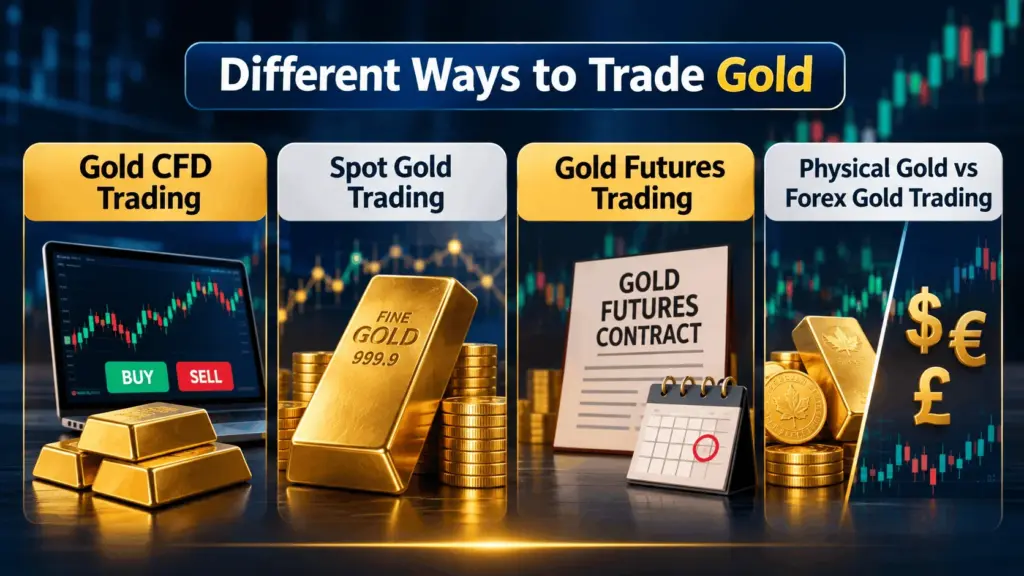
Different Ways to Trade Gold
Gold CFD Trading
A CFD is an agreement with a provider to settle changes in a reference price. Margin lets you control exposure with a smaller deposit, but profit and loss depend on the full position. Financing charges and counterparty risk also matter.
Spot Gold Trading
Spot gold concerns transactions for near-term settlement. The spot price provides a reference for immediate-market value. However, a retail product labelled “spot gold” may be a rolling derivative rather than an allocated bullion purchase. Read the agreement to establish what you actually own.
Gold Futures Trading
Futures are standardized, exchange-traded contracts with defined expiries and settlement arrangements. The benchmark COMEX Gold futures contract, GC, represents 100 troy ounces; other gold futures have different sizes. Traders must understand margin requirements and delivery obligations before holding contracts near expiry.
Physical Gold vs Forex Gold Trading
Physical bars and coins involve ownership, dealer premiums, storage, and potentially insurance. Gold CFDs provide contractual price exposure instead. Gold ETFs offer another route, but their fees, trading hours, and ownership structure depend on the fund. These products are not interchangeable.
What Factors Affect Gold Prices?
Gold responds to several forces at once. A useful analysis asks which influence currently dominates, rather than assuming one economic release determines the next move.
US Dollar Strength and Gold Prices
A stronger dollar can make dollar-priced gold more expensive for buyers using other currencies. Traders therefore monitor the US Dollar Index, or DXY. Nevertheless, gold and the dollar can rise together during periods of uncertainty; their relationship is not fixed.
Interest Rates and Treasury Yields
Gold pays no interest, so rising real yields can increase its opportunity cost compared with interest-bearing assets. Real yields reflect inflation-adjusted returns. Federal Reserve expectations matter, but central-bank demand and other forces can offset the effect of higher yields.
Inflation and Gold Prices
Inflation can encourage demand for gold as a store of value. However, an unexpectedly high inflation report may also increase expectations of tighter monetary policy. The resulting changes in real yields and the dollar help explain why gold does not rise after every inflation surprise.
Geopolitical Events and Safe-Haven Demand
War, political instability, and financial stress can increase demand for perceived safe havens. That label does not make gold risk-free: prices can reverse, and investors may sell gold to obtain cash during market stress.
Central Bank Gold Purchases
Central banks hold gold as part of their reserves. Purchases associated with diversification and geopolitical concerns can support demand, but reserve trends do not provide a reliable short-term entry signal.
Supply and Demand in the Gold Market
Mine production and recycling contribute supply. Jewellery, technology, investment products, and central banks contribute demand. Because these groups respond differently to prices and economic conditions, gold cannot be analysed through US interest rates alone.
🚀 Connect Economic Events With Gold Price Movements
Explore FastPip’s gold market analysis alongside economic releases to understand the reasoning behind different market scenarios.
Best Time to Trade Gold in Forex
| Trading Period | Market Relevance | Practical Consideration |
|---|---|---|
London Trading Session |
European institutional participation can increase activity. | Watch local economic releases and changing spreads. |
New York Trading Session |
US data and futures-market participation can influence price discovery. | Inflation, employment, and Fed announcements may trigger abrupt moves. |
London and New York Session Overlap |
Simultaneous participation can increase trading activity and volatility. | Higher activity does not guarantee better execution or profitable trades. |
Best Days and Hours for Gold Trading |
No weekday or hour is universally best; scheduled events and the strategy matter. | Check broker hours, daily breaks, holidays, and daylight-saving changes. Do not assume CFD hours match futures hours. |
Popular Gold Trading Strategies
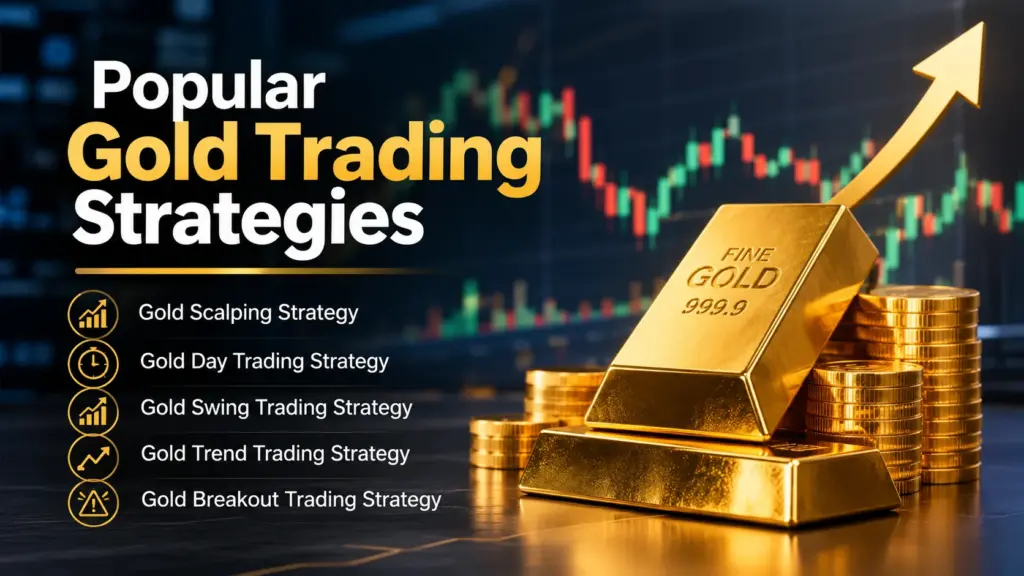
Gold Scalping Strategy
Scalping seeks small moves over short holding periods. Spreads, commissions, and execution delays can consume the expected gain. Frequent trading also increases the consequences of inconsistent discipline.
Gold Day Trading Strategy
Day traders close positions within the trading day, often using support, resistance, and session conditions. Avoiding overnight exposure does not remove intraday news risk.
Gold Swing Trading Strategy
Swing traders hold positions for days or weeks to capture broader moves. They may combine chart structure with macroeconomic analysis, while accounting for financing charges and weekend gaps.
Gold Trend Trading Strategy
Trend trading seeks entries in the prevailing direction, using tools such as moving averages and successive price highs or lows. Indicators lag, and sideways markets can generate repeated losing signals.
Gold Breakout Trading Strategy
Breakout traders watch for price moving beyond established support or resistance. Follow-through can fail. Retail CFD volume is not a complete measure of global gold trading, so volume-based confirmation needs careful interpretation.
Gold Trading Risks and Risk Management
Gold volatility and leverage can produce rapid losses. Stops may execute beyond the requested level during gaps or fast markets. Account protections, margin close-out rules, and liability for negative balances depend on the product, provider, and jurisdiction.
Avoid assuming that one gold pip has a universal value. Providers use different point and pip conventions. Calculate exposure from ounces and the actual price change instead.
- Gross long-position P&L = (exit price − entry price) × ounces.
- Gross short-position P&L = (entry price − exit price) × ounces.
- Planned position size = cash risk budget ÷ stop distance per ounce.
For a hypothetical $2,000 account, a chosen 1% risk budget is $20—not a recommendation. With a $10 stop distance, that budget corresponds to 2 ounces before costs and slippage. If the provider defines one lot as 100 ounces, 2 ounces equals 0.02 lots. Verify that specification rather than assuming it applies everywhere.
At a hypothetical $3,000 price, those 2 ounces create $6,000 of exposure. With 20:1 leverage, initial margin would be $300. A $10 adverse move still loses $20 before costs; margin is collateral, not the maximum possible loss.
Before-Trade Risk Checklist
- Confirm ounces per lot and minimum order size.
- Check spread, commission, financing, and account-currency conversion.
- Identify upcoming economic announcements.
- Choose an invalidation level before calculating volume.
- Allow for costs and possible slippage.
- Check margin availability and the provider’s liquidation rules.
These checks address the contract and execution risks highlighted in the brief.
Gold Trading vs Forex Trading
| Comparison | Gold Trading | Currency Trading |
|---|---|---|
| Underlying exposure | A precious metal priced in a currency. | One currency relative to another. |
| Main influences | Real yields, dollar movements, reserve demand, and gold supply and demand. | Relative monetary policy, economic performance, and capital flows. |
| Costs and sizing | Check ounces, tick value, spread, and financing. | Check base-currency units, pip value, spread, and financing. |
Differences in Market Volatility
Compare percentage changes and cash risk at equivalent exposure—not raw price points. Gold is not always more volatile than every currency pair.
Different Price Drivers
Currency pairs compare two economies, while gold also reflects physical-market and reserve demand.
Trading Costs and Contract Specifications
A smaller displayed spread does not necessarily mean a cheaper trade. Compare total costs for equivalent position values.
Which Is Better for Different Trading Styles?
Neither is universally better. Suitability depends on tested methods, available hours, transaction costs, and tolerance for losses.
Conclusion
Gold trading begins with understanding your instrument: XAUUSD pricing alone does not establish ownership, contract size, or risk. Combine analysis of gold’s drivers with verified specifications, realistic costs, and disciplined position sizing. Treat practice and education as preparation—not evidence that live trading will be profitable.
🚀 Continue Learning With FastPip
Explore gold market insights and economic-event coverage to develop a clearer understanding of XAUUSD.