Do Trading Signals Work Better in Volatile Markets?
Do Trading Signals Work Better in Volatile Markets?
Do trading signals perform better when markets are moving rapidly, or are calm markets actually more suitable for reliable trade setups?
There is no universal answer.
High volatility creates larger and faster price movements, which can generate more opportunities and allow profitable signals to reach their targets quickly.
But the same environment also creates:
- More market noise
- Greater Slippage
- Wider Spreads
- False Breakouts
- Faster Stop Loss activation
- Higher psychological pressure
Calm markets provide almost the opposite environment.
Price behavior may become cleaner and more predictable, execution may improve, and technical levels can become easier to interpret.
But there is also a disadvantage:
There may simply not be enough movement.
This means the performance of trading signals in volatile markets cannot be evaluated by asking whether volatility is “good” or “bad.”
The better question is:
Does the signal strategy match the current volatility regime?
A Breakout strategy may perform extremely well during expanding volatility.
A Mean-Reversion strategy may perform better when markets remain stable and range-bound.
Ultimately, signal quality depends on the relationship between:
Strategy + Volatility + Market Structure + Execution + Risk Management
—not volatility alone.
What Is a Volatile Market?
A volatile market experiences relatively large price changes over a short period.
Price may move:
- Faster
- Further
- More unpredictably
than it does during normal market conditions.
Volatility can increase because of:
- Economic data
- Central-bank decisions
- Geopolitical events
- Changes in liquidity
- Shifts in market sentiment
For traders, this means opportunities may develop much faster.
But risk also accelerates.
What Is a Calm Market?
A calm or low-volatility market usually experiences:
- Smaller price fluctuations
- Slower movements
- Lower short-term uncertainty
- More stable trading ranges
These conditions can give traders more time to:
- Analyze signals
- Confirm entries
- Manage positions
However, extremely low volatility can make it difficult for price to reach meaningful profit targets.
So low volatility is not automatically better.
Volatility Directly Affects Trading Signal Quality
Almost every trading signal depends on price behavior.
Signals may be generated from:
- Trend
- Breakout
- Support and resistance
- Momentum
- Indicators
- Mean Reversion
But the reliability of those tools can change as volatility changes.
A strategy calibrated for normal volatility may behave very differently during an extreme volatility spike.
That is why trading signals in volatile markets should be evaluated within the current environment rather than judged only from historical accuracy.
Advantages of Trading Signals in Volatile Markets
High volatility can create several major advantages.
Faster Price Movement
The most obvious benefit is speed.
A trade that might require several days to reach its target in a quiet market could reach the same target within hours during a highly active session.
This can benefit:
- Scalpers
- Day traders
- Momentum traders
- Breakout traders
More Trading Opportunities
When price moves more aggressively, more setups may develop.
For example, traders may see:
- More Breakouts
- More momentum moves
- Stronger directional swings
- Larger intraday ranges
This creates additional opportunities for active signal services.
Larger Potential Targets
Suppose normal daily movement is:
50 pips.
During a volatile period it increases to:
150 pips.
A strategy may now have room to pursue larger targets without necessarily increasing the percentage risk of the account.
This can improve Risk/Reward when the setup is well structured.
Volatility Can Strengthen Trend Signals
Trend-Following systems often benefit when volatility expands in a clear direction.
A strong market may produce:
Higher High → Higher High → Higher High
or:
Lower Low → Lower Low → Lower Low
Momentum becomes visible.
Breakouts have enough energy to continue.
Under these conditions, Trend-Following signals may perform extremely well.
But High Volatility Does Not Always Mean Strong Trend
This distinction is important.
Markets can experience:
High volatility + clear direction
or:
High volatility + no direction
The second situation can be extremely difficult.
Price may move sharply:
Up → Down → Up → Down
without creating a sustainable trend.
This environment produces:
- Whipsaws
- False Breakouts
- Repeated Stop Losses
So volatility alone is not enough.
Direction matters.
Disadvantages of Signals in Highly Volatile Markets
The same environment that creates large profits can also create large errors.
More Market Noise
High volatility often produces additional short-term price fluctuations.
Some moves reflect genuine changes in market direction.
Others are temporary noise.
Separating the two becomes more difficult.
More False Breakouts
Suppose resistance is:
1.1000
Price jumps to:
1.1020
A Breakout signal triggers.
Minutes later price returns to:
1.0970
The breakout was false.
False Breakouts often become more common when price is unstable and liquidity changes rapidly.
Stop Losses Can Be Hit Before the Analysis Plays Out
This is another major problem.
Suppose the underlying direction is correct.
The trader expects price to rise.
But volatility causes a temporary downward movement first.
The Stop Loss is triggered.
Then price rallies toward the original target.
The market analysis was directionally correct.
The trade still lost.
This is why Stop Loss distance needs to reflect current market volatility.
Risk Management Becomes More Important as Volatility Rises
High volatility increases the potential range of outcomes.
That means risk management becomes even more important.
CFA Institute describes risk management as the process of identifying and measuring risk and keeping exposure consistent with the level of risk an investor intends to take.
For signal users, this means position size should not remain unchanged simply because the provider publishes the same trade format.
Position Size May Need to Decrease
Consider:
Normal market Stop Loss:
50 points
Volatile market Stop Loss required:
100 points
If you use the same lot size, your monetary risk doubles.
Professional risk management instead keeps account risk stable.
For example:
Normal conditions:
50-point Stop × 1 lot
Volatile conditions:
100-point Stop × 0.5 lot
The distance changes.
Account risk remains approximately similar.
Wider Stop Loss Does Not Mean More Risk
This distinction is important.
A trader may widen the Stop Loss because volatility has increased.
That does not necessarily mean accepting more account risk.
Position size can be reduced accordingly.
The correct relationship is:
Stop Distance × Position Size = Intended Risk
Why Signals Can Be More Accurate in Calm Markets
High volatility attracts attention.
But low-to-moderate volatility can produce cleaner technical environments.
Price may behave more systematically around:
- Support
- Resistance
- Channels
- Moving averages
- Range boundaries
This can reduce the number of random price spikes that distort technical signals.
Lower Noise Can Improve Technical Analysis
Suppose resistance has repeatedly held.
In a relatively stable market, another rejection from that area may provide a clear Reversal setup.
In an extreme volatility environment, price may move through resistance, reverse immediately, break it again, and then collapse.
The technical level still exists.
Its short-term behavior becomes much less predictable.
Calm Markets Give Traders More Decision Time
A slower market provides more time to evaluate:
- Entry
- Stop Loss
- Target
- Volume
- Risk/Reward
- Broader trend
This can reduce rushed execution.
For discretionary traders, that can be an important advantage.
Extremely Low Volatility Creates Its Own Problems
Calm markets should not automatically be considered ideal.
If volatility becomes extremely low:
- Targets take longer to reach
- Breakouts lack momentum
- Trades can stagnate
- Reward potential decreases
A breakout system may produce repeated failed attempts because the market lacks sufficient energy.
The Ideal Environment Often Lies Between Extremes
For many strategies, the best environment is neither:
extreme volatility
nor:
almost no volatility
but a sufficiently active market with clear structure.
In this environment:
- Price moves enough to reach targets
- Risk remains manageable
- Market structure remains readable
- Execution remains relatively stable
Price Speed Affects Signal Execution
Volatility and execution are closely connected.
When price moves rapidly, even a small delay can change:
- Entry price
- Stop distance
- Risk/Reward
- Final result
Investor.gov notes that trade execution is not instantaneous and that prices can change while an order is being routed and executed—especially in fast-moving markets.
This is particularly important for short-term signal services.
Slippage Becomes More Important
Slippage occurs when your trade executes at a different price from the expected price.
Example:
Signal:
BUY at 2,700
Actual execution:
2,703
That three-point difference reduces your potential profit and increases your effective risk.
Why Slippage Increases During Volatility
Possible causes include:
- Rapid price movement
- Reduced liquidity
- Large orders
- News releases
- Execution delays
Investor.gov also notes that a Market Order generally prioritizes execution but does not guarantee the exact execution price.
Spread Can Also Expand
During normal conditions:
EURUSD Spread:
0.5 pip
During extreme conditions:
2.5 pips
For a swing trader targeting 150 pips, the impact may remain relatively small.
For a scalper targeting 5 pips, the difference is enormous.
This is why trading style matters.
FastPip’s Trading Types guide explains that Scalping relies on very small price movements, making Spread, commission and execution especially important. FastPip – Trading Types
CFA Institute: Volatility and Liquidity Affect Trade Strategy
Professional execution analysis also treats volatility and liquidity as key variables.
CFA Institute notes that trade strategy should incorporate factors including:
- Price volatility
- Liquidity profile
- Trading volume
- Bid–ask spreads
- Current market conditions
because those conditions can vary significantly over time.
This reinforces an important point for signal users:
A valid analytical signal can still produce a weak real-world trade if execution conditions are poor.
Trading Signals in Volatile Markets and Trend-Following
Trend-Following signals can perform particularly well when volatility expansion occurs alongside directional momentum.
For example:
Resistance Break → Strong Volume → Momentum Continues
This environment gives the signal room to develop.
Potential advantages include:
- Larger targets
- Faster target achievement
- Stronger continuation
But the strategy needs protection against False Breakouts.
Trading Signals in Volatile Markets and Breakouts
Breakout systems generally need price expansion.
If the market is extremely quiet, a breakout may not have enough participation to continue.
Higher volatility can provide the necessary energy.
However, the trade-off is:
More breakouts + potentially more false breakouts
Volume, momentum and market structure therefore become important confirmation tools.
Reversal Signals Often Prefer Calmer Conditions
Reversal and Mean-Reversion signals tend to rely on prices returning toward an equilibrium or range.
They may perform better when:
- Market structure is stable
- Support and resistance remain respected
- Directional momentum is limited
In these environments, buying near support and selling near resistance can be more logical.
Reversal Signals Become Dangerous During Strong Trends
Suppose Gold is experiencing a powerful bullish trend.
A Mean-Reversion system repeatedly identifies:
“Overbought”
and sells.
But price continues rising.
The indicator may remain overbought for a long time.
This demonstrates why signal type needs to match market regime.
Volume Can Help Validate Volatile-Market Signals
Volatility tells you:
Price is moving.
Volume can help answer:
How much participation supports the move?
A breakout accompanied by strong participation is generally more meaningful than a sudden price spike with weak confirmation.
Volatility Alone Does Not Confirm a Signal
Imagine:
Price rises 2%.
That looks powerful.
But if the movement occurs in a thin market with weak participation, it may reverse easily.
Volatility measures movement.
It does not automatically measure quality.
More Profit Does Not Mean Better Performance
Suppose Strategy A earns:
+20%
during a volatile month.
Maximum Drawdown:
30%
Strategy B earns:
+12%
Maximum Drawdown:
7%
Which performed better?
There is no meaningful answer without considering risk.
Professional evaluation should consider:
- Return
- Drawdown
- Risk
- Stability
- Expectancy
—not profit alone.
Compare Risk-Adjusted Performance
A high-volatility strategy can naturally produce larger gross profits.
But if the account experiences extreme fluctuations, the additional return may not justify the additional risk.
FastPip’s Signal Provider Performance Evaluation guide explains why Win Rate and Return should be evaluated alongside Drawdown, Expectancy and Risk/Reward.
FastPip – Signal Provider Performance Evaluation
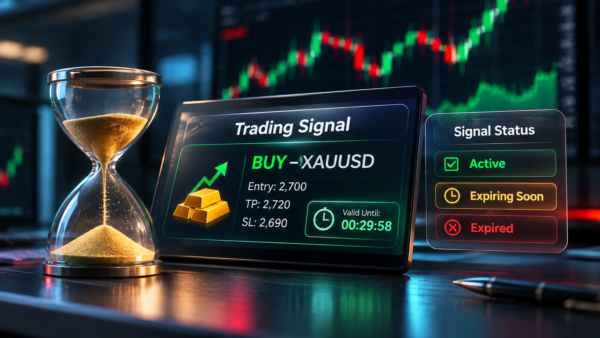
Volatility Can Shorten Signal Lifespan
A signal generated at:
10:00
may remain usable at:
10:20
during normal conditions.
During extreme volatility, it might become outdated by:
10:02.
Price can simply move too quickly.
This is one reason market conditions affect Trading Signal Expiration.
FastPip – Trading Signal Expiration
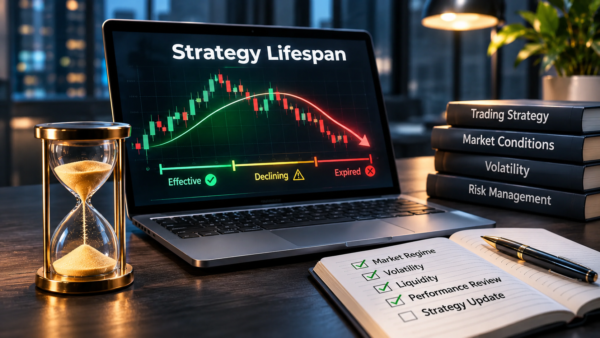
Volatility Can Also Shorten Strategy Lifespan
There is another level to consider.
If a strategy was designed for normal volatility and the market moves into a structurally different volatility regime, the entire strategy may deteriorate.
This is different from one signal expiring.
It means the signal-generation model itself may no longer fit current conditions.
FastPip – Signal Strategy Lifespan
Why Two Traders Can Get Different Results in Volatile Markets
Imagine two traders receive exactly the same BUY signal.
Trader A enters immediately.
Trader B enters 40 seconds later.
During a calm market, the difference may be minimal.
During extreme volatility, price may already have moved substantially.
Their:
- Entry prices
- Risk/Reward
- Spread
- Slippage
may all differ.
FastPip examines this issue in more detail here:
FastPip – Same Trading Signal, Different Results
Psychological Pressure Increases With Volatility
Fast markets create:
- Fear
- FOMO
- Greed
- Urgency
A trader may:
- Chase a signal
- Increase size
- Close too early
- Widen Stop Loss
- Enter without confirmation
The signal may be perfectly valid.
Execution behavior destroys the result.
Calm Markets Can Improve Discipline
In slower conditions, traders often have more time to:
- Check the setup
- Calculate risk
- Review economic events
- Place orders carefully
This can produce more consistent execution.
However, slow markets can create another psychological risk:
Overtrading because nothing is happening.
Which Market Is Better for Scalping Signals?
Scalping requires enough movement to generate profit.
But extreme volatility can create:
- Slippage
- Spread expansion
- Fast reversals
Therefore scalpers often prefer:
Active liquidity + controlled volatility
rather than chaotic volatility.
Which Market Is Better for Day-Trading Signals?
Day traders usually need sufficient intraday movement.
Moderate-to-high volatility can therefore be useful.
But the best conditions often include:
- Clear directional structure
- Strong liquidity
- Manageable Spread
rather than random price spikes.
Which Market Is Better for Swing Signals?
Swing Trading is less sensitive to very short-term fluctuations.
A few extra pips of Spread may matter less.
Swing traders typically focus more on:
- Broader trend
- Daily structure
- Macro conditions
This allows signals to tolerate more intraday noise.
Match the Signal Type to Market Conditions
A professional signal process begins by identifying the environment.
Ask:
Is the Market Trending?
Trend-Following may be suitable.
Is the Market Range-Bound?
Mean Reversion may be more suitable.
Is Volatility Expanding?
Breakout or momentum signals may become more attractive.
Is Volatility Extremely High and Chaotic?
Risk reduction may be more important than finding another signal.
Use Volatility as a Filter
Instead of treating volatility as simply good or bad, use it as a strategy filter.
For example:
Low Volatility:
Avoid momentum signals.
Normal Volatility:
Use standard settings.
High Controlled Volatility:
Reduce size and consider wider stops.
Extreme Volatility:
Avoid trading or use specialized strategies.
This approach is far more professional than using the same signal logic under every condition.
Adapt Stop Loss to Current Volatility
A fixed 20-pip Stop Loss does not behave the same way when average market movement is:
30 pips
versus:
150 pips.
A volatility-sensitive approach adjusts trade structure according to current conditions.
Tools such as Average True Range can help estimate recent price movement
Reduce Position Size When Volatility Rises
Suppose:
Normal Stop = 50 pips
Position Size = 1 lot
Volatile Stop = 100 pips
If account risk must remain unchanged:
Position Size may need to decrease to approximately:
0.5 lot.
This allows the market more room while preserving risk discipline.
Avoid Using the Same Stop Loss in Every Market
This is one of the most common mistakes.
A fixed Stop Loss ignores:
- Volatility
- Timeframe
- Market structure
The Stop should relate to the actual invalidation point of the trade.
Position size then adapts to the required distance.
When Should You Avoid High-Risk Signals?
Consider avoiding or reducing exposure when:
- Major economic news is imminent
- Volatility becomes abnormal
- Liquidity deteriorates
- Spread expands sharply
- Risk/Reward becomes weak
- Market structure becomes chaotic
Sometimes the highest-quality trade is:
No trade.
Common Mistakes With Trading Signals in Volatile Markets
Chasing Price
The market already moved significantly from the entry.
Using Normal Position Size
Volatility increased but exposure did not change.
Keeping Stops Too Tight
Normal market movement triggers unnecessary exits.
Ignoring Spread
Transaction costs expand.
Ignoring Slippage
Actual execution differs from theoretical results.
Treating Every Breakout as Real
Volatile markets can generate False Breakouts.
Trading Through Every News Event
Technical conditions can change instantly.
A Professional Pre-Trade Volatility Checklist
Before executing a signal, ask:
1. What Is the Current Volatility Level?
Normal, elevated or extreme?
2. Is the Market Trending or Ranging?
Choose the appropriate strategy.
3. Is Price Movement Directional?
Volatility without direction can create noise.
4. Is Volume Supporting the Move?
Participation can improve signal quality.
5. Is Spread Normal?
Do not ignore transaction costs.
6. Is Slippage Risk High?
Especially important for Market Orders.
7. Is Major News Approaching?
Conditions can change instantly.
8. Does the Stop Match Current Volatility?
Avoid using arbitrary distances.
9. Has Position Size Been Adjusted?
Keep account risk controlled.
10. Is Risk/Reward Still Acceptable?
Large movement before entry may ruin the setup.
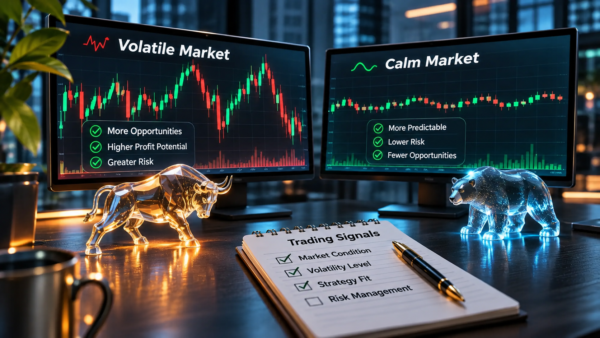
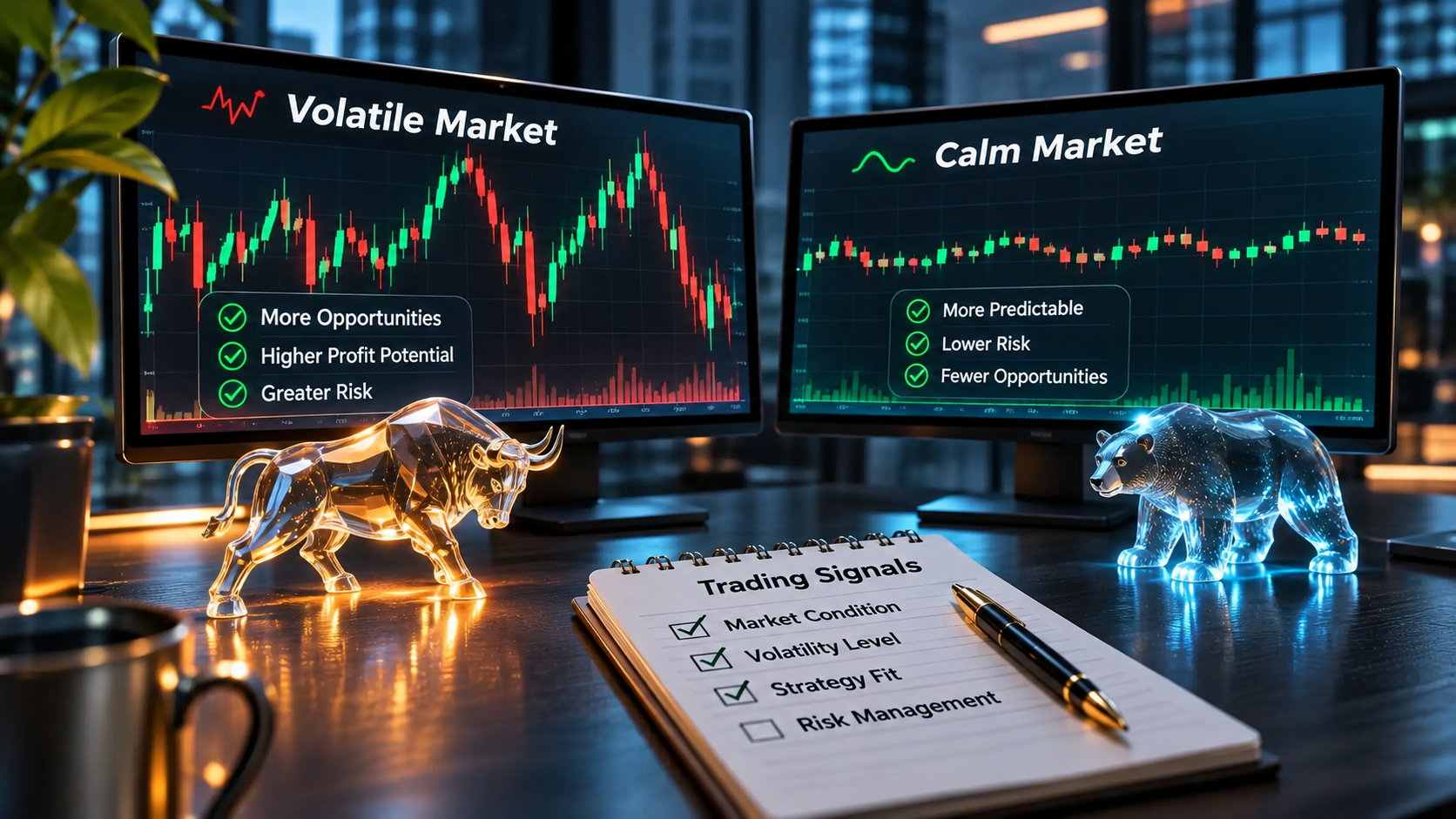
Volatile vs. Calm Markets: Quick Comparison
| Factor | Volatile Market | Calm Market |
|---|---|---|
| Price Movement | Large/Fast | Small/Slow |
| Opportunities | More | Fewer |
| Profit Potential | Higher | Usually Lower |
| Market Noise | Higher | Lower |
| False Breakouts | More Common | Often Lower |
| Slippage | Higher Risk | Usually Lower |
| Spread | Can Widen | Often More Stable |
| Decision Time | Shorter | Longer |
| Psychological Pressure | Higher | Lower |
| Best Fit | Trend/Momentum/Breakout | Range/Reversal |
| Risk Management | Critical | Still Essential |
Neither side wins automatically.
The correct environment depends on the strategy.
So Are Trading Signals Better in Volatile Markets?
Sometimes.
If the signal is designed for:
- Trend
- Momentum
- Breakout
then controlled volatility can significantly improve opportunity.
But extreme volatility can reduce signal reliability because of:
- Noise
- Slippage
- Spread
- False Breakouts
Likewise, calm markets may benefit:
- Reversal
- Range
- Support/Resistance
strategies.
But excessively low volatility can prevent price from reaching targets.
Conclusion: Volatility Does Not Determine Signal Quality Alone
There is no simple rule that says trading signals in volatile markets are always better—or worse—than signals in calm markets.
Volatility changes the trading environment.
High volatility can provide:
- More opportunities
- Faster movement
- Larger potential targets
But it can also produce:
- Greater risk
- False signals
- Slippage
- Wider Spreads
- More emotional pressure
Calm markets often provide:
- Cleaner technical structures
- Lower execution friction
- More time to analyze
- Better conditions for Reversal and Range strategies
But they may also produce:
- Fewer opportunities
- Slower trades
- Smaller price movement
The key principle is:
The best market is the market that matches the strategy.
A Trend-Following strategy does not need calm conditions.
A Mean-Reversion strategy does not necessarily need aggressive volatility.
The professional process is therefore:
Identify Market Conditions → Select the Appropriate Signal → Adjust Risk → Execute Carefully
Before using a signal, ask:
Is this strategy designed for the market I am trading right now?
That question matters much more than simply asking whether volatility is high or low.
Frequently Asked Questions
Do trading signals work better in volatile markets?
Some do. Trend, Breakout and Momentum signals may benefit from higher volatility, while Reversal and Range strategies often prefer more stable conditions.
Are trading signals in volatile markets more profitable?
They can produce larger profits because price moves further, but higher profit potential usually comes with greater risk.
Why are signals less reliable during extreme volatility?
Extreme volatility can increase market noise, False Breakouts, Slippage, Spread and rapid reversals.
Are calm markets better for trading signals?
They can be better for strategies that rely on support, resistance, Mean Reversion and stable price structures.
What type of signals work well in volatile markets?
Trend-Following, Momentum and Breakout strategies can perform well when high volatility is accompanied by clear direction.
What type of signals work well in calm markets?
Range Trading and Reversal strategies may work better when price remains stable around defined support and resistance levels.
Does volatility increase Slippage?
It can. Rapid price movement and changing liquidity can cause orders to execute away from the expected price.
Does Spread increase during volatile markets?
It can, particularly during economic news, sudden price changes or reduced liquidity.
Should Stop Losses be wider in volatile markets?
Sometimes. Stops should reflect market structure and normal volatility, while position size should be adjusted to maintain controlled account risk.
Should position size decrease when volatility increases?
Often yes, particularly if a wider Stop Loss is required to preserve the same percentage risk.
Does high volatility create more False Breakouts?
It can. Fast price movements may temporarily move beyond technical levels before reversing.
Is a high-volatility market always trending?
No. A market can be extremely volatile while moving chaotically without a sustainable direction.
Why are calm markets easier psychologically?
They generally provide more time for analysis and create fewer sudden price movements.
Can low volatility be bad for trading?
Yes. Extremely low volatility can reduce opportunities and make it difficult for price to reach profit targets.
How do I know whether a market is suitable for a signal?
Evaluate trend, volatility, volume, liquidity, Spread, news risk and whether the signal strategy matches the current market regime.
Do short-term traders need volatility?
They usually require sufficient movement to overcome Spread and trading costs, but excessive volatility can create execution problems.
Can volatility change a signal’s expiration time?
Yes. Faster markets can make signals become outdated more quickly.
Does signal performance depend on market regime?
Yes. Many strategies perform best only under specific conditions such as trending, ranging, high-volatility or low-volatility regimes.
Is more profit in a volatile market proof of better performance?
No. Return must be evaluated together with Drawdown, risk and consistency.
What is the most important rule for trading signals in volatile markets?
Match the strategy to the current market environment and adjust risk instead of using identical settings in every volatility regime.