Why Signal Entry Prices Differ
Why Signal Entry Prices Differ
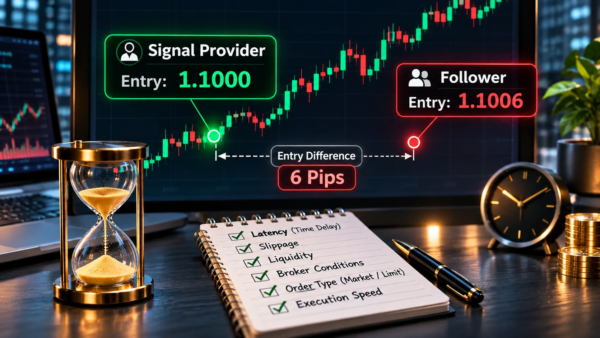
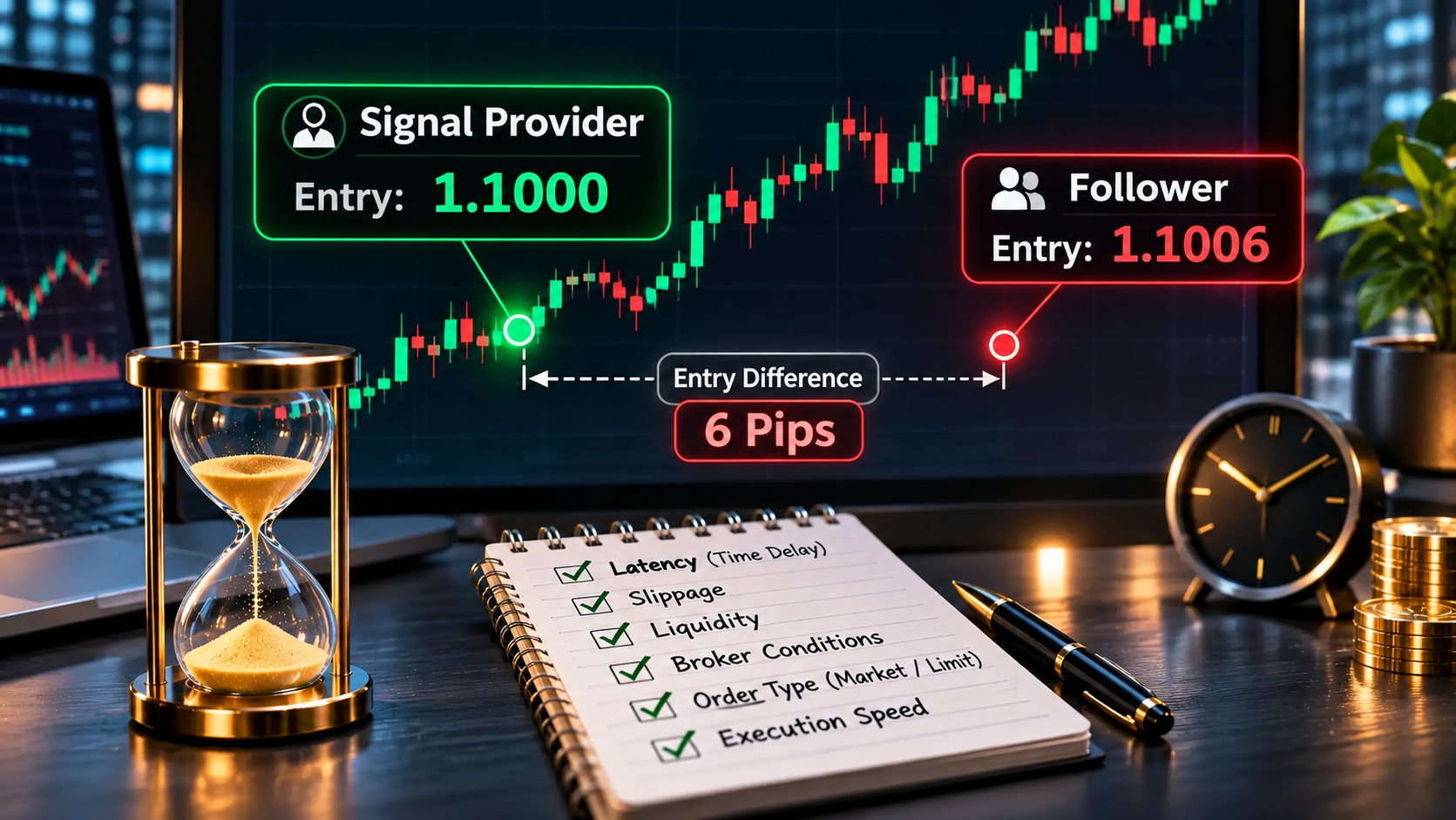
A signal provider enters EURUSD at:
1.1000
You receive the exact same signal a few seconds later.
Your trade opens at:
1.1006
Nothing appears wrong with the signal.
Yet your entry is different.
This situation is extremely common in real trading and is known here as signal entry price difference.
The difference between the provider’s entry and the follower’s actual execution price can result from:
- Signal-delivery delay
- Execution latency
- Slippage
- Market volatility
- Liquidity
- Broker infrastructure
- Order type
- Order size
- Spread
- Internet quality
A trading signal is not executed in a frozen market.
Prices continue changing between:
Provider Entry → Signal Publication → Signal Delivery → Follower Decision → Order Submission → Actual Fill
Even if the entire process takes only a few seconds, the market can move.
This means expecting every follower to receive the provider’s exact entry price is usually unrealistic.
The important question is therefore not:
“Why didn’t I get exactly the same price?”
It is:
“Was my execution still close enough to preserve the logic and Risk/Reward of the trade?”
What Is Signal Entry Price Difference?
Signal entry price difference is the gap between the entry price reported or obtained by a signal provider and the actual price at which a follower’s order is executed.
For example:
Provider Entry:
1.2500
Follower Entry:
1.2505
Entry Difference:
5 pips
The same concept applies to:
- Forex
- Gold
- Indices
- Crypto
- Stocks
The size and importance of the difference depend heavily on the strategy.
Why the Provider and Follower Rarely Enter at Exactly the Same Price
Most signal providers follow a sequence similar to this:
- Analyze the market
- Place the trade
- Confirm execution
- Publish the signal
- Followers receive it
- Followers place their own orders
Every step takes time.
The provider is naturally earlier in that sequence.
Even with a highly efficient system, the follower usually enters after the original trader.
Time Is the First Source of Entry Difference
Financial markets update continuously.
Suppose:
10:00:00 — Provider enters BUY at 1.1000
10:00:03 — Signal is published
10:00:05 — You receive the signal
10:00:08 — You place the order
Eight seconds have passed.
In a calm market, price may still be:
1.1001
In a volatile market, price could already be:
1.1010
The same eight-second delay can therefore have completely different consequences.
Signal Delivery Delay Matters
The provider may send the signal immediately, but delivery itself can take time.
Possible delays include:
- Messaging apps
- Push notifications
- Website dashboards
- Mobile operating systems
- Server congestion
A signal sent at one moment is not necessarily displayed to every user at exactly the same moment.
User Reaction Time Adds Another Delay
Even if the signal arrives instantly, followers may react differently.
Trader A:
Clicks immediately.
Trader B:
Checks the chart first.
Trader C:
Calculates position size.
Trader D:
Sees the notification one minute later.
By the time each trader enters, the market may be at a different price.
This explains why several followers can receive the same signal and still obtain different entries.
Execution Is Not Instantaneous
Another important component of signal entry price difference is order execution itself.
Investor.gov explains that trade execution is not instantaneous. Orders must travel through brokerage infrastructure, and prices can change before an order reaches the market—particularly in fast-moving conditions.
Investor.gov – Executing an Order
So even after you press BUY or SELL, the final execution price may differ from the price visible when you clicked.
Slippage Is One of the Main Causes
Slippage occurs when an order is executed at a different price from the expected price.
Example:
Expected BUY:
1.2500
Actual Fill:
1.2504
Slippage:
4 pips
This can happen even when the signal arrives on time.
Positive vs. Negative Slippage
Slippage is not always negative.
Negative Slippage
Expected:
1.2500
Executed:
1.2505
For a BUY order, this is worse.
Positive Slippage
Expected:
1.2500
Executed:
1.2498
For a BUY order, this is better.
Both are possible.
The important point is that real execution depends on available market prices.
Why Slippage Increases During Volatility
Slippage tends to become more noticeable when:
- Price moves rapidly
- Liquidity changes
- Economic news is released
- Many orders arrive simultaneously
The faster price changes, the less likely a follower is to receive exactly the quoted signal price.
Slippage Also Affects Exits
Slippage is not limited to entry.
It can occur during:
- Stop Loss execution
- Take Profit execution
- Manual close
- Forced liquidation
This means two followers can start with similar entries and still finish with different results.
Liquidity Has a Major Impact
Liquidity describes how much buying and selling interest exists at different prices.
In a deep market, large numbers of orders can be executed without moving price significantly.
In a thin market, even relatively small orders may move through multiple price levels.
Example of Limited Liquidity
Imagine the market offers:
10 units at $100.00
20 units at $100.10
50 units at $100.20
A trader places a market order for:
50 units
The full order cannot execute at $100.
Instead, it fills across several levels.
The average execution price becomes higher.
This is a natural form of price impact.
Order Size Can Change Entry Price
For many retail traders, order size is too small to significantly move highly liquid markets.
But larger orders can experience:
- Partial fills
- Multiple execution prices
- Greater average Slippage
This becomes especially important in:
- Low-liquidity assets
- Smaller cryptocurrencies
- Thin trading sessions
- Large institutional orders
Investor.gov notes that parts of a large Market Order may execute at different prices when sufficient liquidity is not available at one level.
Volatile Markets Increase Entry Differences
Market volatility directly increases the probability that followers will enter at different prices.
Suppose Gold moves:
$1 every several minutes
during normal conditions.
During a major news release it may move:
$5–$10 in seconds.
A signal provider entering just before the move can have a dramatically better entry than followers entering seconds later.
Signal Entry Price Difference Is Often Larger Around News
Periods that commonly create larger deviations include:
- CPI
- NFP
- Interest-rate decisions
- Central-bank speeches
- Major geopolitical headlines
These periods combine:
- Rapid price movement
- Changing liquidity
- Wider Spread
- More Slippage
That makes exact signal replication difficult.
The Provider Usually Gets the First Opportunity
One reason the provider often receives a better price is simple:
They are already watching the market when the trade setup occurs.
The provider may:
- Execute immediately
- Use predefined orders
- Monitor the market continuously
Followers first need to receive the information.
That structural delay gives the provider an execution advantage.
This Does Not Automatically Mean the Signal Is Misleading
A small, normal difference does not necessarily indicate:
- Fake results
- Manipulation
- Bad signal quality
The relevant question is whether the provider publishes entries that are realistically achievable.
For example:
Provider entry:
1.1000
Typical follower entries:
1.1002–1.1005
This may be perfectly reasonable.
But if the provider repeatedly reports entries far better than what followers could realistically obtain, the service deserves closer evaluation.
Exact Entry vs. Entry Zone
Professional signal design can reduce this problem by using an Entry Zone instead of one exact number.
Instead of:
BUY Gold at 2700.00
a provider could publish:
BUY Gold: 2699.50–2702.00
This acknowledges real execution conditions.
Followers can evaluate whether the current market price still fits the intended trade structure.
Entry Zones Improve Real-World Usability
An Entry Zone can help account for:
- Small price movements
- Signal-delivery delay
- Spread
- Broker quote differences
- Minor Slippage
This makes the signal more practical.
But the zone should not be so wide that Risk/Reward becomes unclear.
Market Order vs. Limit Order
Order type can significantly affect signal entry price difference.
Market Order
A Market Order prioritizes immediate execution.
You accept the best available market price.
Investor.gov states that a Market Order generally ensures execution when buyers and sellers exist, but the execution price may not be the price the trader expected.
Limit Order
A Limit Order prioritizes price.
Example:
BUY Limit at 1.1000
The order can execute only at:
1.1000 or better.
The advantage:
More control over entry.
The disadvantage:
The order may never execute.
Why Market Orders Create More Entry Variation
Suppose a BUY signal arrives when ask price is:
1.1000
By the time the Market Order reaches execution:
1.1004
The trade fills at the available price.
The trader entered quickly.
But not at the original signal price.
Why Limit Orders Can Miss Trades
Suppose a provider enters at:
1.1000
The market immediately rises.
You place a Buy Limit at:
1.1000
Price never returns.
Your trade remains unfilled.
The provider wins.
You never entered.
This does not mean one order type is better in every case.
It is a trade-off between:
Execution certainty
and:
Price certainty.
Broker Differences Can Create Different Entry Prices
Two followers may use different brokers.
Broker A:
Ask = 1.1001
Broker B:
Ask = 1.1004
They click BUY at exactly the same moment.
They can still receive different entries.
Why?
Because brokers may differ in:
- Liquidity providers
- Price feeds
- Spread
- Execution routing
- Infrastructure
Crypto Exchanges Can Show Different Prices Too
The same principle applies to cryptocurrency exchanges.
BTC may trade at slightly different prices across:
- Exchange A
- Exchange B
- Exchange C
because each venue has its own order book and liquidity.
A signal referencing one exchange may therefore not map perfectly onto another.
Spread Also Affects the Apparent Entry Difference
A signal provider may quote a chart price or Bid price.
A follower executing a BUY pays the Ask price.
If Spread is:
2 pips
then even without any actual market movement, the visible chart price and execution price may differ.
This can confuse inexperienced traders.
Signal Users Should Understand Bid and Ask
For a BUY:
You generally enter around the Ask.
For a SELL:
You generally enter around the Bid.
That difference matters when comparing:
- Chart price
- Signal price
- Broker execution
Especially in markets with wider Spreads.
Internet and Platform Latency Matter
Latency is the delay between:
Your action
and:
The trading system receiving that action.
Possible sources include:
- Internet connection
- Geographic distance
- Device performance
- Broker server
- Trading platform
For slow strategies, small latency differences may be irrelevant.
For scalping, they can matter significantly.
Server Location Can Affect Execution
Suppose Trader A is connected with very low latency to the broker server.
Trader B has a slower route.
In a calm market, both may receive almost identical fills.
During rapid price movement, Trader A’s order can reach the execution venue earlier.
This may produce a better price.
FastPip Has Already Covered Execution Speed
The broader relationship between latency, Slippage, liquidity and signal results is covered in FastPip’s execution article:
FastPip – Order Execution Speed
Execution speed becomes especially important when signals target small market movements.
How Much Entry Difference Is Acceptable?
There is no universal answer.
The importance depends on:
- Target size
- Stop Loss
- Strategy duration
- Market volatility
Example: Swing Trade
Original Entry:
1.1000
Target:
1.1300
Follower Entry:
1.1004
Difference:
4 pips
Against a 300-pip target, this may be relatively small.
Example: Scalping Trade
Original Entry:
1.1000
Target:
1.1010
Follower Entry:
1.1004
Difference:
4 pips
Now 40% of the original target distance has already disappeared.
The same four-pip difference is much more important.
Risk/Reward Is the Correct Way to Judge Entry Difference
Do not ask only:
“How many pips late am I?”
Ask:
“What has happened to the Risk/Reward?”
Suppose the original signal is:
Entry: 100
Stop: 95
Target: 110
Original risk:
5
Original reward:
10
Risk/Reward:
1:2
Late Entry Can Destroy the Structure
Now suppose you enter at:
103
Stop remains:
95
Target remains:
110
Risk:
8
Reward:
7
The new Risk/Reward is:
worse than 1:1
The signal direction may remain correct.
The trade quality has changed dramatically.
This Is Where Signal Entry Price Difference Becomes Important
A two-pip difference may be irrelevant in one setup.
A two-pip difference may ruin another setup.
The correct threshold depends on:
how much of the original trade structure remains intact.
Why Two Traders Can Get Different Results
Suppose:
Signal:
BUY at 100
Stop: 95
Target: 110
Trader A enters:
100
Trader B enters:
104
Price falls to:
98
then rises to:
Trader A survives comfortably.
Trader B may experience much greater psychological pressure and different risk dynamics.
If Trader B used a tighter Stop based on the late entry, they may even lose before the market reaches the target.
This is why the same signal can produce different results.
FastPip covers this topic in more depth here:
FastPip – Same Trading Signal, Different Results
Signal Expiration and Entry Difference Are Connected
As price moves farther from the intended entry, the signal may eventually become unsuitable for new execution.
This connects directly with Trading Signal Expiration.
FastPip – Trading Signal Expiration
A signal does not remain valid forever simply because the target has not been reached.
When Should You Skip a Late Entry?
Consider skipping the signal when:
- Price moved significantly away from the Entry Zone
- Risk/Reward deteriorated substantially
- Market structure changed
- Target is already close
- Major news changed conditions
- Spread expanded sharply
Missing the trade is often better than entering an inferior version of it.
FOMO Makes Entry Difference Worse
A trader receives the signal late.
Price is already moving toward the target.
The thought appears:
“I need to enter before I miss the move.”
This can create a poor entry.
The trader is no longer following the original signal structure.
They are chasing price.
Missed Profit Is Not a Loss
This principle helps manage FOMO.
If a signal moved without you:
You did not lose the profit.
You simply did not participate.
Entering late can convert:
zero financial loss
into:
an actual losing trade.
Copy Trading Can Reduce Manual Delay
Copy Trading can help reduce some aspects of signal entry price difference.
Instead of:
Provider enters → Message sent → Follower reads → Follower clicks
the process becomes more automated.
That can reduce:
- Human reaction time
- Manual order errors
- Notification delay
FastPip offers Copy Trading alongside its signal services.
Copy Trading Does Not Eliminate Entry Differences
Even automated copying can still experience:
- Slippage
- Broker differences
- Different liquidity
- Server latency
- Order-size effects
So Copy Trading can reduce the difference.
It cannot guarantee identical execution.
Large Follower Groups Can Affect Execution
Suppose thousands of users receive the same signal simultaneously.
If they all attempt to execute in a less liquid market:
- Available liquidity may be consumed
- Later orders may receive worse fills
This effect is small in extremely liquid markets for ordinary retail sizes.
It can become more important in thinner assets.
Entry Difference Can Be a Service-Quality Metric
Signal providers should not evaluate only:
Provider Entry vs. Provider Result
They should also consider:
Follower Execution Quality
For example:
Average Provider Entry:
1.1000
Average Follower Entry:
1.1003
Average Entry Deviation:
3 pips
Tracking this over time provides useful information about how realistically followers can reproduce published results.
How Signal Providers Can Reduce Entry Differences
Professional providers can improve execution quality by:
Publishing Quickly
Reduce the gap between provider entry and notification.
Using Entry Zones
Avoid unrealistic exact-price expectations.
Defining Maximum Deviation
Example:
Do not enter above 1.1010.
Publishing Expiration Rules
Make clear when the trade is no longer valid.
Avoiding Extremely Thin Markets
Low liquidity increases execution differences.
How Followers Can Reduce Signal Entry Price Difference
Followers can also improve execution.
1. Enable Fast Notifications
Reduce message-reading delay.
2. Use Stable Internet
Avoid connectivity problems.
3. Prepare the Platform
Do not wait until after receiving the signal to log in.
4. Understand the Entry Zone
Do not chase price outside the acceptable range.
5. Calculate Position Size Quickly
Predefined risk rules help.
6. Choose the Correct Order Type
Market and Limit Orders solve different problems.
7. Monitor Spread
Avoid entering when Spread becomes abnormal.
Do Not Sacrifice Risk Management for a Better Entry
Never respond to a late entry by:
- Increasing leverage
- Moving Stop Loss further away
- Increasing lot size
- Removing Stop Loss
This does not restore the original trade.
It increases risk.
Evaluate Signal Quality Beyond Exact Entry
A professional signal should be evaluated using several factors:
- Logical analysis
- Entry Zone
- Stop Loss
- Targets
- Risk/Reward
- Historical consistency
- Execution realism
A service can still be high quality even if followers experience small, normal entry differences.
When Entry Differences Become a Red Flag
Investigate further when:
- Provider entries are consistently impossible to reproduce
- Signals arrive after large market moves
- Provider always reports ideal prices
- Entry zones are absent
- Followers regularly receive much worse Risk/Reward
Persistent unrealistic differences may indicate that published performance does not reflect follower experience.
A Professional Signal Entry Price Difference Checklist
Before entering a signal, ask:
1. What Was the Original Entry?
Know the provider’s reference price.
2. What Is the Current Price?
Measure the deviation.
3. Is Price Still Inside the Entry Zone?
If not, reassess.
4. What Is the New Risk/Reward?
Calculate it from your actual price.
5. Is Spread Normal?
Execution cost matters.
6. Is the Market Highly Volatile?
Slippage risk may be higher.
7. Is Liquidity Adequate?
Thin markets produce larger deviations.
8. Should I Use Market or Limit?
Choose based on strategy requirements.
9. Has the Signal Expired?
Old signals should not be chased.
10. Would I Still Take the Trade at This Price?
If no, skip it.
Example: Acceptable vs. Poor Entry Deviation
Signal:
XAUUSD BUY
Entry Zone: 2700–2703
SL: 2690
TP: 2725
Trader A
Entry:
2701
Still inside the intended zone.
Trade structure remains reasonable.
Trader B
Entry:
2718
Only seven points remain to target.
Stop is 28 points away.
The original trade is no longer attractive.
Same signal.
Completely different trade quality.
Signal Entry Difference vs. Signal Quality
It is important not to confuse the two.
Small entry differences can be normal.
Signal quality depends on whether the trade idea remains valid and reproducible under realistic execution conditions.
If a strategy requires every follower to enter at one exact tick to remain profitable, it may be too execution-sensitive for a broad signal service.
Why Realistic Signal Design Matters
A robust signal should ideally tolerate reasonable differences in:
- Entry
- Spread
- Minor Slippage
- Execution time
without immediately losing its edge.
This is particularly important for public signal services with many followers.
Conclusion: Why Signal Entry Prices Differ
Signal entry price difference is a normal consequence of real-market execution.
The provider and follower operate at different points in time.
Between those points, multiple factors can change the final fill:
- Signal-delivery delay
- User reaction time
- Execution latency
- Slippage
- Liquidity
- Volatility
- Broker conditions
- Order size
- Spread
- Market vs. Limit Orders
Investor.gov specifically notes that execution takes time and that investors may not receive the exact price visible when they submit an order—particularly when markets move quickly.
The key principle is therefore:
Exact Price Matching Is Less Important Than Preserving Trade Structure.
A small difference may not matter if:
- Risk/Reward remains acceptable
- Price remains inside the Entry Zone
- Market conditions remain unchanged
But a large deviation can transform a strong setup into a weak trade.
Before entering a signal late, do not ask only:
“Is this still the same direction?”
Ask:
“Would I still accept this trade at my actual execution price?”
That is the more professional way to evaluate signal execution.
Frequently Asked Questions
What is signal entry price difference?
Signal entry price difference is the gap between the provider’s reported entry and the follower’s actual execution price.
Why is my signal entry different from the provider?
Common reasons include delay, Slippage, liquidity, Spread, broker differences, order type and execution speed.
Is signal entry price difference normal?
Yes. Small differences are common because prices continue changing during signal delivery and order execution.
What is Slippage?
Slippage is the difference between the expected price of an order and its actual execution price.
Can Slippage be positive?
Yes. Orders can occasionally execute at a better price than expected.
Why is entry difference larger during volatile markets?
Price moves faster and liquidity can change rapidly, increasing execution variation.
Does broker choice affect signal entry price?
Yes. Brokers may have different liquidity sources, Spreads, price feeds and execution infrastructure.
Does internet speed affect signal execution?
It can, especially in very fast markets and short-term strategies.
Does order size affect entry price?
Large orders can consume available liquidity and fill across multiple price levels.
Is a Market Order guaranteed to execute at the signal price?
No. Market Orders prioritize execution, but the exact execution price is not guaranteed.
Can a Limit Order reduce entry difference?
It can provide more price control, but there is no guarantee the order will execute.
How much entry difference is acceptable?
It depends on Stop Loss, target, timeframe and Risk/Reward. There is no universal number.
Why does entry difference matter more in Scalping?
Small targets mean even a few pips of deviation can consume a large percentage of expected profit.
Can Copy Trading eliminate entry differences?
No. It can reduce manual delays but Slippage, liquidity and infrastructure differences can still create different fills.
Should I chase a signal after price moves away from entry?
Usually not automatically. Recalculate Risk/Reward and confirm the original setup is still valid.
Can two traders get opposite results from the same signal?
Yes. Different entry prices, Stop Loss handling, Spread and execution can create very different outcomes.
Is provider entry always better than follower entry?
Not always, but providers often enter first because they generate the signal before distributing it.
Are large entry differences a warning sign?
Repeatedly large and unrealistic differences can justify closer review of the service’s execution quality and reporting.
What is the best way to reduce signal entry price difference?
Use fast notifications, stable infrastructure, reasonable Entry Zones, suitable order types and disciplined execution.
What matters more than the exact signal price?
Preserving acceptable Risk/Reward, market logic and risk management matters more than matching one exact number.