Yes. Forex trading is risky because currency prices can move unexpectedly, leverage magnifies both gains and losses, and trading decisions can be affected by emotion. A trader can lose part or all of the money in a trading account; whether losses can exceed the deposit depends on the product, provider, and applicable protections.
Forex is not automatically unsafe for everyone, but it is not risk-free. Understanding market volatility, margin, leverage, broker conditions, and a practical risk plan is essential before placing a live trade.
Key Takeaways
- Forex trading carries real financial risk, including the possibility of losing your trading capital.
- Leverage increases exposure; it does not reduce the dollar loss caused by an adverse price move.
- Volatility, economic news, liquidity changes, and gaps can make execution less predictable.
- A stop-loss can help define a planned exit, but it does not guarantee execution at the exact requested price.
- Broker rules, regulation, and negative-balance protection differ by jurisdiction and product.
- Risk management can limit exposure, but it cannot remove market risk or guarantee profits.
These points distinguish inherent market risk from risks that traders can manage through position sizing, planning, and provider selection.
What Is the Forex Market?
The forex market is where currencies are exchanged. Traders usually take positions through currency pairs, such as EUR/USD, and profit or lose depending on changes in the exchange rate. Before examining the risks, it helps to understand how currency pairs are traded and what drives exchange-rate movements.
Before exploring the risks of forex trading, it’s important to understand how the forex market works, how currency pairs are traded, and what drives exchange rate movements. Read our guide to What Is Forex? to build a solid foundation.
What Are the Risks of Forex Trading?
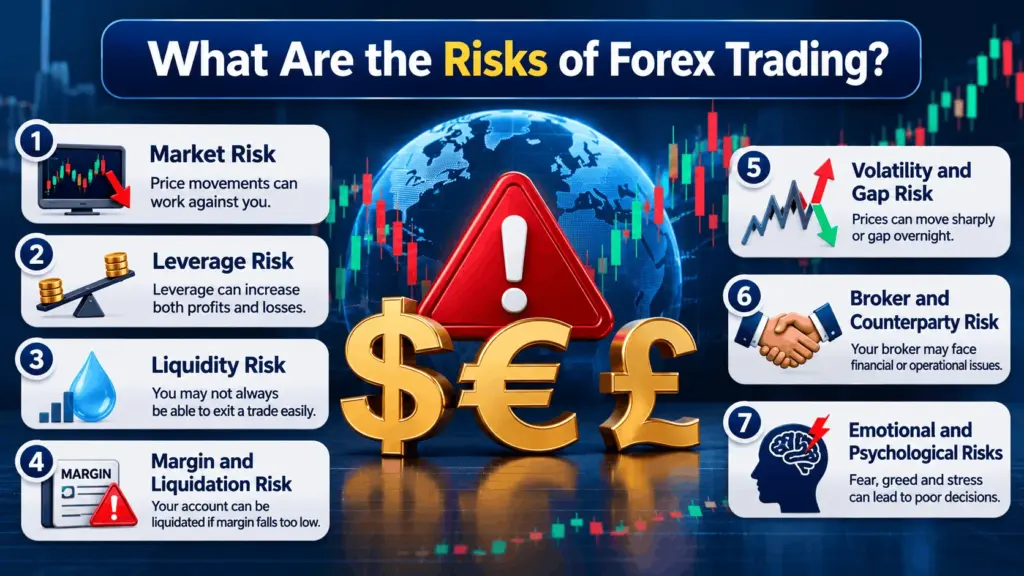
| Risk | What It Means | Potential Consequence |
|---|---|---|
| Market risk | Prices may move against a long or short position. | Trading losses, including rapid losses during volatile conditions. |
| Leverage risk | A smaller deposit controls a larger position. | Losses are calculated on the full position, not only the margin. |
| Liquidity risk | Market depth or available liquidity may fall. | Wider spreads and more difficult exits. |
| Margin and liquidation risk | Available margin can fall as unrealized losses increase. | Margin call or forced position closure. |
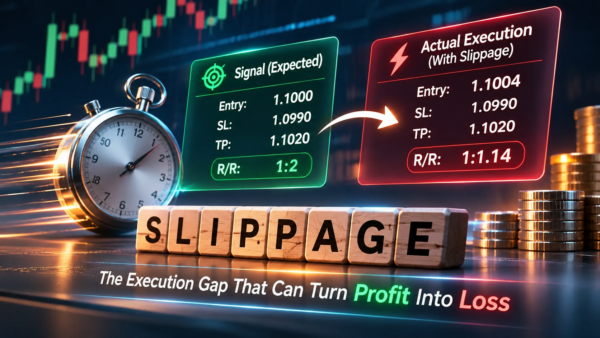
| Volatility and gap risk | Prices can move sharply around major news or market openings. | Slippage or execution at a worse-than-requested price. |
| Broker and counterparty risk | Provider, execution, custody, and withdrawal arrangements may fail. | Operational issues, restricted access to funds, or execution problems. |
| Emotional and psychological risk | Fear, greed, revenge trading, and overtrading affect decisions. | Larger positions, abandoned plans, and repeated losses. |
1.Market Risk
Market risk is the possibility that price moves against your position. A long position generally loses when the pair falls, while a short position generally loses when the pair rises. No analysis can make future price movements certain.
2.Leverage Risk
Leverage lets a trader control a larger position with a smaller amount of capital. For example, 10:1 leverage means a $1,000 margin can support a $10,000 exposure. A 1% adverse move on that exposure is a $100 loss before costs—10% of the margin.
Forex trading risk is often amplified by leverage, which allows traders to control larger positions with a smaller amount of capital. To understand how leverage works and why it can increase both potential profits and losses, read our guide to What Is Leverage in Forex?
3.Liquidity Risk
Liquidity refers to how easily an asset can be bought or sold without materially affecting its price. During thin trading periods, major economic events, or unusual market stress, spreads can widen and orders may be harder to exit at the intended price.
4.Margin and Liquidation Risk
Margin is the amount set aside to maintain an open position. Free margin is the portion of equity not currently used to support open trades. If unrealized losses reduce equity toward the required margin level, a broker may issue a margin call or close positions.
Under the UK Financial Conduct Authority’s rules for retail CFD accounts, firms must close positions when net equity falls below 50% of the margin required to maintain them. These rules apply to specific products and jurisdictions; conditions vary elsewhere.
5.Volatility and Gap Risk
Volatility describes the speed and size of price changes. Major data releases, central-bank decisions, and unexpected geopolitical events can produce sharp moves. A price gap occurs when the market opens at a level different from the prior close, potentially skipping the requested stop-loss level.
6.Broker and Counterparty Risk
Broker risk includes execution failures, unclear pricing, withdrawal restrictions, and weak client-protection arrangements. Counterparty risk is the possibility that the party on the other side of a transaction cannot meet its obligations. Choosing a regulated provider does not eliminate market risk, but it is an important part of provider due diligence.
7.Emotional and Psychological Risks
Fear can lead to premature exits, while greed can lead to oversized positions. Revenge trading—trying to recover a loss immediately—and overtrading can turn a manageable loss into a larger drawdown. A written plan and predefined exit rules help reduce impulsive decisions.
How to Manage Risk in Forex Trading
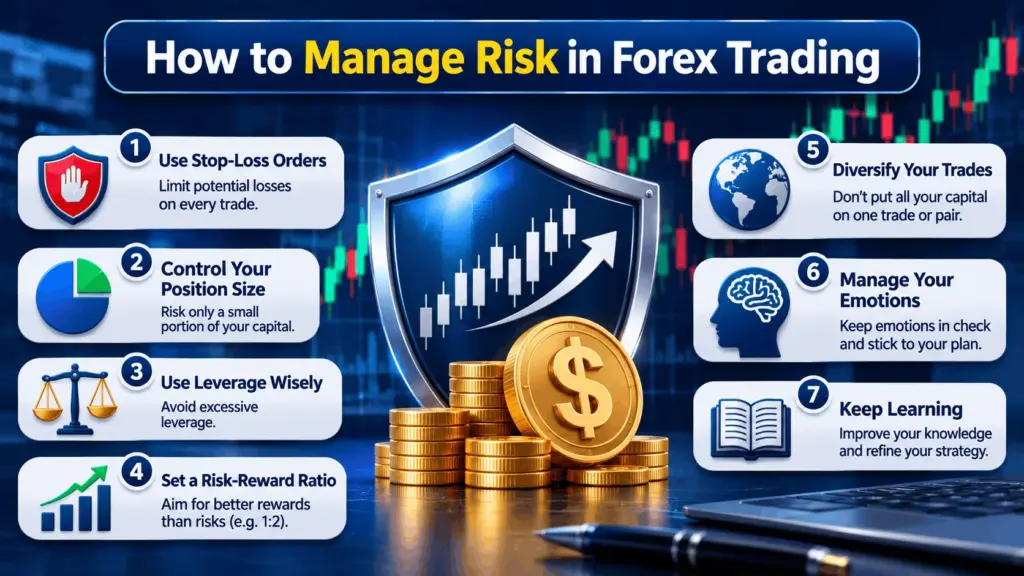
Risk management cannot eliminate losses, but it can make the size of a potential loss deliberate rather than accidental. Start by deciding the maximum amount you are willing to lose on a single trade, then calculate position size from that amount and the distance to your invalidation level.
Use this simple formula:
- Position size = risk budget ÷ stop distance per unit.
- Long-position loss = (entry price − exit price) × units.
- Short-position loss = (exit price − entry price) × units.
For example, suppose a trader has a $2,000 account and sets a $20 maximum loss per trade. If the stop distance is 20 pips and each pip is worth $1 per standard lot, the position size is 0.01 lots. This is a hypothetical illustration; pip value, lot size, and margin requirements vary by pair and provider.
- Use only money you can afford to lose without affecting essential living expenses.
- Define entry, stop-loss, and exit conditions before opening a trade.
- Keep position size consistent with your account balance and stop distance.
- Avoid increasing size after losses to recover a drawdown.
- Check the economic calendar before trading around major announcements.
- Review spreads, commissions, financing, and withdrawal terms before choosing a provider.
Understanding the risks of forex trading is just the first step. To learn how to manage those risks, protect your capital, and make more informed trading decisions, explore our guide to Risk Management in Forex.
Before-Trade Risk Checklist
- Confirm the currency pair, lot size, and minimum trade volume.
- Calculate the dollar amount at risk before entering.
- Set an invalidation level and consider a stop-loss order.
- Check upcoming economic events and market-opening conditions.
- Review spread, commission, financing, and account-currency conversion.
- Confirm margin requirements and the broker’s close-out rules.
- Do not risk money needed for essential expenses or emergencies.
These checks address the market, leverage, margin, and execution risks identified in the brief.
How to Trade Forex Risk-Free

There is no way to trade live forex with zero risk. The only environment that can provide practice without directly risking real trading capital is a simulated or demo account, provided its conditions, spreads, and execution are understood as simulations rather than guarantees of live-market behavior.
A demo account can help you learn order types, test position sizing, and observe how your plan behaves under different market conditions. It cannot prove that a strategy will remain profitable in live trading, where spreads, slippage, financing, and emotional pressure may differ.
Learn Forex Fundamentals Before Trading
Understand how the forex market works, how currency pairs are quoted, and how leverage affects exposure before placing your first live trade.
Conclusion
Forex is a high-risk market because currency prices are uncertain, leverage can magnify losses, and trading decisions are vulnerable to emotion. Risk management can help control exposure through position sizing, stop-loss planning, and disciplined execution, but it cannot remove market risk or guarantee profits.
Before trading live, assess your financial situation, knowledge, and tolerance for loss. Practice in a demo environment, use only discretionary capital, and make decisions based on a tested plan rather than promises of quick returns.