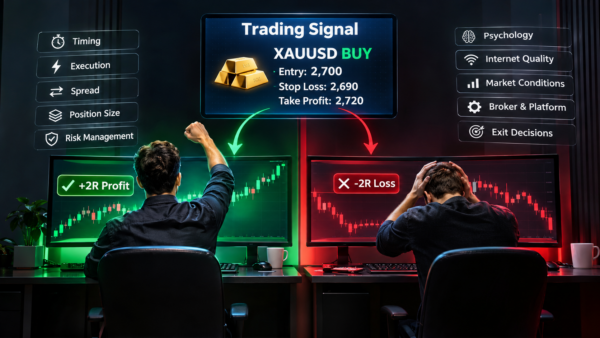

Forex trading, also known as foreign exchange trading or currency trading, is the process of buying and selling currencies to profit from changes in exchange rates. Traders do not usually exchange physical banknotes; instead, they speculate on whether one currency will strengthen or weaken against another.
The forex market is a global, decentralized marketplace where banks, financial institutions, companies, governments, and retail traders exchange currencies. It operates 24 hours a day on weekdays, although liquidity and volatility change across different trading sessions.
Forex trading can be approached in several ways, depending on your trading goals, strategy, and time commitment. To explore the different approaches and find the one that suits you best, read our guide to Trading Types.
📋 Key Takeaways
- Forex trading is the buying and selling of currency pairs, not individual currencies in isolation.
- In the EUR/USD pair, EUR is the base currency and USD is the quote currency.
- Traders can open a long position when they expect a currency pair to rise, or a short position when they expect it to fall.
- Pips, lots, spread, leverage, and margin are core forex trading terms.
- Forex trading is highly leveraged, which can amplify both profits and losses.
- The global FX market recorded an average daily turnover of USD 9.6 trillion in April 2025, according to the BIS survey.
- Retail forex trading carries substantial risk, and losses can exceed the initial deposit in some cases.
- Beginners should start with education, a demo account, and a clear risk-management plan before using real money.
🌍 What Is Forex Trading?
Forex trading is the process of buying and selling currencies in the foreign exchange market. Traders aim to profit from changes in exchange rates between two currencies, such as the euro and the US dollar.
What Does Forex Mean?
Forex is short for “foreign exchange.” It refers to the global market where currencies are exchanged and their relative values are determined.
What Is the Forex Market?
The forex market is a decentralized global marketplace where currencies are traded. It includes banks, financial institutions, companies, governments, and retail traders.
Why Do People Trade Forex?
- To seek potential profit from changes in exchange rates.
- To hedge against currency risk.
- To conduct international transactions.
- To participate in global financial markets.
⚙️ How Does Forex Trading Work?
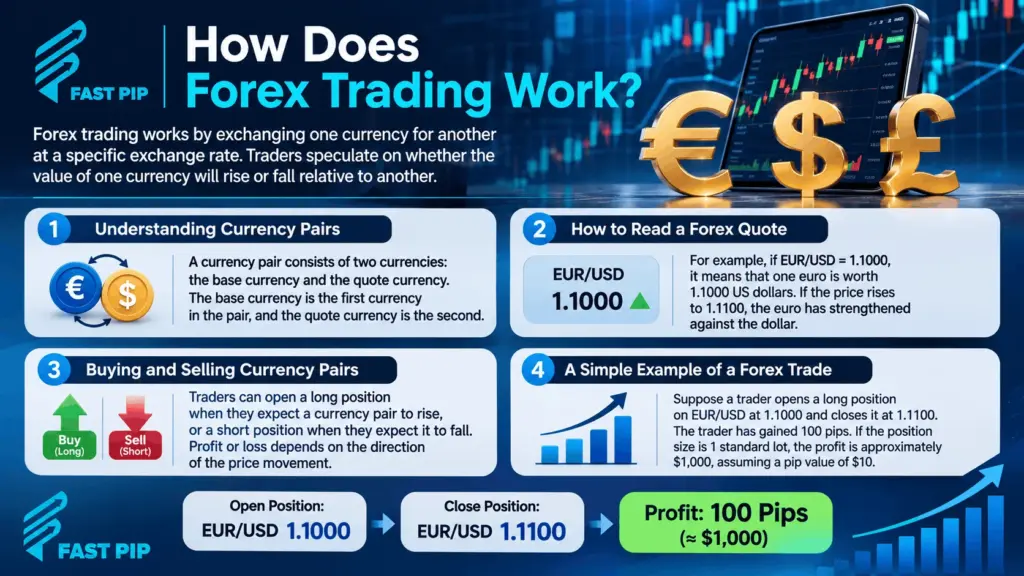
Forex trading works by exchanging one currency for another at a specific exchange rate. Traders speculate on whether the value of one currency will rise or fall relative to another.
Understanding Currency Pairs
A currency pair consists of two currencies: the base currency and the quote currency. The base currency is the first currency in the pair, and the quote currency is the second.
How to Read a Forex Quote
For example, if EUR/USD = 1.1000, it means that one euro is worth 1.1000 US dollars. If the price rises to 1.1100, the euro has strengthened against the dollar.
Buying and Selling Currency Pairs
Traders can open a long position when they expect a currency pair to rise, or a short position when they expect it to fall. Profit or loss depends on the direction of the price movement.
A Simple Example of a Forex Trade
Suppose a trader opens a long position on EUR/USD at 1.1000 and closes it at 1.1100. The trader has gained 100 pips. If the position size is 1 standard lot, the profit is approximately $1,000, assuming a pip value of $10.
💱 What Are the Main Currency Pairs in Forex?
Currency pairs are categorized into major, minor, and exotic pairs. Major pairs include the most traded currencies, while minor and exotic pairs involve less commonly traded currencies.
Major Currency Pairs
- EUR/USD
- GBP/USD
- USD/JPY
- USD/CHF
- AUD/USD
- USD/CAD
- NZD/USD
Minor Currency Pairs
- EUR/GBP
- EUR/CHF
- GBP/JPY
- AUD/JPY
Exotic Currency Pairs
Exotic pairs combine a major currency with the currency of a smaller or emerging economy. These pairs often have lower liquidity and wider spreads.
🔁 Ways to Trade Forex
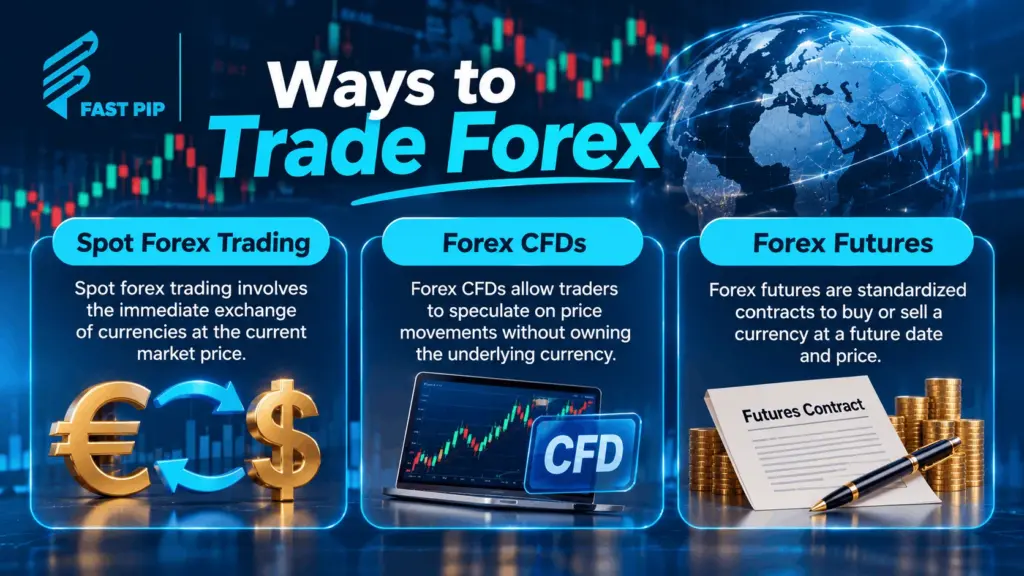
Spot Forex Trading
Spot forex trading involves the immediate exchange of currencies at the current market price.
Forex CFDs
Forex CFDs allow traders to speculate on price movements without owning the underlying currency.
Forex Futures
Forex futures are standardized contracts to buy or sell a currency at a future date and price.
📚 Forex CFD Trading Terminology
Pips
A pip is the smallest price movement in a currency pair. For most pairs, one pip equals 0.0001.
Lots
A lot is a standardized unit of trading volume. A standard lot equals 100,000 units of the base currency.
Leverage and Margin
Leverage allows traders to control a larger position with a smaller amount of capital. Margin is the amount of money required to open and maintain a position.
🗂️ Types of Forex Pairs
| Type | Description | Examples | Liquidity |
|---|---|---|---|
| Major forex pairs | Include the most traded currencies | EUR/USD, GBP/USD, USD/JPY | High |
| Minor forex pairs | Include less commonly traded currencies | EUR/GBP, EUR/CHF, GBP/JPY | Medium |
| Exotic forex pairs | Combine a major currency with a smaller or emerging economy currency | USD/TRY, USD/ZAR, EUR/MXN | Lower |
Major forex pairs
Major forex pairs include the most traded currencies and usually have high liquidity.
Minor forex pairs
Minor forex pairs include less commonly traded currencies and may have lower liquidity.
Exotic forex pairs
Exotic forex pairs combine a major currency with the currency of a smaller or emerging economy and may have wider spreads.
✅ Benefits of Forex CFD Trading
- Access to a global market.
- Potential to profit from both rising and falling prices.
- High liquidity in major currency pairs.
- Ability to use leverage.
- Availability of demo accounts for practice.
📊 Forex CFD Trading Examples
Example 1: Long Position on EUR/USD
A trader opens a long position on EUR/USD at 1.1000 and closes it at 1.1100. The trader has gained 100 pips. If the position size is 1 standard lot, the profit is approximately $1,000, assuming a pip value of $10.
Example 2: Short Position on USD/CHF
A trader opens a short position on USD/CHF at 0.9000 and closes it at 0.8900. The trader has gained 100 pips. If the position size is 1 standard lot, the profit is approximately $1,000, assuming a pip value of $10.
⚠️ What Are the Risks of Forex Trading?
Market Volatility
Currency prices can move sharply due to economic news, central bank decisions, and geopolitical events.
Leverage Risk
Leverage can amplify both profits and losses. A small price movement against a leveraged position can result in a significant loss.
Liquidity and Execution Risks
Liquidity can vary across currency pairs and trading sessions. Slippage can occur when the executed price differs from the expected price.
Emotional Trading
Fear and greed can lead to impulsive decisions and excessive trading. A clear trading plan and risk-management strategy are important.
📝 Conclusion
Forex trading is the process of buying and selling currency pairs to profit from changes in exchange rates. It is a global, decentralized market with high liquidity and 24-hour trading on weekdays.
However, forex trading is highly leveraged and carries substantial risk. Beginners should start with education, a demo account, and a clear risk-management plan before using real money.
🚀 Start Your Forex Learning Journey
Build your trading knowledge with FastPip’s beginner-friendly Forex resources.