Introduction
The kinds of financial markets shape the global economy and influence nearly every aspect of modern finance. Whether someone trades currencies, invests in stocks, buys government bonds, or speculates on cryptocurrencies, they are participating in a financial
market. These markets connect buyers and sellers, provide liquidity, support capital formation, and help economies grow.
Understanding the different kinds of financial markets is essential for traders, investors, institutions, and even governments. Each market has its own structure, participants, risks, volatility, and opportunities. Some markets focus on long-term investing, while others are designed for short-term speculation and rapid execution. Some are heavily regulated, while others remain decentralised and highly volatile.
Financial markets also play a critical role in price discovery. The prices traders see on charts are not random. They reflect supply and demand, economic expectations, interest rates, inflation forecasts, geopolitical risk, and institutional positioning. This is why professional traders spend years learning how different markets interact with one another.
In today’s digital world, access to financial markets has become easier than ever. Retail traders can now access global currencies, commodities, indices, and cryptocurrencies directly from platforms like MetaTrader. However, easy access does not automatically mean easy profits. Every market behaves differently, and understanding those differences is one of the foundations of professional trading.
This article provides a complete and professional explanation of the kinds of financial market, including how they work, their major characteristics, advantages, risks, and their importance in the global economy.
What Is a Financial Market?
A financial market is a marketplace where financial assets are traded between buyers and sellers. These assets may include currencies, stocks, bonds, commodities, derivatives, or digital assets. Financial markets allow capital to move efficiently across the economy while helping businesses raise funds and investors grow wealth.
Without financial markets, companies would struggle to expand, governments would face difficulty financing infrastructure projects, and investors would have limited opportunities to allocate capital. Financial markets create an organised environment where pricing mechanisms operate continuously.
The modern financial system depends on interconnected markets. For example, rising interest rates in the bond market may strengthen a currency in the forex market, which can then influence stock market valuations and commodity prices. This interconnected structure is why professional traders often analyse multiple markets simultaneously.
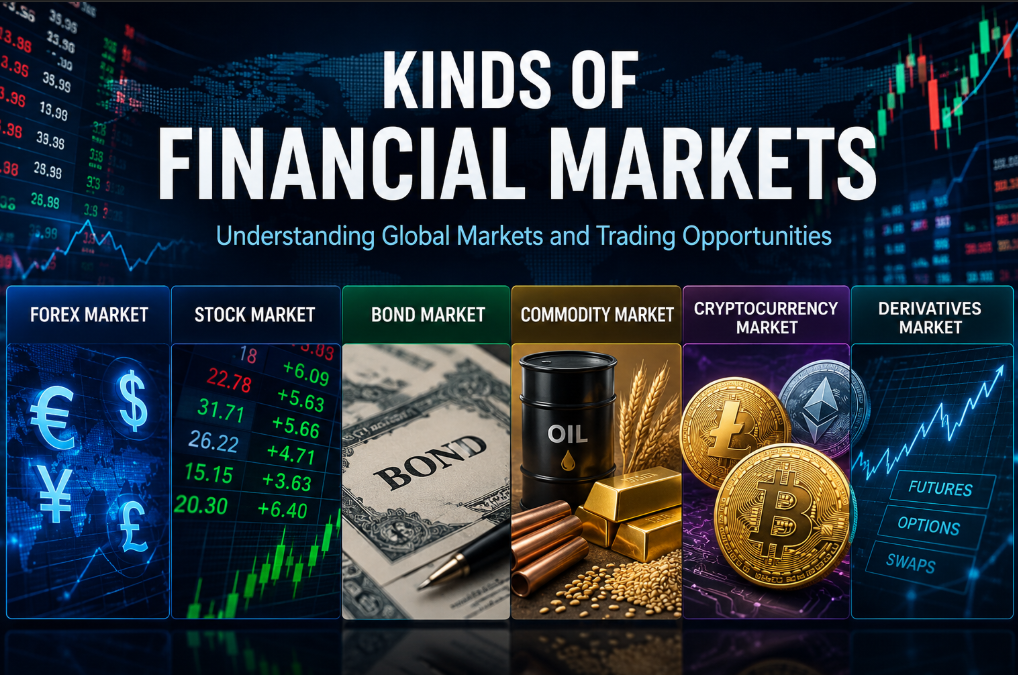
Financial markets are generally divided into several major categories based on the type of assets traded. These include capital markets, money markets, forex markets, derivatives markets, commodities markets, cryptocurrency markets, and others.
Why Financial Markets Matter
The importance of financial markets extends far beyond trading profits. Financial markets support economic growth, improve liquidity, encourage investment, and facilitate risk management.
One of their most important functions is capital allocation. Investors provide money to businesses and governments in exchange for financial returns. This capital helps companies expand operations, hire employees, develop products, and innovate.
Financial markets also improve price transparency. Through continuous trading activity, market participants collectively determine the fair value of assets. This process is called price discovery.
Another important role is risk transfer. Through derivatives and hedging instruments, businesses and investors can manage exposure to fluctuations in interest rates, currencies, or commodity prices.
Central banks also closely monitor financial markets because market conditions often reflect economic confidence and future expectations. Sharp declines in stock markets or extreme volatility in forex markets may signal deeper economic concerns.
Stock Market
The stock market is one of the most recognized kinds of financial market. It allows companies to raise capital by selling shares to investors. When traders buy shares, they become partial owners of the company.
Major global stock exchanges include the New York Stock Exchange, NASDAQ, London Stock Exchange, and Tokyo Stock Exchange.
Stocks are typically divided into sectors such as technology, finance, healthcare, energy, and industrials. Market participants include retail traders, institutional investors, hedge funds, pension funds, and banks.
The stock market offers long-term wealth-building opportunities, but it also experiences volatility. Prices can move based on earnings reports, economic data, interest rates, geopolitical events, and investor sentiment.
Professional investors often analyze company fundamentals such as revenue growth, debt levels, cash flow, and earnings potential before investing in stocks.
Forex Market
The forex market, also called the foreign exchange market, is the largest financial market in the world. It involves the trading of currency pairs such as EUR/USD, GBP/USD, and USD/JPY.
The forex market operates 24 hours a day during weekdays and has extremely high liquidity. Major participants include central banks, commercial banks, hedge funds, multinational corporations, brokers, and retail traders.
Currencies move based on interest rates, inflation, monetary policy, economic performance, and geopolitical developments. For example, if the Federal Reserve raises interest rates, the US dollar may strengthen against other currencies.
Forex trading is popular because of leverage, liquidity, and accessibility. However, leverage also increases risk significantly. Many inexperienced traders underestimate the importance of risk management in forex trading.
The forex market is also heavily influenced by macroeconomic news such as Non-Farm Payrolls, CPI inflation reports, GDP releases, and central bank decisions.
Bond Market
The bond market is where governments and corporations borrow money from investors. Bonds are essentially debt instruments. Investors lend money to the issuer in exchange for regular interest payments and repayment at maturity.
Government bonds are generally considered safer than corporate bonds because they are backed by sovereign governments. Examples include US Treasury bonds and UK Gilts.
Bond prices move inversely to interest rates. When interest rates rise, existing bond prices often fall because newer bonds offer higher yields.
The bond market is extremely important because it reflects expectations regarding inflation, economic growth, and monetary policy. Institutional investors closely monitor bond yields to assess market conditions.
Bond markets also influence stock valuations and currency markets. Rising yields may attract foreign capital, strengthening a country’s currency.
Commodity Market
The commodity market involves trading raw materials and natural resources such as gold, silver, crude oil, natural gas, wheat, and coffee.
Commodities are divided into two major categories: hard commodities and soft commodities. Hard commodities include metals and energy products, while soft commodities include agricultural products.
Gold is often considered a safe-haven asset during periods of economic uncertainty. Oil prices can influence inflation, transportation costs, and global economic growth.
Commodity prices are affected by supply and demand, geopolitical conflicts, weather conditions, sanctions, and production decisions by major exporters.
Professional traders often monitor inventory reports, OPEC meetings, and geopolitical tensions when trading commodities.
Cryptocurrency Market
The cryptocurrency market is one of the newest kinds of financial market. It includes digital assets such as Bitcoin, Ethereum, and thousands of alternative cryptocurrencies.
Unlike traditional financial markets, many cryptocurrency markets operate in a decentralized environment. Trading occurs continuously without closing hours.
Cryptocurrencies are highly volatile. Prices can rise or fall dramatically within short periods. This volatility attracts speculators but also increases risk.
The crypto market has grown rapidly due to blockchain technology, decentralized finance, and institutional adoption. However, regulation remains uncertain in many jurisdictions.
Professional traders in crypto markets often pay attention to liquidity, exchange stability, on-chain data, market sentiment, and macroeconomic conditions.
Money Market
The money market focuses on short-term borrowing and lending. Instruments in this market generally have maturities under one year.
Examples include Treasury bills, certificates of deposit, and commercial paper. Central banks and financial institutions are major participants in money markets.
Money markets provide liquidity and help maintain stability in the financial system. They are usually considered lower-risk compared to equity markets.
Interest rates in money markets strongly influence broader financial conditions and monetary policy transmission.
Derivatives Market
The derivatives market includes financial contracts whose value depends on an underlying asset. Common derivatives include futures, options, and swaps.
Derivatives are widely used for hedging and speculation. Airlines may hedge fuel costs using oil futures, while traders may speculate on market direction using index options.
Although derivatives provide flexibility, they can also increase systemic risk if used irresponsibly. Excessive leverage in derivatives markets has contributed to financial crises in the past.
Professional traders use derivatives for portfolio management, hedging exposure, and advanced trading strategies.
Capital Market
Capital markets help businesses and governments raise long-term funding. These markets include both equity markets and debt markets.
The primary market involves issuing new securities, while the secondary market involves trading existing securities between investors.
Capital markets are essential for economic growth because they provide access to funding for expansion and development projects.
Efficient capital markets improve investor confidence and attract international investment.
Primary Market vs Secondary Market
The primary market is where securities are issued for the first time. Initial Public Offerings (IPOs) occur in the primary market.
The secondary market is where investors trade securities after issuance. Most daily trading activity occurs in secondary markets.
Liquidity in secondary markets is critical because it allows investors to buy and sell assets efficiently.
Strong secondary markets also encourage participation in primary offerings because investors know they can later exit positions if needed.
Over-the-Counter Market
An over-the-counter market, or OTC market, is a decentralised marketplace where assets are traded directly between parties without a centralised exchange.
Forex trading is largely conducted over the counter. Some bonds and derivatives are also traded in OTC markets.
OTC markets provide flexibility but may involve counterparty risks because trades are not always processed through centralised clearing systems.
Financial Market Participants
Financial markets include many different participants with varying objectives.
Retail traders seek speculative profits. Institutional investors manage large portfolios. Central banks influence monetary conditions. Hedge funds pursue advanced trading strategies. Brokers provide market access and liquidity.
Each participant contributes differently to market liquidity and price movement.
Understanding who controls liquidity at different times is one of the key differences between amateur and professional trading approaches.
Role of Central Banks
Central banks have enormous influence over financial markets. Institutions such as the European Central Bank and the Bank of England adjust interest rates and monetary policy to control inflation and support economic stability.
Their decisions impact currencies, bonds, stocks, and commodities simultaneously.
Forward guidance from central banks often shapes long-term market expectations even before policy changes occur.
Financial Market Regulation
Regulation is necessary to maintain transparency, reduce fraud, and protect investors.
Regulators monitor exchanges, brokers, banks, and trading activity. Strong regulation helps improve confidence in financial systems.
However, excessive regulation may reduce innovation or liquidity in some markets.
Cryptocurrency regulation remains one of the biggest debates in modern finance.
Liquidity in Financial Markets
Liquidity refers to how easily assets can be bought or sold without significantly affecting price.
Forex markets typically have very high liquidity, while smaller stocks or cryptocurrencies may experience lower liquidity.
High liquidity usually leads to tighter spreads and better execution quality.
Professional traders prioritise liquidity because poor liquidity can increase slippage and execution risk.
Volatility in Different Markets
Different kinds of financial markets experience different levels of volatility.
Cryptocurrencies and commodities can move aggressively within short periods. Bond markets are generally more stable, while forex volatility varies depending on economic conditions and news events.
Volatility creates both opportunity and risk.
Professional traders adapt position sizing and risk management according to market volatility.
Technology and Modern Financial Markets
Technology has transformed financial markets dramatically.
Algorithmic trading, artificial intelligence, high-frequency trading, and advanced analytics now dominate institutional trading environments.
Retail traders also benefit from improved platforms, mobile trading, and instant market access.
However, technological advancement has also increased competition and market complexity.
Risks of Financial Markets
Every financial market involves risk.
Market risk, liquidity risk, counterparty risk, leverage risk, and psychological risk are all major factors that traders must understand.
Many beginners focus only on profit potential while ignoring downside exposure.
Long-term survival in financial markets depends more on risk management than aggressive speculation.
Best Financial Market for Beginners
There is no single perfect market for every trader.
Some beginners prefer stocks because they are easier to understand. Others are attracted to forex because of accessibility and liquidity. Some choose crypto due to volatility and rapid price movement.
The best approach is to start with education, risk management, and realistic expectations.
Professional traders usually specialise in one or two markets instead of attempting to master everything simultaneously.
Relationship Between Financial Markets
Financial markets are interconnected.
Rising oil prices may increase inflation expectations, which can influence central bank policy and affect currency markets. Strong bond yields may pressure stock valuations. Economic uncertainty may increase demand for gold.
Understanding cross-market relationships helps traders make more informed decisions.
Professional macro traders analyse multiple markets together rather than studying charts in isolation.
The Future of Financial Markets
Financial markets continue evolving rapidly.
Artificial intelligence, blockchain technology, tokenisation, decentralised finance, and automation are reshaping how markets operate.
Central Bank Digital Currencies (CBDCs) may also transform payment systems and global financial infrastructure in the coming years.
Despite technological change, the core principles of risk, liquidity, psychology, and supply-demand dynamics remain unchanged.
Conclusion
Understanding the kinds of financial markets is essential for anyone involved in trading, investing, or financial analysis. Each market serves a different purpose within the global economy and operates according to unique dynamics.
The stock market helps companies raise capital. The forex market facilitates international currency exchange. Bond markets support government and corporate financing. Commodity markets manage raw material pricing, while cryptocurrency markets introduce new forms of digital finance.
Successful traders and investors understand that no market is easy. Every market rewards discipline, education, patience, and risk management.
Financial markets are not simply charts moving on a screen. They are complex ecosystems driven by liquidity, psychology, economic policy, institutional behavior, and global events.
The more deeply traders understand these markets, the better prepared they become to navigate volatility, manage risk, and identify opportunities in the constantly evolving financial landscape.