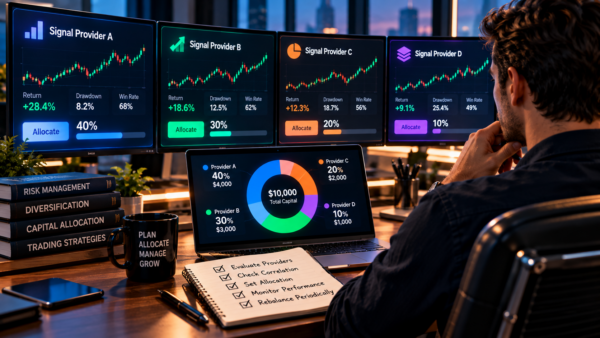

Can You Use Multiple Trading Signals at the Same Time?
Can You Use Multiple Trading Signals at the Same Time?
Can traders use several trading signals simultaneously?
Yes—but receiving more signals does not automatically produce better decisions or higher profits.
Using multiple trading signals can help traders compare different market perspectives, reduce dependence on a single provider, identify stronger setups, and potentially create a more structured confirmation process.
However, the same approach can also create:
- Conflicting signals
- Excessive trading
- Analysis paralysis
- Duplicate market exposure
- Slower execution
- Confirmation bias
- Higher transaction costs
- Poorer risk management
The difference between useful diversification and information overload depends on how the signals are selected and combined.
Professional traders generally do not collect as many signals as possible.
Instead, they use a limited number of relevant sources, define the role of each source, and maintain one clear decision-making framework.
This distinction is essential.
More signals do not necessarily create more information.
Sometimes they simply create more noise.
What Are Multiple Trading Signals?
Using multiple trading signals means incorporating trade ideas from more than one analytical source into your decision-making process.
These signals may come from:
- Technical analysts
- Fundamental analysts
- Algorithmic models
- AI trading systems
- Price-action strategies
- Sentiment models
- Professional signal providers
- Different trading strategies
For example, a trader might receive:
Signal A: XAUUSD BUY
Technical breakout
Signal B: XAUUSD BUY
Fundamental bullish outlook
Signal C: XAUUSD SELL
Short-term overbought reversal
All three signals concern the same market.
But they may use completely different methodologies and time horizons.
Understanding those differences is essential before combining them.
FastPip provides market signals based on different trading methodologies and also publishes broader market analysis that traders can use alongside their own decision-making process. FastPip Trading Signals & Market Analysis
1. Can You Use Multiple Trading Signals at the Same Time?
Yes.
There is nothing inherently wrong with using multiple trading signals simultaneously.
In fact, traders may use several sources to:
- Confirm an existing setup
- Compare alternative market views
- Identify different opportunities
- Reduce dependency on one analyst
- Evaluate different timeframes
The problem begins when the trader has no structure for deciding what each signal means.
Imagine receiving five separate trade recommendations.
If you simply execute all five because they exist, you are not creating a strategy.
You are collecting trades.
A professional process asks:
Why am I using this signal?
What information does it add?
How does it affect my existing exposure?
What happens if another signal disagrees?
If these questions cannot be answered, adding another signal may create complexity rather than value.
2. Why Do Traders Use Multiple Trading Signals?
There are several legitimate reasons.
Reducing Dependence on One Provider
No signal provider performs perfectly in every market environment.
A provider may perform strongly during trending markets but struggle when price becomes range-bound.
Using several independent sources can reduce reliance on one analytical model.
Getting Different Market Perspectives
One source may specialize in technical analysis.
Another may emphasize:
- Macroeconomic data
- Central-bank policy
- Market sentiment
- Positioning
- Order flow
This can create a more complete view of the market.
Finding More Trading Opportunities
Different providers may focus on different:
- Assets
- Sessions
- Timeframes
- Strategies
One may specialize in Gold.
Another may focus on major Forex pairs.
A third may analyze indices.
Multiple sources can therefore broaden the opportunity set.
Confirmation
Some traders use additional signals as confirmation.
Instead of entering because one indicator or provider says BUY, they wait until another independent source supports the same idea.
This is known conceptually as multiple confirmation.
Used carefully, it can improve selectivity.
Used excessively, it can create analysis paralysis.
3. Benefits of Using Multiple Trading Signals
Broader Market Information
Different analytical models can reveal different aspects of the same market.
A technical signal may identify:
Breakout above resistance
while a fundamental source identifies:
A macro catalyst supporting the breakout
The two perspectives may reinforce each other.
Reduced Provider Dependency
If your entire trading process depends on one provider, deterioration in that service can affect every trade.
Using several carefully selected sources may reduce this concentration.
Better Filtering
Suppose your primary system identifies a potential BUY.
You may use a secondary source as a filter.
If both agree, you take the trade.
If the second source strongly disagrees, you conduct additional analysis or stay out.
This can help reduce impulsive entries.
Exposure to Different Trading Styles
Trading signals can be built for:
- Scalping
- Day trading
- Swing trading
- Position trading
These styles use different holding periods and execution requirements.
FastPip’s Trading Types guide explains how these approaches differ in timeframe, monitoring requirements, costs, and risk structure. FastPip Trading Types Guide
Understanding those differences is important before combining signals from several styles.
4. Disadvantages of Multiple Trading Signals
The biggest problem is not necessarily bad information.
It is too much information.
Information Overload
Suppose you monitor:
- Four Telegram channels
- Two trading applications
- Three analysts
- Several technical indicators
- An AI trading tool
You may eventually receive so much information that decision-making becomes slower rather than better.
Analysis Paralysis
Analysis paralysis occurs when a trader keeps looking for more information instead of making a decision.
The sequence may look like:
Signal 1 → BUY
Signal 2 → BUY
Signal 3 → Neutral
Signal 4 → SELL
Instead of following an established process, the trader searches for a fifth opinion.
Then a sixth.
Eventually the market moves without them.
More information has reduced decision quality.
Increased Costs
Following more signals may increase:
- Subscription costs
- Number of trades
- Spreads
- Commissions
- Slippage
More opportunities do not automatically mean more net profit.
Overtrading
Five signal providers can generate far more trading opportunities than one.
If each provider publishes four trades per day:
5 × 4 = 20 potential trades per day
Executing all of them could create excessive account turnover and portfolio exposure.
5. What Should You Do When Trading Signals Conflict?
Conflicting signals are normal.
A market can simultaneously look bullish on one timeframe and bearish on another.
For example:
15-minute signal: SELL
Daily signal: BUY
These are not necessarily contradictory.
The short-term signal may target a temporary correction inside a larger bullish trend.
That is why the first question should be:
Are these signals actually analyzing the same timeframe and trading objective?
Check the Timeframe
Compare:
- Scalping signal
- Intraday signal
- Swing signal
- Long-term signal
A BUY on the daily chart and SELL on the five-minute chart can both make sense.
Check the Methodology
Signal A may use technical momentum.
Signal B may use fundamental valuation.
Signal C may use mean reversion.
Different methodologies can generate different conclusions.
Use a Primary Decision Framework
One of the best solutions is to designate:
Primary System
and:
Secondary Confirmation Sources
For example:
Primary Signal → Determines trade direction
Secondary Signal → Confirms market structure
Fundamental Analysis → Checks major macro risk
This prevents every source from having equal authority.
Consider Taking No Trade
This is often overlooked.
If several reliable sources strongly conflict and your own framework does not provide clarity:
Do nothing.
There is no requirement to be in the market continuously.
6. Do Multiple Trading Signals Improve Accuracy?
Sometimes.
But not automatically.
Imagine three signals all recommend EURUSD BUY.
That looks like powerful confirmation.
However, suppose all three providers use:
- RSI
- Moving averages
- The same timeframe
- Similar breakout rules
You may not have three independent confirmations.
You may simply have three versions of the same analysis.
Independent Confirmation Is More Valuable
Consider:
Signal A
Technical breakout
Signal B
Fundamental macro confirmation
Signal C
Market sentiment confirmation
These signals contain more independent information than three technical signals using nearly identical indicators.
The important concept is:
Diversity of information > Number of signals
7. Best Ways to Combine Multiple Trading Signals
There are several structured approaches.
Method 1: Primary + Confirmation
Choose one main signal source.
Other sources are used only for confirmation.
Example:
Primary provider → BUY Gold
Fundamental analysis → Supports bullish scenario
Sentiment → Supports bullish positioning
Trade becomes eligible.
Method 2: Two-of-Three Confirmation
Create a predefined rule.
For example:
Take the trade only when at least:
2 of 3 approved sources agree
This prevents you from changing the rules emotionally.
Method 3: Different Roles for Different Signals
Instead of asking every source the same question, assign different roles.
For example:
Source A
Market trend
Source B
Entry timing
Source C
Fundamental risk
This can be much more useful than three sources independently generating BUY or SELL recommendations.
Method 4: Timeframe Confirmation
Example:
Daily trend: Bullish
4H structure: Bullish
1H entry: BUY trigger
Now the signals work hierarchically.
This is often more coherent than combining unrelated recommendations.
8. Multiple Trading Signals and Risk Management
One of the biggest dangers occurs when several signals point toward the same market.
Suppose:
Signal A → XAUUSD BUY
Signal B → XAUUSD BUY
Signal C → XAUUSD BUY
You may think:
Three separate signals = stronger trade
But from a risk perspective you may simply have:
Three positions exposed to the same Gold move.
If each risks 1%:
Total effective Gold risk may approach:
3%
depending on position structure.
That is concentration, not diversification.
Never Increase Risk Just Because More Signals Agree
This is critical.
Three providers agreeing does not mean the trade cannot lose.
No number of confirmations removes market uncertainty.
If your trading plan normally allows:
1% risk
do not automatically increase it to:
3% or 5%
because several sources agree.
The quality of confirmation may affect whether you take a trade.
It should not automatically override your risk limits.
9. Confirmation Bias Can Distort Signal Selection
Using several sources creates another psychological risk:
Confirmation bias.
A trader already believes Gold will rise.
They see:
Source A → SELL
They ignore it.
Source B → Neutral
They ignore it.
Source C → BUY
They say:
“Exactly. I knew Gold was bullish.”
At that point, the trader is no longer using multiple sources objectively.
They are searching for information that supports an existing belief.
CFA Institute identifies confirmation bias as one of the belief-perseverance biases that can affect financial decision-making.
CFA Institute – Behavioral Biases of Individuals
A predefined decision framework helps reduce this problem.
10. Common Mistakes When Using Multiple Trading Signals
Following Too Many Sources
More sources eventually create diminishing informational value.
Using Several Similar Signals
Five technical analysts using the same indicators do not necessarily create meaningful diversification.
Having No Primary Strategy
A trader should know which framework ultimately determines whether a trade is executed.
Waiting for Perfect Agreement
Perfect agreement rarely exists.
Waiting for endless confirmation can produce missed entries.
Ignoring Timeframes
A short-term SELL and long-term BUY may not actually conflict.
Increasing Position Size After Confirmation
Multiple confirmations do not eliminate risk.
Switching Providers Constantly
Moving from one signal provider to another after a few losses prevents meaningful performance evaluation.
Failing to Track Results
Without records, traders cannot determine which signal sources actually improve performance.
11. How Many Trading Signal Sources Are Enough?
There is no universal number.
The right number depends on:
- Experience
- Trading style
- Timeframe
- Market
- Ability to process information
- Decision-making framework
However, the principle is simple:
Use the smallest number of sources necessary to improve your decision-making.
For many traders, a few complementary sources are more useful than ten overlapping ones.
Beginners
Beginners should generally keep the system simple.
A limited number of high-quality sources makes it easier to:
- Understand each methodology
- Track results
- Compare performance
- Avoid confusion
Experienced Traders
More experienced traders may use additional sources because they can assign different roles to each.
The important difference is that professionals usually have:
A central strategy
rather than letting external signals determine their entire process.
12. Do Professional Traders Use Multiple Signals?
Yes, but often not in the way beginners imagine.
Professionals may combine:
- Price action
- Technical structure
- Macro data
- Market positioning
- Volatility
- Sentiment
- Order flow
But each input serves a defined purpose.
They do not necessarily wait for five separate Telegram channels to agree.
The professional advantage comes from structured information processing.
Not from maximizing the number of recommendations.
Multiple Trading Signals vs. Multiple Signal Providers
These concepts should also be separated.
Multiple Signals
Several analytical inputs may concern one market opportunity.
Example:
Technical BUY + Fundamental BUY + Sentiment BUY
Multiple Providers
Several independent services each generate their own trades.
The risks are different.
Multiple providers can increase:
- Total trading frequency
- Duplicate positions
- Portfolio exposure
- Subscription costs
Therefore, provider-level risk needs to be considered separately from trade-level confirmation.
Keep a Trading Journal for Every Signal Source
One of the best ways to evaluate multiple sources is to record them.
For every trade, track:
- Signal source
- Symbol
- Direction
- Entry
- Stop Loss
- Take Profit
- Timeframe
- Reason for trade
- Result
- Whether another source agreed
- Whether sources conflicted
FastPip’s Trading Journal guide explains how structured records can help traders identify patterns, mistakes, and strategy performance over time. FastPip Trading Journal Guide
After enough trades, you may discover that:
- Source A adds meaningful value
- Source B rarely improves decisions
- Source C creates unnecessary conflict
That evidence allows you to simplify the process.
Example: Using Multiple Trading Signals Correctly
Suppose your primary strategy identifies:
EURUSD BUY
You then review two additional sources.
Primary System
BUY based on bullish market structure.
Secondary Technical Source
BUY after breakout confirmation.
Fundamental Source
No major bearish macro catalyst.
You execute the trade using your standard risk:
1%
This is structured confirmation.
Example: Using Multiple Trading Signals Incorrectly
Suppose you receive:
Provider A → Gold BUY
Provider B → Gold BUY
Provider C → Gold BUY
You conclude:
“Three signals agree, so this trade is almost guaranteed.”
You increase risk from:
1% → 5%
Gold reverses.
The trade loses.
The problem was not necessarily the signals.
The problem was interpreting agreement as certainty.
Create a Signal Hierarchy
A simple hierarchy can make the process much easier.
Level 1 — Primary Strategy
Determines whether a setup exists.
Level 2 — Confirmation
Checks whether another independent source supports it.
Level 3 — Risk Filter
Checks:
- Economic news
- Volatility
- Existing exposure
- Correlation
Level 4 — Execution
Defines:
- Entry
- Stop Loss
- Position size
- Take Profit
This creates a repeatable process.
Build Rules for Conflicting Signals
Decide what happens before conflict occurs.
For example:
Rule 1
If the primary and secondary signals agree → normal evaluation.
Rule 2
If they disagree → no immediate trade.
Rule 3
If the disagreement is caused by different timeframes → follow the timeframe defined in the trading plan.
Rule 4
If risk is unclear → skip.
This prevents emotional improvisation.
Multiple Signals Should Not Replace Risk Management
This principle deserves emphasis.
Suppose four independent models say:
BUY
The market can still fall.
Probability is not certainty.
Therefore:
- Keep Stop Losses
- Respect maximum account risk
- Control leverage
- Monitor correlated exposure
- Avoid oversized positions
Signal confidence and account survival are two different issues.
How to Evaluate Whether an Extra Signal Is Useful
Before adding a new source, ask:
Does It Provide New Information?
Or does it repeat what you already have?
Is It Independent?
Does it use a different methodology?
Can I Measure Its Performance?
If not, its value is difficult to assess.
Does It Improve My Decisions?
Your trading journal should eventually answer this.
Does It Slow Me Down?
For execution-sensitive strategies, extra confirmation may become harmful.
Does It Increase Risk?
More trades can produce more portfolio exposure.
If a source does not improve the process, remove it.
Multiple Trading Signals for Scalping
Scalping requires particularly careful signal selection.
FastPip’s Trading Types guide notes that scalping operates on very short timeframes and is highly sensitive to execution speed and transaction costs.
Waiting for too many confirmations may create:
- Late entry
- Worse price
- Slippage
- Reduced risk-to-reward
Scalpers therefore usually need a faster and simpler decision framework.
Multiple Trading Signals for Swing Trading
Swing traders have more time.
They may be able to compare:
- Technical structure
- Fundamental drivers
- Higher timeframes
- Market sentiment
Because positions may remain open for days or weeks, a few minutes of additional analysis usually matter much less than they would in scalping.
The appropriate number of signals therefore depends partly on the strategy timeframe.
A Professional Checklist for Multiple Trading Signals
Before combining several signals, ask:
1. Are the sources independent?
Avoid multiple copies of the same analysis.
2. Do I know the timeframe of each signal?
Never compare incompatible horizons blindly.
3. Do I have a primary system?
One framework should guide the final decision.
4. What happens when signals disagree?
Define this in advance.
5. Am I duplicating exposure?
Three Gold signals may create one concentrated Gold position.
6. Is my risk still within limits?
Do not increase risk simply because several sources agree.
7. Does each source add value?
Every signal should have a purpose.
8. Can I track performance?
Maintain records.
9. Am I becoming dependent on confirmation?
Watch for analysis paralysis.
10. Can I make the process simpler?
Remove unnecessary sources.
Conclusion: Are Multiple Trading Signals a Good Idea?
Using multiple trading signals can improve the trading process when the signals are:
- High quality
- Independent
- Complementary
- Properly prioritized
- Used inside a defined strategy
- Combined with strict risk management
They can help traders:
- Compare perspectives
- Reduce dependence on one source
- Confirm higher-quality setups
- Identify different market opportunities
But more signals can also create:
- Information overload
- Analysis paralysis
- Conflicting recommendations
- Duplicate exposure
- Overtrading
- Confirmation bias
The key lesson is simple:
Quality matters more than quantity.
Professional traders do not try to collect every possible opinion.
They build a decision-making system.
Each signal has a role.
Each source has a purpose.
Risk remains controlled regardless of how many sources agree.
For many traders, a few carefully selected, complementary sources will be far more useful than dozens of signals arriving simultaneously.
So the answer is:
Yes, you can use multiple trading signals at the same time—but only if they make your decision process clearer rather than more complicated.
If an additional signal does not provide new information, improve risk control, or support better decisions, it is probably adding noise rather than value.
Frequently Asked Questions
Can I use multiple trading signals at the same time?
Yes. Multiple signals can be used together when each source has a clear role and total trading risk remains controlled.
Are multiple trading signals more accurate?
Not automatically. Independent and complementary signals may improve confirmation, but several similar signals can simply repeat the same information.
What should I do if trading signals conflict?
Check their timeframe, methodology and purpose. If the conflict cannot be resolved through your predefined rules, skipping the trade may be appropriate.
How many trading signals should I follow?
There is no universal number. A small number of reliable, complementary sources is generally easier to manage than a large collection of overlapping signals.
Should I increase position size if several signals agree?
No. Agreement between several signals does not remove market risk and should not automatically justify larger position sizes.
Can several signals create too much risk?
Yes. Multiple signals on the same instrument or correlated markets can create concentrated portfolio exposure.
What is multiple confirmation in trading?
Multiple confirmation means using more than one independent analytical input to support a potential trade before execution.
Can multiple signals cause analysis paralysis?
Yes. Too many opinions can make decision-making slower and more difficult, particularly when the sources conflict.
Are conflicting signals always a problem?
No. They may use different timeframes or strategies. A short-term bearish signal can coexist with a longer-term bullish outlook.
Do professional traders use multiple signals?
Many professionals use several data sources and analytical inputs, but usually within a predefined decision framework rather than following every available signal.
Should beginners use multiple signal providers?
Beginners should generally keep the process simple and focus on a limited number of transparent, understandable sources.
How can I evaluate which signal source is useful?
Track each source separately in a trading journal and compare its performance, consistency, risk, and contribution to your decisions.
Can multiple trading signals reduce risk?
They can reduce dependence on one analytical source, but they can also increase risk if several signals create similar or correlated positions.
What is the biggest mistake when using multiple trading signals?
Assuming that more signals automatically mean more confidence, higher accuracy, or lower risk.