

The best day trading strategy is the one that fits the market conditions, your available time, risk tolerance, and ability to follow clear rules. Popular approaches include scalping, momentum trading, breakout trading, pullback trading, range trading, reversal trading, and VWAP-based trading.
No day trading strategy guarantees profit. A useful strategy must define when to enter, when to exit, where the trade idea is invalid, how much capital to risk, and how results will be measured after spreads, commissions, and slippage.
📋 Key Takeaways
- Day trading means opening and closing positions within the same trading day.
- There is no universally best strategy; market conditions and trader discipline matter.
- Trend-following and pullback strategies are usually considered in trending markets.
- Range trading is generally considered when price moves between support and resistance.
- Breakout strategies can work in volatile markets but are vulnerable to false breakouts.
- Scalping requires fast execution, low costs, and intense focus.
- Indicators such as moving averages, RSI, VWAP, and ATR are tools—not complete strategies.
- Always define stop-loss, position size, and maximum daily risk before entering a trade.
- Test a strategy with historical data and a demo account before using real money.
📈 What Is Day Trading?
How Day Trading Works
Day trading involves buying and selling financial instruments within the same trading day to profit from short-term price movements. Traders may use charts, technical indicators, news, volume, and market structure to identify potential opportunities.
Common timeframes include 1-minute, 5-minute, 15-minute, and hourly charts. Shorter timeframes provide more trade opportunities but also increase the impact of spreads, slippage, noise, and emotional decision-making.
Want to learn how day trading works and explore its key strategies? Read our guide to Day Trading.
Day Trading vs. Swing Trading vs. Scalping
| Approach | Typical Holding Period | Main Challenge |
|---|---|---|
| Scalping | Seconds to minutes | Costs, execution speed, and concentration |
| Day trading | Minutes to hours; closed same day | Intraday volatility and discipline |
| Swing trading | Days to weeks | Overnight and weekend risk |
Which Markets Can You Day Trade?
Day trading can be applied to stocks, ETFs, forex, futures, options, and crypto, but each market has different liquidity, trading hours, costs, leverage rules, and risks. Forex and crypto often operate around the clock or for extended hours, while stock markets have defined sessions.
Before choosing a market, review its spread, commission structure, liquidity, volatility, and regulatory requirements. A strategy that works in one market may perform differently in another because of these differences.
Explore the Crypto Coins Heatmap to track cryptocurrency price movements and spot market trends at a glance.
🎯 7 Popular Day Trading Strategies
| Strategy | Best Market Condition | Main Tools | Main Risk |
|---|---|---|---|
1. Scalping Strategy |
High liquidity and tight spreads | Price action, order flow, short timeframes | Spread, slippage, overtrading |
2. Momentum Trading Strategy |
Strong directional movement | Price, volume, market context | Late entries and sudden reversals |
3. Breakout Trading Strategy |
Consolidation followed by volatility | Support, resistance, volume | False breakouts |
4. Pullback Trading Strategy |
Established trend | Trend structure, moving averages, support | Trend reversal |
5. Range Trading Strategy |
Sideways, low-trend market | Support, resistance, RSI | Range breakout |
6. Reversal Trading Strategy |
Potential exhaustion of a trend | Price action, RSI, candlestick confirmation | Early entry against ongoing trend |
7. VWAP Trading Strategy |
Markets with reliable volume data | VWAP, volume, price action | Poor VWAP relevance in markets without reliable volume |
Ready to take your first steps? Read How to Start Day Trading.
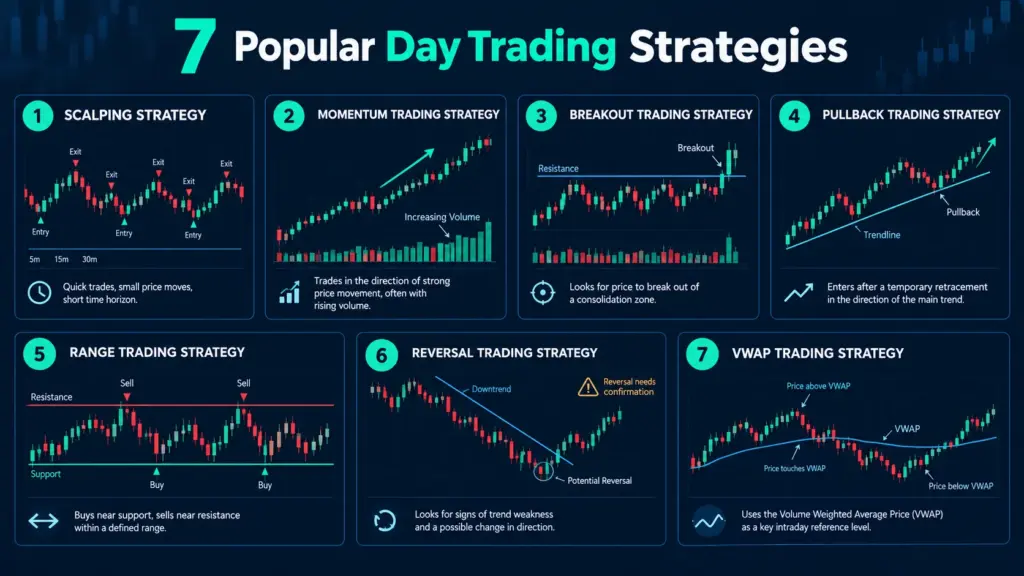
1. Scalping Strategy
How Scalping Works
Scalping aims to capture very small price movements through frequent trades. Positions may last seconds or minutes, and traders often rely on liquid markets, fast execution, and strict exit rules.
Entry and Exit Rules
A scalping plan should define the exact setup, entry trigger, invalidation level, profit target, and maximum number of trades per session. For example, a trader may look for a short-term pullback within an intraday trend, enter only after a confirmation candle, and exit at a predefined target or stop-loss.
Risks of Scalping, Spreads, and Slippage
Because scalping targets small moves, trading costs can quickly erase profits. Wide spreads, slow execution, and slippage are especially damaging. Scalping is generally not ideal for beginners because it demands speed, discipline, and constant attention.
2. Momentum Trading Strategy
Identifying Strong Price Momentum
Momentum trading focuses on assets moving strongly in one direction. Traders look for expanding candles, increasing volume, clear market structure, or a catalyst such as news or an earnings release.
Using Price, Volume, and Market Context
Price movement alone is not enough. Volume, liquidity, broader market direction, and the reason behind the move should support the trade idea. A momentum move without participation can reverse quickly.
Common Momentum Trading Mistakes
Common mistakes include chasing price after a large move, entering without a stop-loss, ignoring news risk, and assuming momentum will continue indefinitely. Momentum can reverse sharply, especially after extended moves.
3. Breakout Trading Strategy
Identifying Support, Resistance, and Consolidation
A breakout occurs when price moves beyond a defined support or resistance level after a period of consolidation. Traders look for a clear level, reduced volatility before the breakout, and a decisive move beyond it.
Confirming a Breakout
Confirmation may include a candle close beyond the level, increased volume, a retest that holds, or alignment with the broader trend. No confirmation method eliminates risk, but it can help filter weak setups.
Avoiding False Breakouts
A false breakout happens when price briefly moves beyond a level and then reverses. To reduce exposure, avoid entering immediately after an extended spike, define invalidation below or above the breakout level, and consider waiting for a retest or confirmation.
4. Pullback Trading Strategy
Identifying the Dominant Trend
Pullback trading seeks to join an existing trend after a temporary retracement. First, identify whether the market is making higher highs and higher lows in an uptrend, or lower highs and lower lows in a downtrend.
Finding Potential Pullback Entries
Potential entry areas include prior support or resistance, moving averages, trendlines, or a defined retracement zone. The key is to wait for price to reach an area where the trend may resume—not simply to buy because price has fallen.
Confirming Trend Continuation
A continuation signal may include a bullish or bearish rejection candle, a return of momentum, or a break of a short-term structure in the trend direction. If the pullback breaks the trend structure, the setup may be invalid.
5. Range Trading Strategy
Identifying a Sideways Market
A range forms when price repeatedly moves between horizontal support and resistance without making a sustained directional trend. Range trading aims to buy near support and sell near resistance.
Trading Near Support and Resistance
Rather than entering in the middle of the range, traders often wait for price to approach a boundary and show a reaction. Stop-loss placement should account for normal market noise, not sit exactly at the obvious level.
Recognizing When a Range May Break
Increasing volatility, stronger momentum candles, repeated tests of a level, or a catalyst can signal that a range may break. If a range breaks, continuing to trade it as a range can lead to repeated losses.
6. Reversal Trading Strategy
Recognizing Potential Trend Exhaustion
Reversal trading looks for signs that a trend may be losing strength, such as weakening momentum, divergence, failed continuation attempts, or a strong rejection at a key level.
Confirming a Possible Reversal
A reversal should be confirmed by a change in market structure, such as a break of a significant higher low in a downtrend or lower high in an uptrend. Candlestick patterns alone are not enough.
Why Early Reversal Entries Can Be Risky
Entering too early means trading against an active trend. Trends can continue longer than expected, so reversal traders often need tighter risk control and stronger confirmation than trend-following traders.
7. VWAP Trading Strategy
What VWAP Measures
VWAP, or Volume Weighted Average Price, shows the average price weighted by trading volume. It is often used as a reference for whether price is trading above or below the day’s average traded price.
Using VWAP as a Contextual Trading Tool
Some traders use VWAP to assess intraday bias, identify potential pullback areas, or filter trades in the direction of stronger volume participation. VWAP works best as context, not as a standalone buy or sell signal.
VWAP Limitations Across Markets
VWAP is most meaningful in markets with reliable centralized volume data, such as many stock exchanges. In decentralized or over-the-counter markets, including much of forex, the volume shown by a platform may not represent total market volume.
🧭 How to Choose the Best Day Trading Strategy
Match the Strategy to Market Conditions
Trend-following and pullback strategies are generally more relevant in trending markets, while range trading is more relevant when price is moving sideways. Breakout strategies may work when consolidation resolves into a strong move, but they can produce false signals in choppy conditions.
Consider Your Experience and Trading Style
Scalping requires rapid decisions and constant monitoring. Momentum and breakout trading require patience to wait for valid setups. Reversal trading requires stronger confirmation because you are often trading against the current move.
Evaluate Trading Costs and Available Tools
Before choosing a strategy, calculate the cost of a typical trade, including spread, commission, slippage, and data fees. A strategy with many small trades needs especially low costs and reliable execution.
Wondering whether day trading is right for you? Read Is Day Trading Worth It.
Want to explore trading signals and potential market opportunities? Visit our SIGNAL page for the latest trading setups.
🧮 Best Day Trading Indicators and Tools
Moving Averages and Trend Analysis
Moving averages help traders visualize the general direction of price. However, they are lagging tools and can produce late signals, especially in sideways markets.
RSI and Momentum Analysis
The Relative Strength Index (RSI) measures the speed of price changes and is often used to assess momentum. Overbought or oversold readings do not automatically mean a reversal will occur; context and confirmation matter.
VWAP and Volume Analysis
VWAP and volume can help traders understand whether price movement has participation behind it. Volume data quality varies by market, so interpret it carefully.
ATR for Volatility and Stop Placement
Average True Range (ATR) measures market volatility, not the direction of price. Traders may use it to help size stops or account for normal price movement, but ATR alone cannot predict direction.
🛡️ Risk Management for Day Trading
Set a Maximum Risk per Trade
Decide the maximum amount you are willing to lose on a single trade before entering. This should be based on capital you can afford to lose, not on the size of the potential profit.
Understand Risk-to-Reward Ratio
Risk-to-reward ratio compares potential loss with potential gain. A favorable ratio does not guarantee profitability; win rate, costs, and consistency also matter.
Use Stop-Loss Orders and Position Sizing
Position size should be calculated from the distance to your stop-loss and the amount you are willing to risk. A wider stop requires a smaller position if the monetary risk stays the same.
Avoid Overtrading and Excessive Leverage
Overtrading, revenge trading, and excessive leverage can turn a manageable loss into a severe one. The SEC warns that day trading can be highly risky and that margin trading may result in losses beyond the initial investment.
Important: Investor.gov notes that leveraged strategies can cause rapid and substantial losses, and in some cases losses may exceed the amount initially invested.
🧪 How to Test a Day Trading Strategy
Define Objective Entry and Exit Rules
Convert your idea into measurable rules. Specify the market, timeframe, setup, entry trigger, stop-loss location, profit target, and conditions that cancel the trade.
Backtest the Strategy on Historical Data
Backtesting checks how the rules would have performed on past data. Include realistic costs and avoid overfitting—meaning do not adjust rules only to make historical results look better.
Forward-Test with a Demo Account
A demo account lets you practice execution in current market conditions without risking real capital. Demo results are useful for testing discipline and platform familiarity, but they do not guarantee live-market performance.
Track Results in a Trading Journal
Record the setup, entry, exit, stop-loss, result, fees, screenshots, emotional state, and whether you followed the plan. Review a meaningful sample of trades before changing your strategy.
⚠️ Common Day Trading Strategy Mistakes
- Changing strategies after only a few losing trades.
- Entering without a predefined stop-loss.
- Using too many conflicting indicators.
- Ignoring spreads, commissions, and slippage.
- Trading during major news releases without understanding volatility risk.
- Judging a strategy from a very small number of trades.
- Assuming backtest results will repeat exactly in live trading.
- Using leverage without understanding margin and liquidation risk.
🌱 Day Trading Strategies for Beginners
Start with One Clearly Defined Strategy
Choose one simple, testable strategy rather than combining several systems at once. Learn its valid market conditions, entry rules, exit rules, and limitations before adding complexity.
Practice Before Trading with Real Money
Use a demo account to practice order execution, risk sizing, and journaling. Treat the demo account seriously, but remember that simulated fills and emotions can differ from live trading.
Build a Repeatable Trading Routine
A simple routine may include market preparation, identifying scenarios, executing only valid setups, reviewing trades after the session, and tracking adherence to rules.
✅ Day Trading Strategy Checklist
☐ I defined the market condition required for my strategy.
☐ I wrote objective entry and exit rules.
☐ I defined the condition that invalidates the trade.
☐ I set a stop-loss before entering.
☐ I calculated position size based on my risk limit.
☐ I included spread, commission, and slippage in my cost estimate.
☐ I backtested the strategy on historical data.
☐ I practiced the strategy on a demo account.
☐ I keep a trading journal and review results regularly.
🚀 Strengthen Your Trading Knowledge
Explore FastPip’s day trading guides, market analysis, and economic calendar to strengthen your trading knowledge and evaluate your strategy.
🏁 Conclusion: Build a Day Trading Strategy You Can Test
The most useful day trading strategy is not necessarily the most complex one. It is a clear, repeatable process that matches current market conditions, controls risk, accounts for costs, and can be evaluated objectively.
Start by choosing one market and one strategy. Define entry, exit, invalidation, and risk rules. Backtest the idea, practice it on a demo account, and track results in a trading journal. Only then consider using real capital—and only with money you can afford to lose.