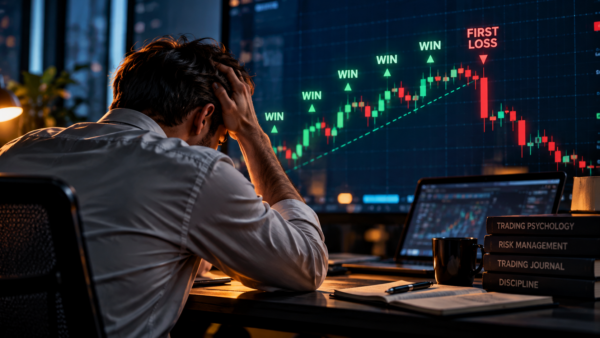

Scalping Trading Risks: Why Most Scalping Strategies Fail in the Long Run
Introduction
Scalping is one of the most attractive trading styles in the Forex, crypto, indices, and CFD markets. The idea of entering and exiting trades within seconds or minutes appears exciting, fast-paced, and highly profitable. Social media has amplified this image even further, showing traders making quick profits multiple times a day with minimal holding time.
However, behind this attractive appearance lies a much harsher reality.
The truth is that scalping trading risks are significantly higher than most traders initially realize. While some traders may experience short-term success, a large percentage eventually struggle with emotional exhaustion, inconsistent execution, hidden transaction costs, liquidity problems, and unstable profitability.
Many beginners assume scalping is easier because trades are short. In reality, it is one of the most difficult trading styles to sustain over the long term. Scalping depends heavily on:
- Execution speed
- Liquidity quality
- Spread stability
- Emotional control
- Risk management
- Market infrastructure
- Broker performance
Even small weaknesses in any of these areas can completely destroy a scalping strategy over time.
In this article, we will explore the hidden scalping trading risks that most traders ignore. We will explain why many scalping systems fail in live market conditions, how psychological pressure affects scalpers, why execution quality matters more than indicators, and what separates professional scalpers from traders who eventually burn out.
Why Scalping Looks Easy but Is Actually Extremely Difficult
One of the biggest misconceptions in trading is that scalping is simple. At first glance, the concept appears straightforward:
Enter quickly, capture a few pips, close the trade, and repeat the process multiple times throughout the day.
Because the profit targets are small, many traders believe scalping carries less risk. In reality, the opposite is true.
Scalping is one of the most sensitive forms of trading because the margin for error is incredibly small. Swing traders may survive temporary execution issues or slightly wider spreads, but scalpers often cannot.
A scalper depends on precision.
Even tiny market frictions can dramatically impact performance:
- Slippage
- Latency
- Spread widening
- Poor fills
- Delayed execution
- Requotes
When the average profit target is only three to five pips, even a one-pip execution issue can significantly damage profitability.
This is one of the primary scalping trading risks that many traders underestimate.
Another problem is that scalping requires constant attention. Scalpers often spend hours monitoring charts, reacting to rapid market changes, and making repeated decisions under pressure.
This creates mental fatigue much faster than longer-term trading styles.
Professional traders understand that decision-making quality declines after extended periods of stress. Scalping continuously pushes the brain into high-speed decision mode, making emotional discipline far more difficult to maintain over time.
Hidden Market Costs That Destroy Scalping Strategies
Many traders focus entirely on strategy entries and indicators while ignoring hidden market costs.
This is a major mistake.
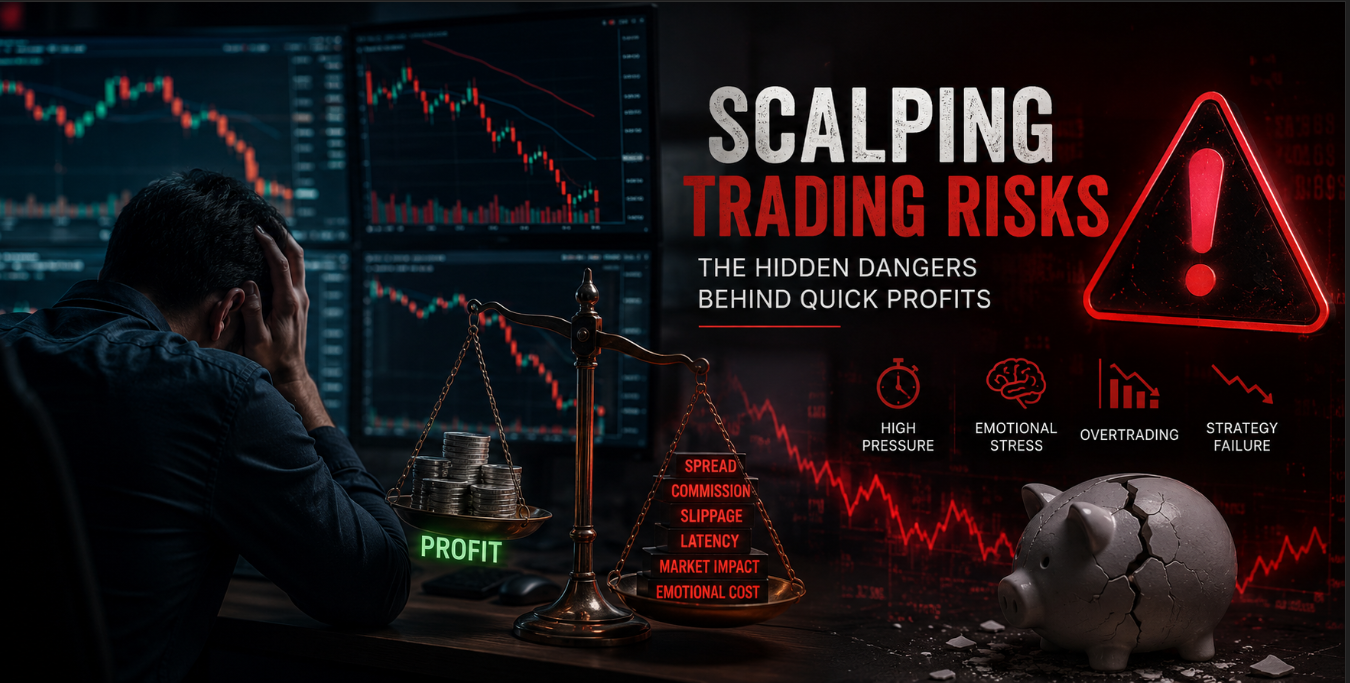
One of the biggest scalping trading risks is that small transaction costs gradually consume the entire trading edge.
These hidden costs include:
- Spread
- Commission
- Slippage
- Execution delay
- Market impact
- Liquidity deterioration
A swing trader targeting 300 pips may barely notice a slightly wider spread. A scalper targeting three pips absolutely will.
For example:
A trader executing 50 trades daily with a five-pip target may appear profitable on paper. However, if average slippage increases by only half a pip, a large portion of the strategy’s edge disappears.
This explains why many scalping systems perform well in backtests but collapse in real market conditions.
Live execution is never perfect.
During volatile sessions:
- Liquidity changes rapidly
- LP behavior shifts
- Spreads widen suddenly
- Execution quality deteriorates
These realities rarely appear accurately in backtesting software.
This is why professional firms place enormous emphasis on execution analytics instead of focusing only on indicators.
Why Scalpers Experience Extreme Psychological Pressure
Scalping creates a unique form of psychological stress.
Unlike swing traders who may analyze calmly over hours or days, scalpers must constantly react within seconds.
The brain remains under continuous pressure.
Scalpers frequently experience:
- Fear of missing out
- Emotional overreaction
- Decision fatigue
- Performance anxiety
- Dopamine addiction from fast trades
- Revenge trading behavior
This continuous stimulation eventually creates mental exhaustion.
One of the most dangerous scalping trading risks is psychological burnout.
Many traders initially perform well because excitement and focus are high. Over time, however, constant pressure damages emotional discipline.
This leads to:
- Overtrading
- Emotional entries
- Rule breaking
- Poor risk control
- Loss of concentration
Professional trading desks understand this problem clearly. Many institutional short-term traders operate under strict psychological monitoring systems because emotional deterioration directly impacts execution quality.
A tired mind becomes a dangerous trading environment.
Why Overtrading Is Extremely Common Among Scalpers
Scalping naturally encourages excessive activity.
Because the market constantly moves, traders begin believing every small fluctuation is a trading opportunity.
This mindset creates overtrading.
One of the major scalping trading risks is confusing activity with profitability.
Many scalpers believe:
“The more I trade, the more I earn.”
In reality, excessive trading usually produces:
- Lower-quality setups
- Higher transaction costs
- Increased emotional mistakes
- Faster mental exhaustion
Professional traders understand that not every movement deserves participation.
Sometimes the best trade is no trade.
Unfortunately, many scalpers become psychologically dependent on market activity. They feel uncomfortable when not trading.
This emotional dependence gradually destroys discipline.
Why Scalping Strategies Often Fail in Real Markets
Many scalping systems look extraordinary in historical testing.
Backtests may show:
- High win rates
- Smooth equity curves
- Small drawdowns
- Fast profit growth
However, live markets behave very differently.
This is one of the most misunderstood scalping trading risks.
Backtests often fail to simulate:
- Real slippage
- Dynamic spreads
- Liquidity gaps
- News volatility
- Execution delays
- Broker routing behavior
A strategy targeting three pips may collapse completely when average slippage reaches one pip.
This difference between theory and live execution destroys many scalping systems.
Another issue is overfitting.
Many scalping algorithms are excessively optimized for historical data. They memorize past behavior rather than adapting to future market conditions.
As markets evolve, the edge disappears.
Professional trading firms evaluate strategies based on:
- Robustness
- Stability across market conditions
- Execution sensitivity
- Slippage resistance
- Scalability
Retail traders often ignore these factors entirely.
Why Broker Quality Matters More in Scalping
Broker quality has a much greater impact on scalping compared to longer-term trading.
A swing trader may barely notice minor execution changes.
A scalper absolutely will.
This makes broker infrastructure one of the most critical scalping trading risks.
Scalpers depend heavily on:
- Low latency
- Stable spreads
- High-quality liquidity providers
- Fast order routing
- Consistent fills
Even a few milliseconds of delay can significantly impact profitability.
Professional scalpers often invest in:
- VPS hosting
- Low-latency infrastructure
- Co-location services
- Premium liquidity environments
Because infrastructure itself becomes part of the trading edge.
Another important factor is LP behavior.
Some liquidity providers aggressively manage toxic flow and may alter execution quality for high-frequency scalpers.
This can result in:
- Increased slippage
- Worse fills
- Execution delays
- Higher rejection rates
Many traders mistakenly believe their strategy stopped working when the real issue is execution deterioration.
Why High Win Rates Can Be Dangerous
A high win rate often creates a false sense of security.
Many scalpers proudly advertise:
- 80% win rate
- 90% win rate
- Frequent winning streaks
However, win rate alone means very little.
One of the hidden scalping trading risks is poor risk-to-reward structure.
A trader may win 90 trades and lose only 10, yet still lose money overall if the losses are significantly larger than the gains.
Many high-win-rate systems suffer from:
- Large tail risk
- Weak stop discipline
- Averaging behavior
- Delayed loss acceptance
These strategies often appear stable until one major market event erases months of profits.
Professional traders focus more on:
- Expectancy
- Drawdown control
- Long-term stability
- Risk-adjusted returns
A lower win rate with strong risk management is often far safer than an extremely high win rate with fragile risk exposure.
Why Volatile Markets Are Dangerous for Scalpers
Many traders assume volatility automatically benefits scalpers.
This assumption is often wrong.
Extreme volatility introduces severe execution instability.
During volatile conditions:
- Liquidity disappears
- Spreads widen dramatically
- Slippage increases
- Market depth weakens
- Quotes become unstable
These conditions are extremely dangerous for strategies targeting only a few pips.
This is one of the most overlooked scalping trading risks.
Even if directional analysis is correct, poor execution may completely eliminate profitability.
Professional firms frequently reduce short-term exposure during unstable volatility regimes because they understand that abnormal market conditions destroy execution precision.
Not all volatility is opportunity.
Sometimes volatility becomes pure execution risk.
Why Scalpers Struggle to Maintain Discipline Long Term
Scalping requires constant decision-making.
Every trade demands:
- Entry precision
- Exit timing
- Risk control
- Emotional regulation
Over time, decision fatigue accumulates.
This slowly weakens discipline.
One of the major scalping trading risks is behavioral deterioration.
Traders gradually begin:
- Entering earlier
- Exiting emotionally
- Ignoring stop losses
- Increasing size impulsively
- Trading poor setups
Discipline rarely collapses instantly.
It erodes slowly.
Professional traders understand that consistency matters more than temporary performance spikes.
The ability to execute the same process repeatedly under pressure separates sustainable traders from emotional traders.
Why Revenge Trading Destroys Many Scalpers
Scalping creates immediate emotional feedback.
Losses happen quickly.
This increases the probability of revenge trading.
After several losses, many scalpers attempt to recover money rapidly by:
- Increasing position size
- Trading impulsively
- Ignoring setup quality
- Chasing the market
This behavior becomes extremely dangerous.
One of the most destructive scalping trading risks is emotional escalation after losses.
Professional trading environments often implement:
- Daily loss limits
- Trading pauses
- Risk locks
- Behavioral monitoring
Because emotional trading is one of the fastest ways to destroy a trading account.
Why Scalping Becomes Harder With Large Accounts
Many traders assume that scaling capital automatically increases profits proportionally.
This is rarely true in scalping.
Larger accounts face additional problems:
- Market impact
- Liquidity limitations
- Reduced fill quality
- Greater slippage
- Capacity constraints
A strategy that performs well with small size may fail completely at institutional scale.
This issue is known as the scalability problem.
Professional firms constantly analyze strategy capacity because many short-term edges disappear once position size grows too large.
This is another major scalping trading risk that retail traders often ignore.
Why Many Scalpers Eventually Lose Their Edge
Market structures evolve continuously.
Liquidity providers improve technology.
High-frequency firms optimize pricing models.
Execution environments become more competitive.
As a result, many small short-term inefficiencies disappear over time.
One of the harsh realities of scalping trading risks is that many edges are temporary.
What worked six months ago may no longer function today.
Professional firms constantly monitor:
- Edge decay
- Market structure shifts
- Execution changes
- Liquidity behavior
Adaptability is critical.
Traders who depend entirely on one fixed setup often struggle when market conditions evolve.
Why Risk Management Is the Most Important Survival Factor
No discussion about scalping trading risks is complete without risk management.
Many scalpers focus obsessively on entries while ignoring exposure control.
This is extremely dangerous.
Because scalpers often use:
- High leverage
- Large position sizes
- Tight stops
- Frequent trades
Small mistakes compound rapidly.
Professional traders prioritize:
- Maximum daily loss limits
- Controlled exposure
- Consistent sizing
- Emotional stability
- Capital preservation
Without risk management, even a strong strategy eventually collapses.
Long-term survival matters more than short-term excitement.
The Difference Between Professional Scalping and Destructive Scalping
Professional scalping is not random rapid trading.
Institutional-level scalping involves:
- Strict execution analysis
- Infrastructure optimization
- Statistical modeling
- Advanced risk management
- Psychological discipline
- Liquidity awareness
Destructive scalping, on the other hand, usually involves:
- Emotional overtrading
- High leverage abuse
- Random entries
- Weak discipline
- Poor execution environments
- Lack of structured risk control
The difference between the two is enormous.
Most retail traders unfortunately fall into the second category.
How FastPip Traders Can Improve Market Awareness
Understanding execution quality and market structure is critical for long-term trading survival. Traders who continuously educate themselves about liquidity behavior, volatility regimes, and psychological discipline generally perform far better than traders who rely only on indicators.
The educational resources available on the FastPip Blog regularly discuss professional trading concepts, risk management principles, and market structure analysis that can help traders better understand the realities behind short-term trading environments.
In addition, traders who follow macroeconomic developments and financial market news through the FastPip News Section can improve their awareness of volatility events that significantly impact scalping conditions.
External Resources About Trading Psychology and Risk
Professional traders continuously study behavioral finance and risk management principles because emotional discipline is deeply connected to trading survival.
Useful external educational resources include:
These resources provide additional insights into execution quality, emotional control, and market risk management.
Conclusion
Scalping appears attractive because it promises fast profits and constant market action. However, the reality behind scalping trading risks is far more complex.
Most scalping strategies fail not because traders cannot predict market direction, but because the structure itself is extremely fragile.
Execution costs, slippage, emotional pressure, overtrading, liquidity instability, psychological burnout, and poor risk management gradually destroy profitability over time.
Professional traders understand that successful scalping is not simply about entering trades quickly. It requires:
- Advanced execution quality
- Deep psychological discipline
- Strong infrastructure
- Controlled risk exposure
- Continuous adaptation
Without these elements, even profitable short-term strategies eventually collapse.
In the end, sustainable trading is not about constant activity or rapid profits. It is about consistency, discipline, risk control, and survival across changing market conditions.