Fear of Trading: The Biggest Enemy of Signal Users
Fear of Entering Trades: The Biggest Enemy of Signal Users
Many signal users assume that poor signals, inaccurate analysis, or unpredictable market volatility are the main reasons they struggle to achieve consistent results.
But sometimes the real problem appears after all the analysis has already been done.
The signal has been published.
The entry price is clear.
The stop-loss has been defined.
The take-profit targets are ready.
Everything is prepared.
Then the trader has to press Buy or Sell.
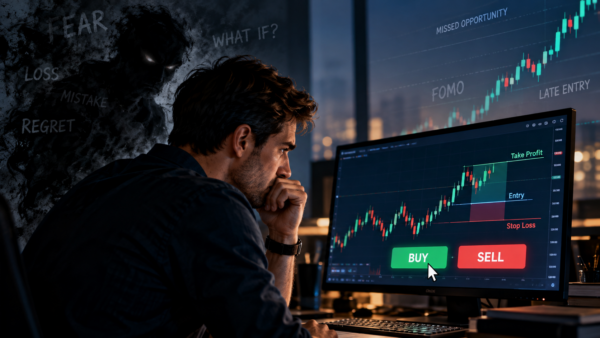
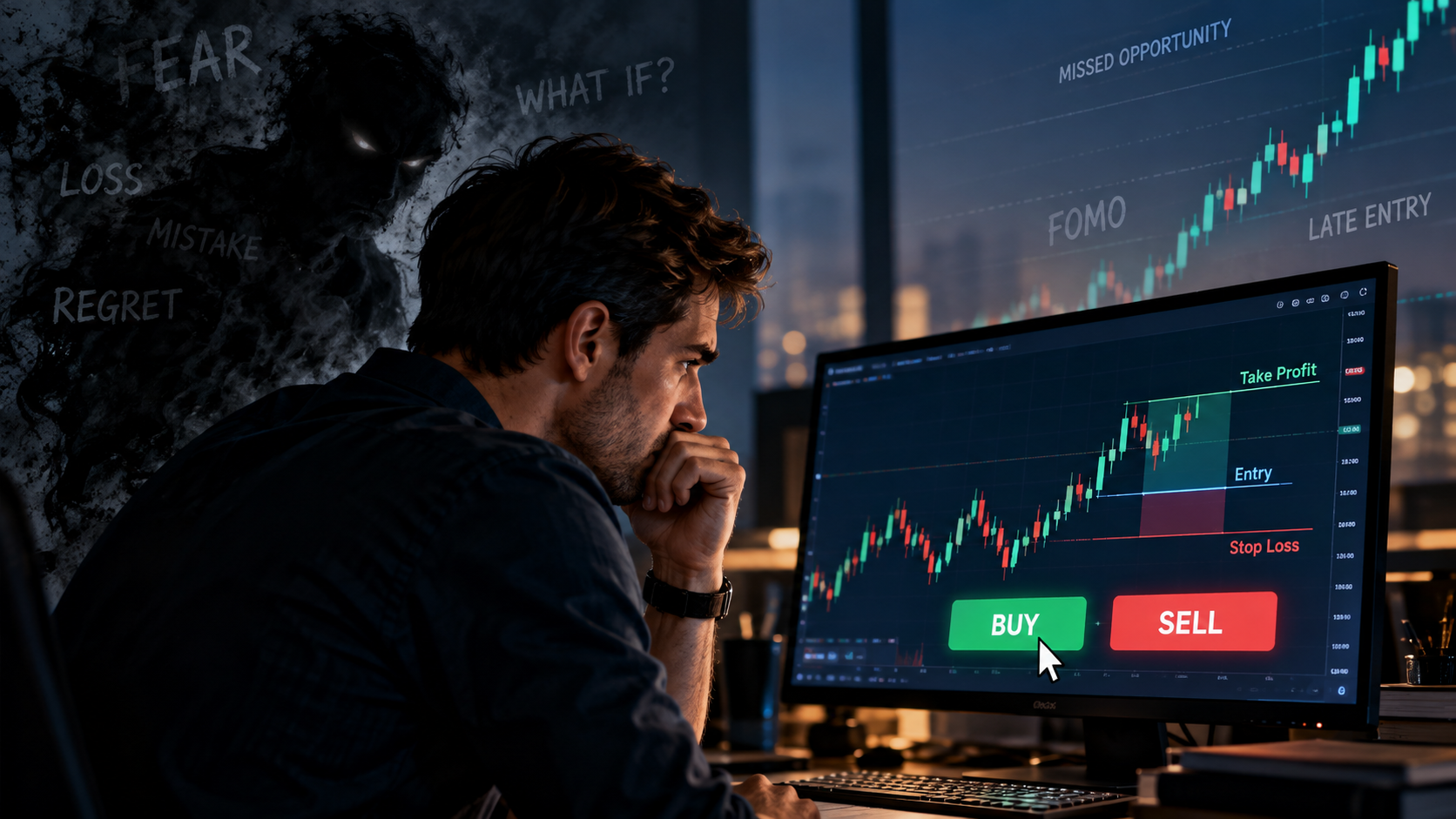
That is often the exact moment when fear takes control.
The fear of entering trades can turn a valid trading opportunity into hesitation, overanalysis, regret, and eventually a poor decision.
A trader opens the chart and thinks:
“What if this one fails?”
They wait.
They check another indicator.
They read another market opinion.
They wait for another candle.
Then price begins moving toward the target.
Hesitation turns into regret.
Regret becomes urgency.
And eventually the trader enters at a worse price simply because they are afraid of missing the rest of the move.
This cycle is one of the most damaging psychological patterns among signal users.
The problem is not always the quality of the signal.
The problem is often the trader’s ability to execute a valid decision under uncertainty.
No trading strategy wins every trade. Even profitable systems experience losses, drawdowns, and losing streaks.
Professional trading does not require certainty.
It requires disciplined decision-making despite uncertainty.
Understanding the psychology behind the fear of entering trades is therefore an important step toward becoming a more consistent trader.
Understanding the Fear of Entering Trades
1. What Is Fear of Entering Trades?
The fear of entering trades is not simply a momentary feeling that appears before clicking Buy or Sell.
It is often the result of previous experiences, financial losses, beliefs about risk, negative memories, lack of confidence in a trading system, and emotional reactions accumulated over time.
A trader may have experienced a painful loss months or even years earlier.
The position may have disappeared from the trading platform, but its psychological impact can remain.
When a new signal appears, the trader may unconsciously connect the new opportunity with the previous loss.
Another major cause is giving too much importance to the outcome of a single position.
Instead of viewing trading as a process involving dozens or hundreds of trades, the trader treats every position as a major test:
“What if I lose?”
“What if I am wrong again?”
“What if the signal provider made a mistake?”
The more emotionally important a single trade becomes, the harder it becomes to execute.
A lack of understanding also increases fear.
If signal users do not understand why a trade was selected, what strategy generated it, or when that strategy is likely to perform poorly, uncertainty naturally becomes stronger.
2. Why Signal Users Often Hesitate More Than Independent Traders
At first glance, signal users should have an easier task.
They may already receive:
- An entry price
- A stop-loss
- Take-profit levels
- Trade direction
- Risk information
- Supporting analysis
FastPip’s Trading Signals section provides real trading setups and illustrates how entry, stop-loss, targets, and risk levels can be structured. FastPip Trading Signals
Yet signal users can still hesitate more than independent traders.
One reason is decision ownership.
An independent trader performs the analysis personally and therefore understands the reasoning behind the position.
A signal user is in a different situation.
Someone else may have produced the analysis, but the financial outcome still belongs to the user.
This can create an uncomfortable psychological gap.
The trader thinks:
“I understand what the signal says, but do I really trust the decision?”
That uncertainty often leads to confirmation seeking.
The trader checks another chart.
Then another indicator.
Then economic news.
Then social media.
Then another analyst.
Each additional source is supposed to increase confidence.
Instead, it often produces more contradictory information.
3. How Previous Losses Shape Today’s Decisions
A losing trade ends financially when the position closes.
Psychologically, it can remain active much longer.
Imagine a trader who once followed a signal using excessive position size and suffered a major loss.
Months later, another trade appears.
The new trade may have:
- Appropriate risk
- A valid stop-loss
- Good market structure
- A reasonable reward-to-risk ratio
But the trader still hesitates.
The current market may not be the real cause.
The trader may be reacting to the memory of the previous loss.
This can result in:
- Skipping valid trades
- Closing positions too early
- Looking for unnecessary confirmation
- Reducing confidence after every loss
- Constantly changing strategies
- Distrusting new signals
Past losses should provide information.
They should not automatically control future decisions.
Why the Brain Makes Trading Decisions Difficult
4. The Brain Was Designed for Survival, Not Trading
The human brain did not evolve to interpret leverage, candlestick charts, technical indicators, or probabilistic trading systems.
It evolved primarily to identify danger and protect resources.
This matters because financial losses can trigger strong defensive reactions.
A trader may rationally know:
“My maximum risk is only 1%.”
Emotionally, however, losing money may still feel threatening.
Behavioral finance research has shown that investors can be influenced by both cognitive errors and emotional biases such as loss aversion, regret aversion, confirmation bias, and overconfidence.
For further reading, see the CFA Institute discussion of behavioral biases in financial decision-making. CFA Institute – Behavioral Biases of Individuals
External link setting: DoFollow
The goal is not to eliminate emotion.
That would be unrealistic.
The goal is to stop emotional reactions from overriding a structured trading process.
5. Analysis Paralysis
One of the most damaging consequences of the fear of entering trades is analysis paralysis.
A signal arrives.
Instead of acting, the trader begins gathering more information.
They check RSI.
Then MACD.
Then another timeframe.
Then economic news.
Then another analyst.
Then social media.
Every new piece of information is supposed to provide certainty.
But markets rarely provide complete agreement.
For almost every bullish argument, someone can present a bearish one.
The result is often more confusion rather than greater confidence.
The trader continues searching until the opportunity disappears.
The purpose of analysis is not to eliminate uncertainty.
The purpose is to create a rational framework for decision-making.
6. Fear That the Signal Provider May Be Wrong
No signal provider can be correct all the time.
No professional trader has a 100% win rate.
And no trading system can predict every market movement.
The problem begins when users expect every published signal to generate profit.
Then each position becomes a test of the signal provider.
Three successful trades may create excessive confidence.
Two losses may destroy that confidence completely.
Professional evaluation should be based on a larger sample.
Useful metrics include:
- Win rate
- Maximum drawdown
- Average winner
- Average loser
- Risk-to-reward ratio
- Consistency
- Transparency
- Position sizing
- Performance across different market conditions
One trade proves very little.
Long-term data is far more useful.
How Fear Changes Trading Behavior
7. Searching for the Perfect Entry
One of the most common disguises of trading fear is the search for the perfect entry.
The signal may provide a valid entry, but the trader thinks:
“I’ll wait a little lower.”
Or:
“There will probably be another pullback.”
Sometimes price does return.
Sometimes it does not.
The real problem begins when waiting is not based on strategy but on discomfort with committing to the trade.
The trader is not improving the entry.
They are delaying the decision.
There is an important difference between a good entry and a perfect entry.
A good entry satisfies a trading system.
A perfect entry usually becomes obvious only in hindsight.
8. Why Traders Enter After the Market Has Already Moved
This creates one of the biggest contradictions in signal trading.
At the original entry price, the trader is afraid.
After the market moves significantly in the predicted direction, they suddenly become confident.
Why?
Because price movement provides psychological confirmation.
Suppose a gold Buy setup has:
- 200 pips potential reward
- 50 pips risk
That represents approximately a 4:1 reward-to-risk ratio.
The trader hesitates.
Gold moves 150 pips higher.
Now the trader finally decides to enter.
Only 50 pips remain to the original target.
The attractive trade has already happened.
The trader rejected the better entry and accepted the weaker one.
Fear created the delay.
9. FOMO: When Fear Turns Into Chasing
Fear and FOMO may appear to be opposites.
In practice, one often creates the other.
The pattern frequently looks like this:
Fear → No Entry → Market Moves → Regret → FOMO → Late Entry
Once price begins moving, the trader starts calculating imaginary profits.
“If I had entered earlier, I would already be profitable.”
This thinking creates psychological pressure.
Eventually the trader enters simply because watching the market move without them becomes uncomfortable.
FOMO can lead to:
- Chasing extended markets
- Increasing position size
- Ignoring stop-loss logic
- Overtrading
- Abandoning the original trading plan
A missed opportunity is not a financial loss.
Turning it into an emotional emergency can create a real financial loss.
10. How Social Media Makes Trading Fear Worse
Modern traders consume enormous amounts of information.
A trader can receive one Buy signal and within minutes find:
- A bearish analyst
- A bullish influencer
- A macroeconomic warning
- A technical reversal setup
- Profit screenshots
- Conflicting market forecasts
The result is often not improved knowledge.
It is information overload.
Social media also creates a distorted picture of trading.
People tend to publish successful trades.
They publish fewer losing streaks, missed entries, emotional mistakes, and drawdowns.
Signal users may therefore compare their complete trading experience with another person’s selected highlights.
This can damage confidence and increase the fear of entering trades.
11. Rational Fear vs. Destructive Fear
Not every fear should be ignored.
Some fear is useful.
Rational fear may be warning you that:
- Position size is too large
- There is no stop-loss
- You do not understand the trade
- Risk is above your normal limit
- The setup violates your strategy
- You are acting impulsively
- Major volatility is approaching
This kind of fear protects capital.
Destructive fear is different.
It appears even when:
- Risk is controlled
- The setup meets your rules
- Position size is appropriate
- The stop-loss is predefined
- The strategy has been tested
Yet the trader still cannot execute because the possibility of losing feels unacceptable.
The ability to distinguish between these two forms of fear is essential.
Risk, Confidence, and Fear of Entering Trades
12. Position Size Can Create Fear of Entering Trades
Sometimes the trader thinks the signal itself is creating anxiety.
The real problem may be position size.
Imagine two traders taking the same setup.
Trader A risks 0.5%.
Trader B risks 10%.
The market analysis is identical.
The psychological experience is completely different.
Oversized positions amplify:
- Fear
- Stress
- Impulsive exits
- Stop-loss manipulation
- Over-monitoring
- Emotional decisions
If the possible loss feels unbearable, position size is probably too large.
Risk tolerance also differs from person to person. FINRA notes that risk tolerance involves the amount of investment risk someone is both willing and able to accept.
For additional background, see FINRA’s guide to risk tolerance. FINRA – Know Your Risk Tolerance
External link setting: DoFollow
Sometimes reducing risk is more effective than adding another indicator.
13. Confidence in the System Creates Confidence in the Signal
Trusting a signal provider is not the same as trusting the underlying process.
A trader may believe that an analyst is experienced.
But confidence remains fragile if the trader does not understand:
- Expected win rate
- Average risk
- Drawdown
- Losing streaks
- Average profit
- Average loss
- Market conditions
- Strategy logic
A tested system changes the question.
Instead of thinking:
“This trade must win.”
the trader thinks:
“This is one trade inside a much larger statistical sample.”
Professional confidence is not confidence that every trade will succeed.
It is confidence in executing a rational process repeatedly.
14. Why Some Traders Remember Only Certain Signals
Memory is selective.
Some traders remember every profitable trade they missed.
Others remember every losing trade they executed.
The first trader concludes:
“I always miss the winners.”
The second concludes:
“Every trade I enter loses.”
Neither belief may reflect reality.
This is why a trading journal is important.
FastPip’s Trading Journal Writing guide explains how recording entries, exits, trade reasons, emotional state, results, and mistakes can help traders identify recurring behavioral patterns.
Read the full FastPip Trading Journal Writing guide here. Trading Journal Writing – FastPip
Internal Link
A useful trading journal can record:
- Entry reason
- Position size
- Entry price
- Exit price
- Stop-loss
- Take-profit
- Profit or loss
- Emotional state
- Reason for skipping a signal
- Whether trading rules were followed
Data corrects distorted memory.
15. The Psychological Impact of Consecutive Losses
One losing trade is normally manageable.
Several losses in a row can seriously damage confidence.
After a losing streak, traders begin asking:
“Has the strategy stopped working?”
“Is the analyst still reliable?”
“Should I skip the next signal?”
The next signal may actually be profitable.
But the trader may stop executing precisely when discipline matters most.
Even profitable systems can experience losing streaks.
Understanding expected drawdowns and historical losing sequences helps prepare the trader psychologically.
16. Does Constantly Changing Signal Providers Solve the Problem?
Sometimes changing signal providers is justified.
A service may be:
- Untransparent
- Poorly managed
- Misrepresenting results
- Taking excessive risk
- Failing to follow its methodology
But there is a major difference between a rational change and an emotional change.
An emotional pattern looks like this:
Three winners → confidence.
Two losses → leave.
New provider → excitement.
First drawdown → leave again.
This behavior prevents the trader from evaluating any system over a meaningful sample.
The goal should not be finding a provider that never loses.
That provider does not exist.
The goal is finding a transparent and understandable process with appropriate risk.
How to Overcome Fear of Entering Trades
17. Practical Techniques for Reducing Fear of Entering Trades
The first step is accepting that fear does not need to disappear completely.
Instead, create a process that limits its influence.
Before entering a trade, use a checklist:
- Does this trade satisfy my rules?
- Is risk within my predefined limit?
- Is position size correct?
- Is the stop-loss clearly defined?
- Do I understand why the trade exists?
- Am I entering at the intended price?
- Am I acting because of strategy or emotion?
If all objective conditions are satisfied, further hesitation may simply be emotional resistance.
Another effective technique is reducing position size.
If clicking Buy or Sell feels overwhelming, trade smaller.
This gives the trader an opportunity to practice execution without excessive psychological pressure.
Keeping a detailed trading journal can also help identify repeated patterns of fear, hesitation, missed entries, and emotional trading.
FastPip provides a complete step-by-step guide to building and reviewing a trading journal. Learn Trading Journal Writing on FastPip
Internal Link
Most importantly, separate the quality of a decision from the outcome.
A disciplined trade can lose.
An undisciplined trade can win.
One result does not determine whether the process was correct.
18. Risk Management Reduces Trading Anxiety
Risk management is not only about protecting money.
It also protects psychological stability.
Before opening a trade, a trader should know the maximum acceptable loss.
Without predefined risk:
“I don’t know how bad this could become.”
With predefined risk:
“If this trade fails, I lose a controlled amount that I already accepted.”
That difference can significantly reduce anxiety.
Strong risk management includes:
- Position sizing
- Stop-loss discipline
- Maximum risk per trade
- Maximum daily or weekly loss
- Controlled leverage
- Realistic reward expectations
FastPip’s Trading Types guide also discusses position sizing, stop-loss use, risk-to-reward ratios, and leverage as important elements of trading risk management.
See the related FastPip Trading Types and Risk Management guide. Trading Types – FastPip
Internal Link
Professional traders frequently think about potential loss before potential profit.
That does not make them pessimistic.
It makes them prepared.
From Signal User to Disciplined Trader
19. How Signal Users Can Become More Independent
Using trading signals is not automatically a weakness.
Signals can help traders learn:
- Market structure
- Entry logic
- Stop-loss placement
- Take-profit management
- Position sizing
- Risk evaluation
The problem appears when the user remains permanently dependent on instructions.
A disciplined signal user begins asking:
Why was this entry selected?
Why is the stop-loss located there?
What invalidates the setup?
What market structure supports the trade?
What is the risk?
This changes the trader from a passive consumer into an active learner.
FastPip’s live trading signals also provide examples of entry zones, targets, risk levels, and trade-management logic.
Explore current FastPip Trading Signals. FastPip Trading Signals
Internal Link
Responsibility remains essential.
Even when another person provides the analysis, the decision to trade belongs to the trader.
20. Build Confidence Through Repeated Execution
Many traders believe:
“Once I become confident, I will execute consistently.”
In practice, confidence often develops in the opposite direction.
Consistent execution creates confidence.
Every time you follow a valid process, regardless of whether the individual trade wins or loses, disciplined behavior becomes stronger.
Over time, the trader develops evidence:
“I can follow my rules.”
“I can accept a normal loss.”
“I don’t need to chase every move.”
“I can miss a trade without panicking.”
“I can execute the next valid setup.”
This is how the fear of entering trades gradually loses control over decision-making.
The objective is not fearlessness.
The objective is disciplined action under uncertainty.
Conclusion: A Trade That Is Never Opened Can Never Produce a Return
The biggest problem facing many signal users is not necessarily the quality of the signal.
It is the inability to convert a valid trading decision into action.
Throughout this article, we have seen that the fear of entering trades can come from many sources:
Past losses.
Oversized positions.
FOMO.
Social-media pressure.
Lack of confidence in the trading system.
Consecutive losses.
Confirmation seeking.
Fear of being wrong.
Searching for a perfect entry.
But all of these problems can produce the same cycle:
Fear → hesitation → missed trade → regret → FOMO → late entry
Breaking this cycle does not require eliminating uncertainty.
Uncertainty is part of financial markets.
Instead, traders need a structured process that allows them to make rational decisions while uncertainty still exists.
Confidence develops through evidence, repetition, manageable risk, and disciplined execution.
Risk management protects both capital and the trader’s state of mind.
A trading journal converts emotional memories into measurable information.
A tested system replaces the impossible demand for certainty.
And experience teaches traders that no single position is important enough to define their entire performance.
Perhaps the most important lesson is this:
Many of the largest missed profits in trading do not come from incorrect analysis. They come from trades that were never executed.
That does not mean traders should follow every signal blindly.
It means that when a trade meets a tested set of rules and the risk is acceptable, fear alone should not become the final decision-maker.
Professional trading begins when a trader stops waiting for certainty and starts executing a disciplined process.
Frequently Asked Questions
What causes fear of entering trades?
Fear of entering trades can result from previous losses, excessive position size, lack of confidence in a trading strategy, fear of being wrong, social pressure, FOMO, or unrealistic expectations.
Is fear before entering a trade normal?
Yes. Markets involve uncertainty, so some concern is normal. The important question is whether the fear reflects a genuine risk problem or an emotional reaction to uncertainty.
Why do I hesitate even when I trust a trading signal?
You may trust the analyst while still feeling uncomfortable accepting the financial responsibility of the trade. Trusting the person and trusting the complete trading process are different things.
Why do traders enter after the market has already moved?
Movement in the expected direction creates psychological confirmation. Unfortunately, waiting for that confirmation can result in a worse entry and a weaker reward-to-risk ratio.
Can position size increase fear of entering trades?
Yes. Excessive position size increases both the financial and psychological impact of a potential loss.
How can I overcome fear of entering trades?
Use predefined trading rules, reduce position size, keep a trading journal, understand the statistics of your strategy, accept normal losses, and judge results over a meaningful number of trades.
Is FOMO connected to fear of entering trades?
Yes. A trader may initially avoid an entry because of fear and then chase the market later because they are afraid of missing the remaining move.
Should I change signal providers after several losses?
Not automatically. First evaluate longer-term results, risk management, drawdown, methodology, and transparency. Losing streaks can occur even in profitable systems.
How can a trading journal reduce fear?
A journal provides objective evidence about trading decisions and results. This helps determine whether fears are supported by data or distorted by selective memory.
Can risk management improve trading confidence?
Yes. Knowing the maximum possible loss before entering a position makes the worst-case scenario more predictable and psychologically manageable.