How to Evaluate Signal Service Quality Beyond Monthly Profit
How to Evaluate Signal Service Quality Beyond Monthly Profit
When traders compare signal providers, the first number they usually look at is monthly profit.
A service advertising 20%, 30%, or even 50% monthly returns can immediately attract attention.
That reaction is understandable.
The purpose of trading is ultimately to generate returns.
But monthly profit alone tells you surprisingly little about signal service quality.
Two services can both produce a 20% monthly return while taking completely different levels of risk.
One may use disciplined position sizing, clearly defined stop-losses, and controlled drawdown.
The other may achieve the same return by using excessive leverage, averaging down losing positions, or exposing a large percentage of the account to a single market move.
If you only look at profit, both services appear equally successful.
They are not.
The real question is not:
How much did the service make?
The better question is:
How was that return produced, and what level of risk was required to produce it?
Professional investors often evaluate returns together with the risk taken to generate them. CFA Institute notes that risk-adjusted performance measures are designed to answer not only what return was achieved, but also what level of risk was taken to achieve it.
CFA Institute – Risk-Adjusted Performance Measures
This is the mindset traders should also apply when evaluating signal service quality.
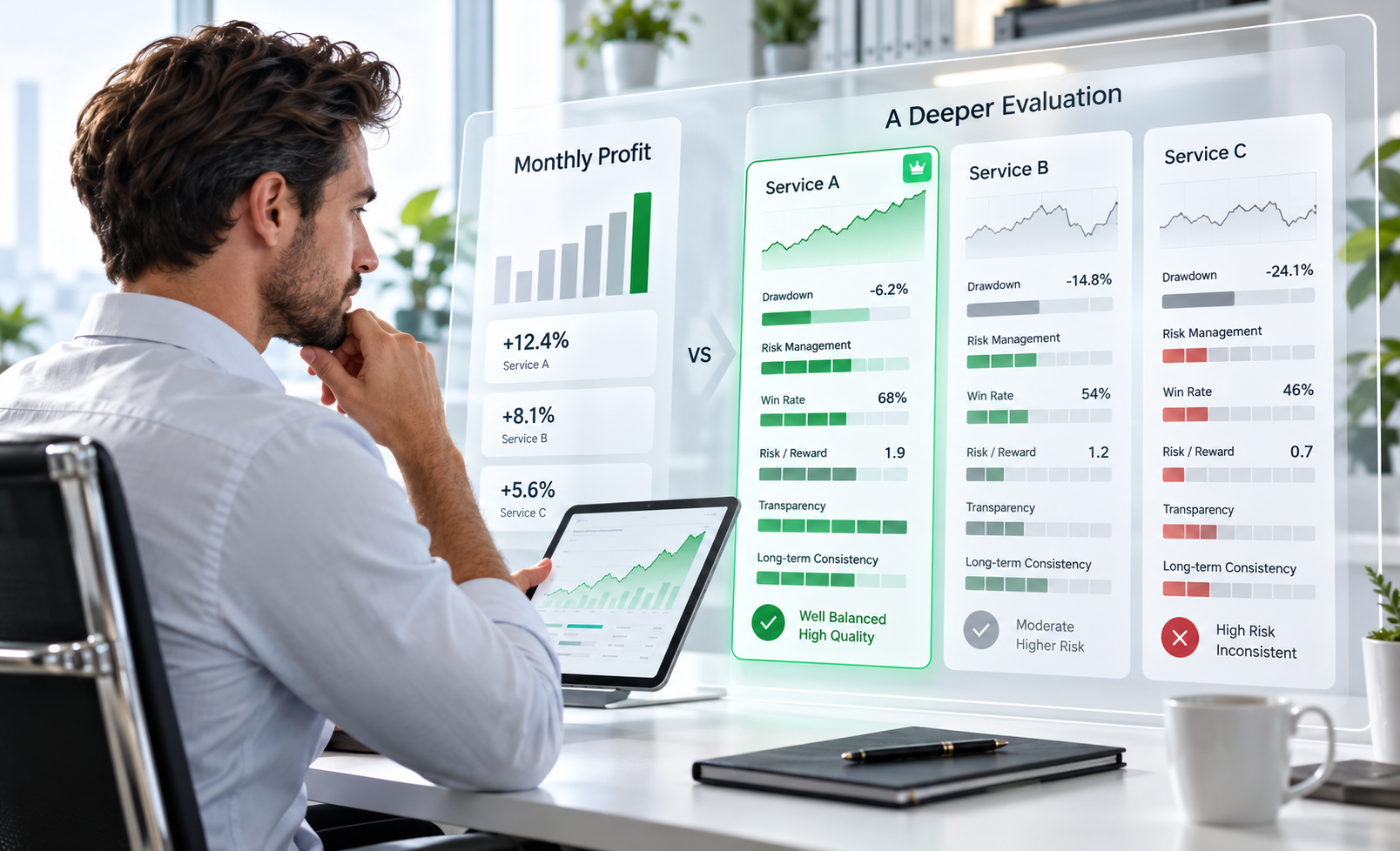
A professional signal service should be judged on risk management, consistency, drawdown, transparency, trade management, sample size, strategy structure, and the quality of its losses—not simply its best month.
Why Monthly Profit Can Be Misleading
A high monthly return can be real.
But that does not automatically make it sustainable.
Short-term performance can be heavily influenced by:
- Market conditions
- Leverage
- Position size
- A small number of successful trades
- Luck
- Concentrated exposure
- Unusually favorable volatility
A weak trading system can sometimes produce exceptional short-term results.
Likewise, a strong system can experience a slow month or a temporary drawdown.
That is why short-term profit should never be the only measure of signal service quality.
FINRA also emphasizes that higher expected returns generally come with higher levels of risk.
FINRA – Know Your Risk Tolerance
A service promising extraordinary returns should therefore make you more curious about risk—not less.
The Biggest Mistake Traders Make When Choosing a Signal Service
Many traders ask:
“How much profit does it make?”
Professional traders tend to ask:
“How does it make that profit?”
That difference is critical.
A signal service may generate strong returns by:
- Increasing lot size aggressively
- Using very high leverage
- Avoiding stop-losses
- Holding losing positions for long periods
- Averaging into losses
- Using martingale-style position sizing
These methods can make performance look excellent for months.
Then one adverse market move can erase a large portion of the previous gains.
This is why signal service quality should be assessed through process, not just outcome.
A profitable result does not automatically prove that the underlying decision was good.
1. Evaluate Signal Service Quality Through Risk Management
If you could examine only one area before subscribing to a signal service, risk management would be one of the strongest candidates.
Ask:
- Is a stop-loss provided?
- Is risk defined before entry?
- Is position size controlled?
- Is leverage reasonable?
- Are losing trades accepted?
- Does the service increase exposure after losses?
- Can several consecutive losses seriously damage the account?
A professional service should have a clear plan for what happens when the market moves against the trade.
Weak services often focus almost entirely on the upside.
Professional services also plan for failure.
FastPip’s guide to different trading types and risk management explains how position sizing, stop-losses, leverage, and risk-to-reward ratios can materially affect trading outcomes.
Trading Types and Risk Management – FastPip
Internal Link
The first principle should always be:
Protect the account before trying to maximize returns.
2. Examine the Risk-to-Reward Ratio
Win rate alone can be misleading.
A signal service can win 80% or even 90% of its trades and still lose money over time if the losing trades are much larger than the winners.
Consider two services.
Service A
- Win rate: 80%
- Average winner: $20
- Average loser: $100
Service B
- Win rate: 50%
- Average winner: $100
- Average loser: $50
Many inexperienced traders immediately prefer Service A because the win rate looks impressive.
But Service B may have much stronger long-term expectancy.
That is why signal service quality should include an assessment of:
- Average win
- Average loss
- Average risk-to-reward ratio
- Win rate
- Expected value per trade
A high win rate without reasonable loss control is not necessarily a sign of quality.
3. Check Maximum Drawdown
Monthly profit tells you how much the account gained.
Drawdown tells you what the account had to survive along the way.
Suppose an account rises from $10,000 to $15,000 and then falls to $12,000.
The decline from the peak is $3,000, or 20%.
This is drawdown.
Now imagine two signal services that both generate 50% over a year.
Service A experiences a maximum drawdown of 10%.
Service B experiences a maximum drawdown of 60%.
Those are not equivalent systems.
CFA Institute includes maximum drawdown and drawdown duration among useful performance-evaluation measures and stresses that evaluating investment skill requires multiple analytical tools rather than relying on a single return number.
CFA Institute – Portfolio Performance Evaluation
A useful rule is:
The larger the return, the more carefully you should investigate the drawdown required to achieve it.
4. Check the Number of Trades Behind the Results
Sample size matters.
Imagine a service claims:
“70% return in three months.”
That sounds impressive.
But what if the entire return came from three trades?
Three trades do not provide enough information to evaluate a trading system reliably.
The result may have been influenced by favorable market conditions or simple luck.
Now imagine another service produced similar results over 500 trades across several market environments.
That dataset tells you far more.
When evaluating signal service quality, ask:
- How many trades are included?
- Over what period?
- Were different market conditions covered?
- Is the win rate based on 10 trades or 1,000?
- Are the results statistically meaningful?
More trades do not automatically mean better quality.
But sufficient sample size makes evaluation more credible.
5. Quality Matters More Than Signal Frequency
Some signal providers advertise:
“10 signals every day.”
“30 opportunities every week.”
This can sound attractive because users assume more trades mean more profit opportunities.
But markets do not produce high-quality setups on demand.
Some days provide excellent opportunities.
Other days provide very little.
A professional service should be able to say:
No trade today.
A provider that feels obligated to publish signals constantly may gradually lower its selection standards.
This can create:
- Overtrading
- Higher trading costs
- More emotional pressure
- Lower average setup quality
- More contradictory trades
A smaller number of well-filtered signals can be far more valuable than dozens of weak setups.
6. Test Performance Across Different Market Conditions
A strategy can look exceptional when market conditions perfectly match its design.
For example:
A trend-following service may perform extremely well in a strong directional market.
A range-trading system may perform well during stable consolidation.
But what happens when market conditions change?
Professional evaluation should consider whether the service has operated through:
- Bullish markets
- Bearish markets
- Sideways markets
- High-volatility environments
- Low-volatility periods
- Major economic events
- Geopolitical shocks
True signal service quality becomes clearer when the strategy is tested outside its ideal environment.
A service that performs well only in one market regime may be useful—but users should understand that limitation.
7. Evaluate How Open Trades Are Managed
A signal is not finished when the entry is published.
In many cases, entry is only the beginning.
Market conditions can change after the position opens.
A professional provider should have a clear process for managing open trades.
Questions to ask include:
- Does the provider publish updates?
- Does it explain when the original thesis changes?
- Can stop-losses be moved logically?
- Is breakeven management used?
- Are partial profits taken?
- Are users informed when risk changes?
- Is there an emergency exit process?
FastPip signal pages illustrate this concept by providing structured entries, stop-loss levels, targets, risk levels, and trade-management updates.
Internal Link
A strong entry with poor trade management can still produce a weak result.
8. Check Whether Stop-Losses Are Real
This is one of the most important tests.
A provider may technically publish a stop-loss.
But does it actually respect that level?
Warning signs include:
- Moving the stop farther away when price approaches it
- Removing the stop entirely
- Telling users to “wait for recovery”
- Adding positions to a losing trade without a predefined plan
- Repeatedly delaying the invalidation point
A real stop-loss means the provider accepts something essential:
The analysis can be wrong.
That is a healthy characteristic.
A service that refuses to accept losses may be more focused on maintaining an attractive win rate than protecting user capital.
9. Transparency Is a Core Measure of Signal Service Quality
A professional service should make evaluation possible.
You should be able to understand:
- Which trades won
- Which trades lost
- How results are calculated
- What the historical drawdown was
- How positions were managed
- Whether results include all trades
- Whether losing trades are removed or hidden
Transparency becomes particularly important when marketing materials are heavily focused on screenshots and impressive returns.
If the service shows only winners, you are seeing a marketing sample—not a performance history.
A credible provider should be willing to discuss both positive and negative results.
Does the Provider Publish Losing Trades?
This is one of the simplest tests available.
Almost every signal provider wants to show profitable trades.
The important question is:
What happens to the losing ones?
Are losses published?
Are they explained?
Are they included in statistics?
Are users shown what went wrong?
A professional service does not need to be perfect.
It needs to be honest.
In fact, the way a provider communicates a losing trade can reveal more about signal service quality than the way it celebrates a winner.
10. Separate Marketing From Real Performance
Marketing is not automatically bad.
Every business needs to explain and promote its services.
The problem begins when promotional material replaces verifiable performance information.
Common marketing tactics include:
- Large profit screenshots
- Highlighting the best month
- High win-rate claims
- “VIP” terminology
- Urgency
- Fear of missing out
- Exceptional trades presented as normal performance
When evaluating a service, ask:
If I removed all promotional language, what objective information would remain?
Would you still have:
- Verified trade history?
- Drawdown data?
- Risk information?
- Losing trades?
- Long-term statistics?
- Strategy explanation?
If the answer is no, the marketing may be stronger than the evidence.
Behavioral-finance research shows that investors can be influenced by biases such as overconfidence, confirmation bias, illusion of control, and loss aversion, which can distort financial decisions.
CFA Institute – Behavioral Biases of Individuals
External DoFollow Link
Why Long-Term History Matters
A few successful weeks prove very little.
Time is one of the strongest filters available.
Suppose:
Service A
- 80% return
- 6 months of history
Service B
- 20% average annual return
- 5 years of documented history
The first service looks more exciting.
The second may provide much more useful information.
Long-term history allows you to evaluate:
- Multiple market regimes
- Drawdowns
- Losing streaks
- Strategy changes
- Risk consistency
- Recovery periods
- Long-term discipline
FINRA also notes that past performance does not guarantee future results and that investment returns should be evaluated over appropriate time periods rather than viewed as isolated numbers.
FINRA – Return and Rate of Return
Psychology Also Affects Signal Service Quality
A good signal service should not encourage unhealthy trading behavior.
A provider that constantly creates urgency can push users toward:
- FOMO
- Overtrading
- Oversized positions
- Emotional reactions
- Unrealistic expectations
A professional service should communicate losses as a normal part of probability-based trading.
It should not imply:
“Every setup must win.”
It should not create dependence.
It should not make users believe they must trade constantly.
Good communication is part of good service design.
Understand the Strategy Behind the Signals
You do not need access to a provider’s proprietary formula.
But you should understand the broad logic.
For example:
Is the strategy based on:
- Trend following?
- Breakouts?
- Mean reversion?
- Technical indicators?
- Price action?
- Fundamental analysis?
- News trading?
- Scalping?
- Swing trading?
Understanding the strategy helps you know when it may work well and when performance may deteriorate.
A user should never have to rely completely on a black box.
Signal Service Quality Must Match Your Account Size
A good setup is not automatically suitable for every trader.
Consider two users:
Trader A has $500.
Trader B has $50,000.
The same signal can affect them very differently depending on:
- Minimum lot size
- Stop-loss distance
- Leverage
- Margin requirements
- Risk tolerance
- Existing exposure
A quality service should allow users to adapt risk rather than forcing everyone into identical position sizes.
Risk should normally be expressed proportionally rather than simply saying:
“Open 1 lot.”
Keep Your Own Trading Journal
Even when using a signal provider, keep independent records.
Record:
- Signal source
- Entry
- Stop-loss
- Target
- Position size
- Actual result
- Maximum adverse movement
- Maximum favorable movement
- Whether instructions changed
- Your emotional response
FastPip’s Trading Journal Writing guide explains how a structured journal helps traders recognize behavioral patterns, evaluate strategies, increase discipline, and create a personal performance database.
Trading Journal Writing – FastPip
Internal Link
Your journal can reveal differences between what a service claims and what you actually experience.
Questions to Ask Before Paying for a Signal Service
Before subscribing, ask the provider:
What is your documented track record?
Avoid relying only on recent screenshots.
What is your maximum drawdown?
Profit without drawdown information is incomplete.
What is your average risk per trade?
You need to know how aggressively the strategy operates.
What is your average risk-to-reward ratio?
Win rate alone is not enough.
How many trades are included in your statistics?
A small sample can create misleading results.
Do you publish losing trades?
Transparency matters.
How are open trades managed?
Entry alone is not sufficient.
Do you use martingale or averaging strategies?
If yes, understand the risk structure carefully.
What happens during major news events?
A provider should have clear rules.
Can the strategy be adapted to different account sizes?
Risk should be scalable.
Professional Checklist for Evaluating Signal Service Quality
Use this checklist before choosing any provider.
1. Documented Track Record
Look for sufficient history rather than a few weeks of exceptional performance.
2. Maximum Drawdown
Measure the worst decline from peak to trough.
3. Risk-to-Reward Ratio
Compare average potential loss with average potential reward.
4. Risk Per Trade
Check whether one position can materially damage the account.
5. Sample Size
Confirm that performance statistics are based on enough trades.
6. Transparency
Both winning and losing trades should be visible.
7. Real Stop-Loss Discipline
Stops should not be repeatedly moved to avoid recording losses.
8. Trade Management
The provider should manage positions after entry.
9. Performance Across Market Regimes
Results should not depend entirely on one ideal market condition.
10. Strategy Structure
Users should understand broadly how the signals are generated.
If a provider performs reasonably well across most of these categories, the service is much easier to evaluate professionally.
If nearly all of its strengths are based on large profit screenshots, extreme win-rate claims, and aggressive marketing, caution is justified.
Conclusion: A Good Signal Is More Than a Profitable Signal
Many traders evaluate signal providers using only one question:
“How much money did it make?”
That question is incomplete.
Real signal service quality requires a much wider evaluation.
A professional service should demonstrate:
- Controlled risk
- Reasonable drawdown
- Logical risk-to-reward
- Adequate sample size
- Transparent losses
- Real stop-loss discipline
- Consistent trade management
- Long-term performance
- Adaptability across market conditions
- A clear strategic framework
Profit matters.
But profit without risk context can be misleading.
A service that generates 30% while risking 70% of the account may be far less attractive than one that produces a lower return with disciplined capital protection.
This is why sophisticated evaluation focuses on risk-adjusted performance, not raw returns alone.
CFA Institute’s performance research makes the same broader point: investors should examine not only returns but also risk-adjusted measures such as maximum drawdown and other performance ratios when evaluating skill. CFA Institute – Risk-Adjusted Performance Measures
The ultimate question is therefore not:
Which signal service has the highest monthly profit?
It is:
Which service produces repeatable results through a transparent, controlled, and understandable process?
That is the difference between attractive marketing and genuine signal service quality.
Frequently Asked Questions
What is signal service quality?
Signal service quality refers to the overall reliability, risk management, transparency, consistency, trade management, and sustainability of a trading signal provider—not simply its monthly profit.
Is monthly profit enough to evaluate a signal service?
No. Monthly profit should be considered together with drawdown, risk per trade, risk-to-reward ratio, sample size, transparency, and long-term consistency.
Why is drawdown important when evaluating signal service quality?
Drawdown shows how much capital the strategy lost from a previous peak. It helps reveal the level of risk hidden behind reported returns.
Is a high win rate always good?
No. A high win rate can still produce poor long-term results if losing trades are significantly larger than winning trades.
What is a good risk-to-reward ratio?
There is no universal ideal ratio because it depends on the strategy and win rate. What matters is whether the relationship between average winners, average losers, and win probability produces positive long-term expectancy.
Should a signal service publish losing trades?
Yes. Transparent reporting of losing trades makes performance easier to evaluate and helps users distinguish real track records from selective marketing.
How much performance history should a signal provider have?
Longer histories are generally more useful because they allow traders to examine performance through multiple market conditions. A few weeks of returns are usually insufficient for a serious evaluation.
Are many daily signals a sign of a good service?
Not necessarily. Signal frequency should depend on the strategy and market conditions. High-quality trade selection is usually more important than publishing a large number of signals.
Why is stop-loss discipline important?
A real stop-loss prevents individual mistakes from becoming uncontrolled losses. Repeatedly moving stops farther away can indicate weak risk management.
Should I keep a journal while using a signal service?
Yes. A journal allows you to compare the provider’s reported performance with your own execution and identify differences caused by position sizing, timing, emotions, or trade management.
What is the best way to evaluate signal service quality?
Evaluate risk management, drawdown, risk-to-reward, sample size, transparency, stop-loss discipline, trade management, long-term consistency, market-regime performance, and the structure of the underlying strategy.