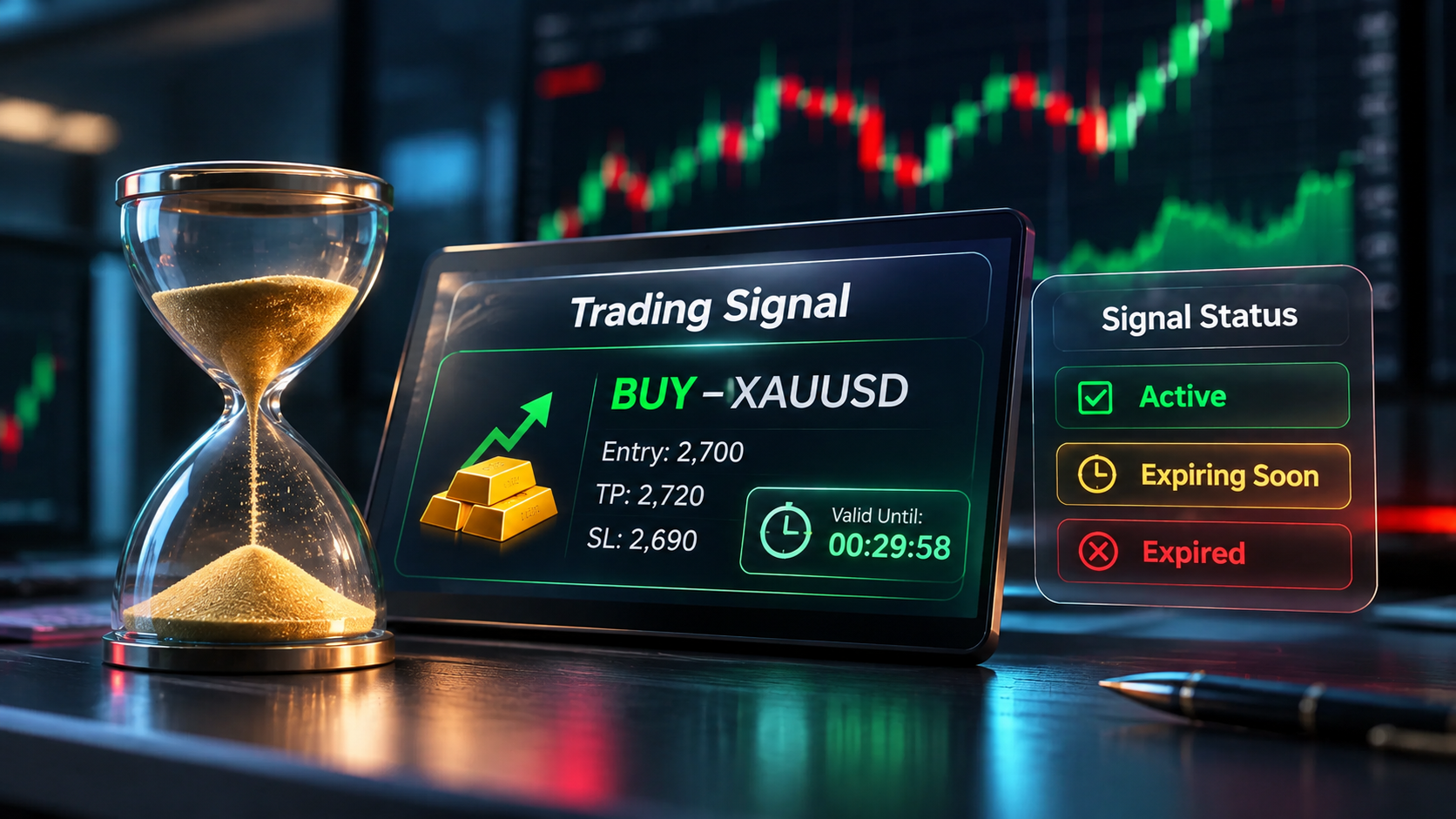
Does a Trading Signal Expire?
Does a Trading Signal Expire?
A trading signal does not remain valid forever.
Every signal is created from a specific market situation at a specific moment. Price structure, volatility, momentum, liquidity, technical levels, and sometimes fundamental conditions all contribute to the original trade idea.
When those conditions change, the signal can lose its validity.
This is the core idea behind trading signal expiration.
A trader should not assume that a signal remains executable simply because:
- Stop Loss has not been reached
- Take Profit has not been reached
- The entry price is still visible
- The original market direction still looks possible
Time itself can change the quality of a setup.
A BUY signal that made sense ten minutes ago may offer poor risk-to-reward now.
A breakout signal issued before an economic announcement may become irrelevant after the news changes market direction.
A scalping signal may expire within minutes, while a swing-trading setup may remain relevant for hours or days.
The correct question is therefore not:
“Is the signal still open?”
It is:
“Are the market conditions that created the signal still valid?”
What Is Trading Signal Expiration?
Trading signal expiration describes the point at which a signal should no longer be treated as a valid new trading opportunity.
A signal can expire because of:
- Time
- Price movement
- Market-structure changes
- Volatility
- News
- Liquidity changes
- Target completion
- Entry-window expiration
Think of a signal as a market hypothesis.
For example:
If Gold holds this support zone and momentum remains bullish, a move toward the next resistance becomes more likely.
That hypothesis depends on certain conditions remaining intact.
If price breaks the support, volatility changes dramatically, or several hours pass without the expected reaction, the original hypothesis may no longer be valid.
A Trading Signal Is a Snapshot of the Market
A signal is created from a particular version of the market.
At the moment it is generated, the analyst may see:
- Bullish structure
- A support level
- Strong momentum
- Acceptable volatility
- Favorable risk-to-reward
But markets continually process new information.
A few minutes later:
- Support may break
- Momentum may disappear
- Price may already travel most of the expected distance
- News may change sentiment
The original signal remains unchanged.
The market does not.
This is why signals should never be treated as permanent instructions.
Why Trading Signals Have a Limited Life
Every signal has an implicit time component.
Suppose a signal says:
XAUUSD BUY
Entry: 2,700
Stop Loss: 2,690
Take Profit: 2,720
If Gold is still trading around 2,700 a minute later, the original structure may remain intact.
But imagine price moves rapidly to:
2,716
and you receive the message late.
Entering at 2,716 creates:
4 points of potential reward
while the original Stop Loss remains:
26 points away.
The original trade had approximately:
1:2 risk-to-reward
The late trade has an entirely different structure.
The analysis may still be directionally correct.
The signal has effectively expired as an entry opportunity.
Time Is Part of the Signal
Traders often focus on:
- Entry
- Stop Loss
- Take Profit
But forget the fourth variable:
Time
A signal should ideally communicate not only:
Where to enter
but also:
When the entry is valid.
This concept becomes especially important in short-term trading.
FastPip’s Trading Types guide shows that Scalping, Day Trading, Swing Trading and Position Trading operate across very different time horizons. FastPip – Trading Types
That means signal expiration cannot be identical across every trading style.
Short-Term Signals Expire Faster
Short-term trading signals are especially sensitive to time.
A scalping signal may depend on:
- A 1-minute structure
- A small breakout
- A short volatility burst
- A very narrow target
In such cases, the useful entry window may be measured in:
seconds or minutes
rather than hours.
Why Scalping Signals Expire So Quickly
Scalpers usually target relatively small market movements.
Imagine:
Entry: 1.1000
Stop: 1.0995
Target: 1.1010
The expected reward is:
10 pips
If the trader receives the signal after price has already moved:
6 pips
the majority of the opportunity has disappeared.
The remaining trade may no longer justify the risk.
Day-Trading Signals Also Have Limited Entry Windows
Day-trading signals generally have a longer life than scalping signals, but they still depend heavily on current market conditions.
A breakout setup may remain valid:
- For several candles
- Until a retest fails
- Until structure changes
But it cannot normally be assumed to remain valid for the entire trading day.
FastPip’s Day Trading Strategies guide notes that short-term strategies depend heavily on current market structure, volatility, execution costs, and clearly defined invalidation rules. FastPip – Day Trading Strategies
Swing-Trading Signals May Stay Valid Longer
Swing trades operate across larger timeframes.
Typical charts include:
- 4-hour
- Daily
- Weekly
A setup based on a daily support level might remain relevant for:
- Several hours
- A full trading session
- Multiple days
depending on the strategy.
However, longer duration does not mean unlimited duration.
A major fundamental event, structural break, or significant price movement can still invalidate the setup.
Long-Term Signals Can Expire Too
Position-trading or macro signals may remain relevant for weeks or months.
But even long-term signals depend on assumptions.
For example:
- Central-bank policy
- Economic growth
- Inflation expectations
- Long-term technical structure
If those assumptions change materially, the signal can expire even if the intended target has not been reached.
No trading signal is permanently valid.
The Entry Window: A Critical Concept
One of the most useful ways to manage trading signal expiration is to define an entry window.
The entry window is the period during which the original signal remains suitable for a new position.
It can be based on:
- Time
- Price
- Number of candles
- Market structure
Example of a Time-Based Entry Window
Signal published:
10:00
Valid until:
10:20
If the trader sees the signal at:
10:25
the trade should be reassessed rather than executed automatically.
Example of a Price-Based Entry Window
Signal:
BUY between 2,700 and 2,704
If price reaches:
2,713
the signal may no longer offer acceptable risk-to-reward.
Even though the market is moving in the predicted direction, the original entry opportunity has expired.
Price Movement Can Expire a Signal
Sometimes a signal expires before any time limit is reached.
Suppose:
Entry: 100
Target: 110
Stop: 95
If price immediately moves to:
108
entering there creates very little upside relative to the remaining downside.
The signal may still be correct.
But the opportunity is no longer attractive.
Do Not Chase an Expired Signal
One of the most common mistakes is entering because:
“The signal is working and I don’t want to miss it.”
This is FOMO.
The trader sees price already moving toward the target and enters at a worse level.
The result is often:
- Higher risk
- Lower reward
- Greater probability of entering near a pullback
The professional response is often:
Missed trade. Wait for the next opportunity.
A Correct Signal Can Still Be Too Late to Trade
This is a crucial distinction.
Suppose a provider predicted:
Gold BUY
Gold then rises strongly.
The prediction was correct.
But if you enter after 80% of the projected movement has already occurred, the trade may no longer make sense.
Accuracy and executability are different things.
Market Structure Can Invalidate a Signal
Time is not the only factor.
A signal can expire because the underlying technical structure changes.
Suppose a BUY signal depends on:
Support at 1.0800
If price decisively breaks below the support and creates a new bearish structure, the original bullish scenario may be invalid.
Even if the official Stop Loss has not yet been reached, the analytical basis may have changed.
No Reaction Can Also Be a Warning
Sometimes the market does not break the signal structure.
It simply does nothing.
Suppose a breakout strategy expects strong continuation.
Instead, price:
- Breaks resistance
- Stalls
- Moves sideways
- Fails to build momentum
The absence of expected follow-through can itself reduce the validity of the setup.
A signal should not necessarily remain active indefinitely just because nothing dramatic has happened.
Volatility Can Shorten Trading Signal Expiration
High volatility can dramatically shorten the useful life of a signal.
In volatile markets:
- Price moves faster
- Technical levels break faster
- Entry zones disappear quickly
- Risk-to-reward changes rapidly
A setup that remains valid for 30 minutes in normal conditions may remain executable for only a few minutes during extreme volatility.
Volatility Does Not Automatically Mean Opportunity
High volatility can create large price moves.
But it also creates:
- Wider spreads
- Slippage
- False breakouts
- Rapid reversals
That means existing signals may lose validity faster.
Economic News Can Invalidate a Signal Instantly
Major economic announcements are among the strongest causes of trading signal expiration.
Examples include:
- Interest-rate decisions
- CPI
- Employment reports
- Central-bank announcements
- Unexpected political or geopolitical events
A technically valid setup can become obsolete within seconds after new information enters the market.
Why News Changes the Signal
A pre-news signal is based on the information available before the announcement.
The news introduces:
new information
Market participants immediately reprice the asset.
That means the assumptions behind the original signal may no longer apply.
A technically bullish setup before a surprise central-bank announcement may become strongly bearish afterward.
Signals Issued Before Major News Need Extra Caution
Before entering an older signal, ask:
Has important economic information been released since the signal was created?
If yes, the setup should usually be reassessed.
Do not assume the old technical structure is still valid.
Liquidity Also Affects Signal Lifetime
Liquidity describes how easily trades can be executed without causing significant price movement.
High-liquidity markets generally allow faster and smoother execution.
But they can also absorb and react to information quickly.
Lower-liquidity conditions can produce:
- Wider spreads
- More Slippage
- Sudden jumps
Both situations affect how long a signal remains practical.
Trading Sessions Can Change Signal Quality
A signal issued during:
London/New York overlap
may behave very differently if executed several hours later during a quiet session.
Liquidity, volatility and market participation have changed.
The price may still be near the original entry.
But the environment is no longer identical.
Delayed Signal Delivery Can Cause Expiration
Sometimes the trader does nothing wrong.
The signal itself arrives late.
Possible causes include:
- Notification delays
- Messaging-platform delays
- Internet problems
- Server congestion
- Provider publication delays
By the time the user sees the signal, the market may already have moved.
Execution Delay Matters Too
Receiving the signal on time does not guarantee the original execution price.
Investor.gov notes that trade execution is not instantaneous and that prices can move quickly between order submission and actual execution in fast-moving markets.
That principle is particularly relevant to short-lived signals.
Market Orders Do Not Guarantee the Signal Price
A trader may see:
BUY at 1.1000
but receive:
1.1008
Investor.gov explains that market orders generally prioritize execution, not a guaranteed execution price.
If the signal has a narrow target, even a small execution difference can materially reduce its quality.
Trading Signal Expiration vs. Stop Loss
These concepts should not be confused.
Stop Loss
Defines when an active trade should be closed because the trade thesis failed or risk limit was reached.
Signal Expiration
Defines when a trader should no longer initiate a new trade based on the old signal.
A signal can expire even though its Stop Loss was never hit.
Example
Signal:
BUY 2,700
SL 2,690
TP 2,720
Price moves to:
2,715
without retracing.
The Stop Loss was not hit.
The signal may still become unsuitable for a new entry because the original risk-to-reward has disappeared.
Trading Signal Expiration vs. Take Profit
Reaching Take Profit is another clear form of signal completion.
Once the target is reached, the original trading scenario is finished.
If price continues higher after the target:
that is a new market situation.
It should not automatically be considered the continuation of the same entry opportunity.
Never Enter an Old Signal After the Target Was Reached
Imagine:
Signal:
Gold BUY at 2,700
TP: 2,720
Price hits:
2,723
then retraces to:
2,710
Entering now simply because the old signal said BUY can be dangerous.
The original scenario already completed.
A new analysis is required.
Can an Expired Trading Signal Become Valid Again?
Sometimes price returns to the original area.
But that does not automatically reactivate the old signal.
Suppose a BUY signal was issued at support.
Price moved away, conditions changed, then returned hours later.
Ask:
- Is the support still valid?
- Is the trend still intact?
- Has news changed sentiment?
- Is volatility similar?
- Has liquidity changed?
If the answers support a new entry, you effectively have:
a new trade setup
not the original signal returning from expiration.
Treat Re-Entries as New Analysis
This is the safest conceptual approach.
Do not think:
“The old signal is active again.”
Think:
“Is there a new valid setup at the same price?”
That prevents attachment to old analysis.
Signs a Trading Signal Has Expired
Here are several common signals of signal expiration.
1. Price Has Moved Too Far From Entry
Risk-to-reward has deteriorated.
2. The Target Was Already Reached
The original scenario is complete.
3. Market Structure Changed
Support, resistance or trend assumptions no longer hold.
4. Major News Changed Conditions
The market is processing new information.
5. Too Much Time Passed
The expected setup did not develop within the intended window.
6. Volatility Changed Dramatically
Original Stop Loss and target assumptions may no longer be appropriate.
7. The Market Failed to React as Expected
Lack of follow-through can invalidate a momentum or breakout setup.
The “Would I Enter Now?” Test
A useful professional question is:
If I had never seen the original signal and looked at the market right now, would I still open this trade?
If the answer is:
No
then the signal should probably be considered expired.
This question helps remove emotional attachment to the original idea.
Old Signal, New Market
One of the biggest mistakes traders make is using:
an old signal
inside:
a new market environment
The signal may have been perfect when published.
But the trader acts on it after:
- A session change
- A volatility shift
- A breakout
- Economic news
- A trend reversal
That is no longer the same trade.
Signal Expiration Depends on Trading Style
There is no universal expiration time.
A useful conceptual framework is:
| Trading Style | Typical Signal Sensitivity |
|---|---|
| Scalping | Very High |
| Day Trading | High |
| Swing Trading | Moderate |
| Position Trading | Lower |
This does not mean every scalping signal expires after a fixed number of minutes.
It means shorter-term strategies generally depend more heavily on precise timing.
FastPip’s Trading Types guide similarly distinguishes styles according to holding period, monitoring requirements and timeframe.
Trading Signal Expiration in Scalping
For scalping:
- A few seconds may matter
- Spread matters greatly
- Slippage matters greatly
- Price deviation matters greatly
A signal may remain useful only while price is close to the intended entry.
Chasing after the initial move is particularly dangerous.
Trading Signal Expiration in Day Trading
Day-trading signals may remain valid:
- Until a specific candle closes
- Until a support/resistance level breaks
- Until volatility conditions change
- Until a scheduled news release
Time and intraday context both matter.
Trading Signal Expiration in Swing Trading
Swing signals often have wider entry ranges and longer time horizons.
But expiration may occur when:
- Daily structure changes
- Fundamental conditions shift
- Major support/resistance breaks
The entry window is broader, not unlimited.
How to Define Expiration Rules
Professional signal providers can make signals easier to execute by defining explicit invalidation conditions.
For example:
Entry: 2,700–2,704
Stop Loss: 2,690
Take Profit: 2,720
Valid Until: London close
Cancel if: price closes below 2,696 before entry
This gives users more information than a simple BUY message.
Time-Based Expiration
Example:
Valid for the next 30 minutes
Useful for:
- Intraday setups
- News-sensitive signals
- Breakouts
Candle-Based Expiration
Example:
Signal valid for the next three 15-minute candles
This can be useful when the strategy depends on specific technical behavior.
Structure-Based Expiration
Example:
Cancel if resistance is reclaimed before entry
This keeps the signal aligned with market logic rather than arbitrary clock time.
Price-Based Expiration
Example:
Do not enter above 2,708
Even if the target is higher, entry beyond that level may no longer provide acceptable risk-to-reward.
Combine Price and Time
The strongest signals often define both.
For example:
BUY 2,700–2,704
Valid for 30 minutes
Cancel if 2,696 breaks
This provides:
- Entry range
- Time window
- Structural invalidation
Much clearer.
How Traders Should Handle Late Signals
If you receive a signal late:
Step 1 — Check Current Price
How far is it from the original entry?
Step 2 — Recalculate Risk-to-Reward
Do not use the original ratio blindly.
Step 3 — Check Market Structure
Is the original setup still present?
Step 4 — Check News
Did anything important happen after the signal?
Step 5 — Skip if Necessary
You do not need to trade every signal.
Missing a Signal Is Not a Loss
This mindset matters.
A trader sees:
Signal already +100 pips
and thinks:
“I lost 100 pips.”
No.
The trader did not lose money.
They missed an opportunity.
There is a major psychological difference.
Chasing an expired signal can turn:
a missed opportunity
into:
a real loss.
How Signal Providers Can Improve Expiration Rules
A professional signal service can include:
- Timestamp
- Entry range
- Expiration time
- Cancel condition
- Market-session context
- News warning
This makes signals much easier for followers to execute consistently.
Example of a Better Signal
Instead of:
XAUUSD BUY NOW
use:
XAUUSD BUY
Entry: 2,700–2,704
SL: 2,690
TP1: 2,715
TP2: 2,725
Valid Until: 14:00 GMT
Cancel if: 15-minute candle closes below 2,696
This creates a clearly defined lifecycle.
Connect Expiration With Execution Quality
Signal expiration also explains why two traders can receive the same signal and obtain different outcomes.
One enters immediately.
Another enters 20 minutes later.
Their trades may have:
- Different prices
- Different risk-to-reward
- Different market conditions
FastPip examines this issue in more detail in:
FastPip – Same Trading Signal, Different Results
Execution Speed Matters More for Short-Lived Signals
The shorter a signal’s lifespan, the more important execution becomes.
Fast-moving markets create a direct relationship between:
Signal Delay → Entry Deviation → Lower Trade Quality
This is why very short-term strategies need:
- Reliable notifications
- Fast platforms
- Tight spreads
- Disciplined execution
Signal Expiration and Risk Management
Never compensate for a late signal by:
- Increasing leverage
- Widening Stop Loss
- Increasing lot size
- Removing Stop Loss
That makes a deteriorated setup even more dangerous.
If the original opportunity is gone:
let it go.
A Professional Trading Signal Expiration Checklist
Before entering an older signal, ask:
1. How Old Is the Signal?
Minutes, hours, or days?
2. What Trading Style Is It?
Scalping and swing signals have different lifespans.
3. Is Price Still Near the Original Entry?
Do not chase large deviations.
4. Is Risk-to-Reward Still Attractive?
Recalculate from the current price.
5. Has the Market Structure Changed?
Check trend, support and resistance.
6. Has Major News Been Released?
New information can invalidate old analysis.
7. Has Volatility Changed?
Original stops and targets may no longer fit.
8. Is Liquidity Different?
Consider trading session and execution conditions.
9. Has the Target Already Been Reached?
If yes, the original setup is complete.
10. Would I Enter This Trade if I Saw It for the First Time Now?
If no, consider the signal expired.
Common Trading Signal Expiration Mistakes
Entering Because the Signal Was Previously Correct
Correct analysis does not automatically mean a valid current entry.
Chasing Price
The move may already be mature.
Ignoring News
New information can completely change market structure.
Using the Original Stop From a New Entry
Late entry changes the real risk.
Reusing Completed Signals
A signal that reached target should usually be treated as finished.
Assuming Price Returning to Entry Reactivates the Signal
A new market analysis is required.
Is There a Universal Trading Signal Expiration Time?
No.
There is no universal rule such as:
Every signal expires after 30 minutes.
Signal lifespan depends on:
- Trading strategy
- Timeframe
- Market
- Volatility
- Liquidity
- News
- Price movement
A scalping opportunity and a weekly swing setup operate on completely different clocks.
How Long Can a Trading Signal Stay Valid?
A rough conceptual range might be:
Scalping
Seconds to minutes
Intraday Trading
Minutes to several hours
Swing Trading
Hours to several days
Position Trading
Days to weeks or longer
These are not fixed rules.
The actual market structure always matters more than a generic time limit.
Conclusion: Every Trading Signal Has a Limited Life
Trading signal expiration is a fundamental concept that every signal user should understand.
A signal is created from:
- A specific market
- A specific price structure
- A specific time
- A specific volatility environment
As those conditions change, signal quality can decline.
A signal may expire because:
- Too much time passed
- Price moved too far
- Risk-to-reward deteriorated
- Market structure changed
- News changed the market
- Volatility shifted
- Target was reached
This means:
A signal can expire even if Stop Loss was never hit.
The most important rule is:
Do not evaluate an old signal based only on its original message. Evaluate the current market.
Before entering, ask:
Is the original setup still present right now?
If the answer is no, the signal has probably expired.
A missed entry is not a trading loss.
Entering an expired setup can become one.
Frequently Asked Questions
Does a trading signal expire?
Yes. Trading signals are based on specific market conditions and can become invalid when time, price, volatility, news or market structure changes.
What is trading signal expiration?
Trading signal expiration is the point at which a previously valid signal should no longer be used as a new trade entry.
How long does a trading signal stay valid?
It depends on timeframe, strategy, volatility and market conditions. Scalping signals may remain valid for minutes, while swing signals may remain relevant for hours or days.
Can a signal expire before Stop Loss is reached?
Yes. Market structure, time or risk-to-reward may change before the original Stop Loss is hit.
Is a late trading signal still valid?
Sometimes, but it should be reassessed. Check current price, market structure, news and risk-to-reward before entering.
Should I enter if price already moved toward the target?
Usually not automatically. If much of the projected move has already occurred, the original risk-to-reward may no longer be attractive.
Does economic news expire trading signals?
Major news can quickly invalidate signals because new information changes market expectations, volatility and price structure.
Do scalping signals expire faster?
Generally yes. Scalping depends on precise short-term price conditions and narrow profit targets, so even small delays can matter.
Can swing-trading signals expire?
Yes. They usually have longer lifespans, but structural or fundamental changes can still invalidate them.
What is an entry window?
An entry window is the period or price range during which the original signal remains suitable for a new position.
Can an expired signal become valid again?
Price may return to the same level, but the trade should be analyzed again as a new setup rather than automatically reactivating the old signal.
Does hitting Take Profit expire a signal?
Yes. Once the original target is reached, the original trade scenario is normally complete.
What happens if price moves past the original target?
Any further movement should generally be evaluated as a new market scenario rather than part of the original signal.
What should I do if I receive a signal late?
Recalculate risk-to-reward, check current structure and news, and skip the trade if the original setup is no longer valid.
What is the best way to identify trading signal expiration?
Evaluate time, price deviation, market structure, volatility, news, liquidity and whether you would still enter the trade based on current conditions.